A Mirror or a Conduit?

When asking myself the advice I would give to my younger self, a question pops up: 

Are we mirroring our circumstances or conduits to taking charge of who we are?

Being a young person in 2023 has some unique challenges and opportunities. If we get down to the nitty-gritty of it, being young regardless of what day and age you’re in has come with its own troubles. For one, since the dawn of humanity, old people tend to get a bit huffy about the activities of young people. Greek philosopher Aristotle summed up his sentiments on the youth as the following:

Their lives are regulated more by moral feeling than by reasoning — all their mistakes are in the direction of doing things excessively and vehemently. They overdo everything — they love too much, hate too much, and the same with everything else.”

This quote might as well be from this year! At the behest of most people, even though we were all young ourselves at one point if we forget how much we still had to learn about the world, we tend to place the burden of conforming on younger people. When in fact, it is not young people’s responsibility to deal with the current state of things, but to have their solutions orientated towards the future, the problems that we cannot foresee at this moment. From movies, science and beyond there is always a fascination with the concept of time-traveling; what would it be like to share what we already know from the future? What would try to warn our younger selves about? What would we equip them with? I saw a hilarious tweet on my timeline once that said they’d offer a glass of Fanta Orange to a caveman just because they can. For me, I have realised that despite the role of mentors, teachers, parents, guardians, and advisers (although they have tremendous influence), experience is the one thing that teaches you lessons you can never forget. When I think about my own research and the areas of interest I have in my freelance writing, it always tends to gravitate towards things I know my younger self would have wanted to know. So here are two things I do that help me effectively learn from experiences not only as a person but as a postgraduate student.

Two Tips for Reflection

  1. Journaling.

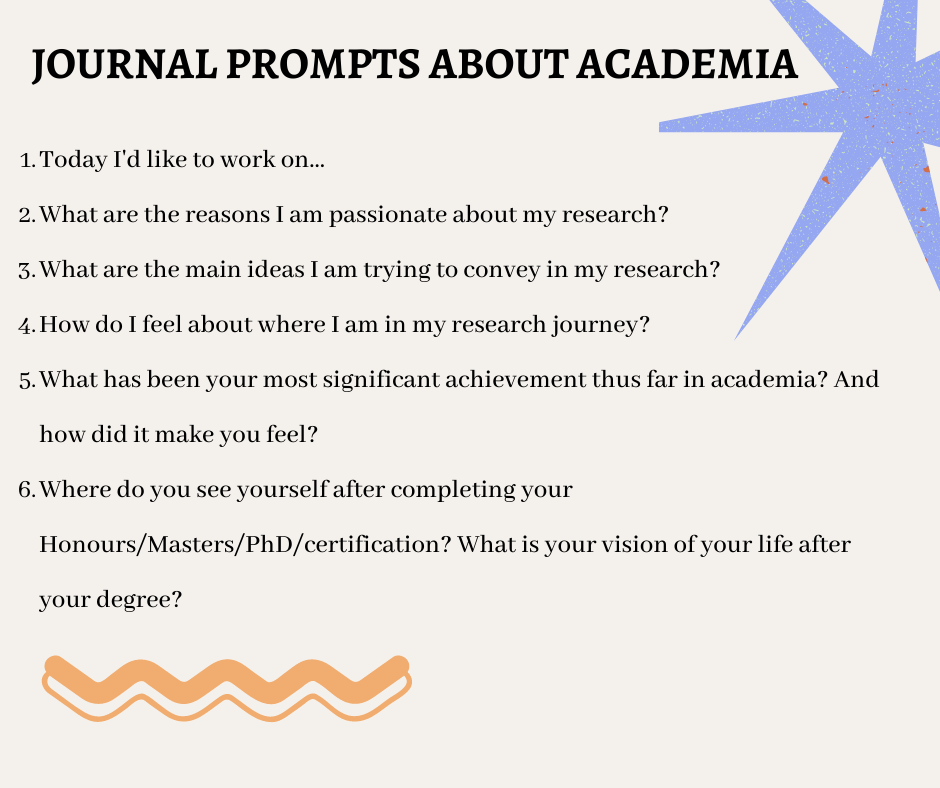
You can either use prompt questions like the ones below or use freewriting (writing without worrying about grammar or structuring your words) to just get your thoughts on paper. Even though it’s more writing on top of your academic writing, freewriting and journaling allow for a creative way of staying on top of your studies while developing a healthy coping mechanism at the same time.
  1. Follow up consistently.

When you’re in university for the first time, or feel intimidated by the institution, knowing the structures that are there to help you makes a massive difference. If you get a lower mark than expected on an assignment, it does not hurt to follow up with your lecturer and see where you could improve. Not feeling ashamed from previous mistakes and accepting continuous feedback as part of the journey allows you to improve as a student over time. Additionally, asking questions in your tutorials and lectures may feel embarrassing, but you always be better off for having asked than remaining silent. When students can communicate where they are struggling and what they need help with, it counts in your favour and allows you to stand out.

In some ways, the youth already know they are conduits for radically rethinking existing global crises that have reached their breaking point. But the pressure to solve everything at once does not fall solely on one set of shoulders. By incorporating at least one or both practices of reflection mentioned above, we do not have to feel overwhelmed with trying to exceed unrealistic expectations. Rather, we can do our best to be conduits to change by simply just trying to be better than the day before.   

For the Love of Work 

As some may or not may not already know, the 1st of May is International Workers’ Day and is celebrated as a public holiday in South Africa. The history of May Day is significant in commemorating past efforts to eradicate workers’ rights violations and poor working conditions. Yet, as we reflect on the importance of worker solidarity, it almost feels disingenuous to attempt to consider the state of ‘work’ as a concept without contextualising within the broader pop culture media discourse taking place online about work and where it fits into our everyday life. And so, we begin with the (alleged) generational divide.

The Inter-Generational Dilemma…or Opportunity?

Every other week, there seems to be a bombardment of articles about how Gen Z (those born between 1997 to 2013) is one of the worst things to have happened to the modern workplace. Established publications write lengthy explanations about how ‘quiet quitting’ and anti-work attitudes wreak havoc on job permanence. On TikTok, countless creators produce viral videos depicting the difference between Boomers, Gen X, Millennials and Gen Z in the workplace. Gen Z’s nonchalant attitudes are often the punchline due to the contrast in behaviour and mannerisms compared to their older colleagues. There seems to be some quietly agreed upon torrential dog-piling on Gen Z. This is not because they are young and naïve (although some would argue otherwise), but because they are choosing a path that many did not think was possible for them. But instead of anger being directed towards the systems that govern and dictate our access to fundamental rights to access a clean environment, housing, and food, the repeated cycle of anger is diverted to younger generations who hold little power compared to the 1% making decisions. Capitalism’s obsession with vilifying aspects of human nature that vigilantly centre on our well-being sets a precedent for how we are valued within the systems, institutions and organisations that we are tied to. Misplaced accountability sets a dangerous narrative on who deserves basic human rights based on “hard work”. But hard work is not determined by how much of ourselves we give to entities, nor is it predicated on tolerating substandard conditions to meet certain targets and objectives. This may sound like a fairy tale, but we all deserve to have jobs that value our time and efforts. We all deserve the right to prioritise our physical and mental well-being above unethical work expectations. We all deserve the right to choose how we show up for work, in whatever capacity that means for each of us. Kahlil Gibran puts it aptly in his book The Prophet by saying the following: 

“…to love life through labour is to be intimate with life’s inmost secret.”

For many marginalised bodies and identities on the outskirts of what would be considered a “good worker”, now more than ever is it important to advocate for worker’s rights everywhere. In January this year, a few of the leading global tech companies laid off about 12,000-18,000 workers with no prior notice. Shareholder wealth since COVID-19 has increased tenfold, along with the salaries of top management executives across the board in various industries. According to an article written by Walter Matli (2020) on the insights of remote workers’ life situations in South Africa, the mixed reactions signalled the vastness in the experiences of workers for those in well or under-serviced communities. If we compare and contrast how we see ourselves and others within different work environments, then we need to consider how much more we have in common with each other than we think. The issues we think will never affect us may very well be the issues that affect us eventually (ditto to load-shedding being the new normal in South Africa).

International Workers’ Day is a crucial occasion to remind us of the significance of inter-generational solidarity and a humanistic perspective towards labour. It provides an opportunity to reflect on the persistent socioeconomic inequalities that afflict workers worldwide. If we are not aware of this crucial aspect of worker solidarity, it becomes a fictitious and non-committal fantasy through which we fail to understand the very essence of our being.