Paradigm shifts in science: are we ready?

Science — great science — takes time. I am not talking about the actual time it takes to conduct research, write a research paper, and if the wind is blowing that day have it published sans correction in a reputable journal. Here I am talking about the time it takes for that great, paradigm-shifting idea to take hold and rock the academic world. You see, as scientists we are sceptical and methodical by nature and training. This means that we are surprisingly slow at really accepting revolutionary new ideas, or even proposing them, until the weight of evidence (painstakingly collected!) is on our side. Despite what many people think, true scientific innovation is therefore slow. And some people suggest we should slow down even further…

This year marks twenty-four years since the hologenome concept of evolution was first publicly introduced[1]. The notion that small microbial organisms inhabit ever part of our body is now widely accepted (the good, the bad, and the REALLY bad). However, what most people are not aware of, is that the genome (all genetic material) of these microbes interacts with our genome. Because these microbes live in/on our bodies, the collective term of their genome and ours is “hologenome”. To many evolutionary biologists and evolutionary ecologists this idea of the hologenome is intuitive, but very few scientist are working on understanding how the hologenome can be acted upon by evolutionary processes – few people are examining how the hologenome might impact the creation of new species, dispersal/migration of species, divergence within species, and selection imposed upon the species by the environment.

As I mentioned in my previously blog post here and here, I consider myself an ecologist — an evolutionary ecologist to be exact. As a result, my current Ph.D work is focused on understanding and developing techniques/approaches that can be used to engineer the hologenome to improve plant health. I am interested in unlocking the hidden the mysteries of the hologenome. I play around with plant genetics and microbial genetics to understand which evolutionary processes shape their interactions. There are still far too few scientists interested in understanding these interactions.

Which leaves me wondering: Is it time to change the way we operate as a scientific community? Could we speed up the process of discovering truly ground-breaking ideas like E=mc2, evolution, the structure of DNA, epigenetics? Are we ready to embrace the idea of truly collaboration across disciplines and skills sets, creating scientific ‘melting pots’ that could accelerate the process of discovery and creation? Or are we too set in our ways?

[1] Richard Jefferson first introduced the concept at a public meeting in 1994
Over the rainbow

Knee-high in snow and clinging to memories of how the African sun warmed my skin and heart, I reflect on my journey from the rainbow nation to francophone Canada. This is a tale like no other; it is neither “rags to riches” nor “tragedy”, but a simple quest for scientific excellence mixed with adventures of a travelling South African.

My undergraduate studies were rather uneventful. If I’m honest, like many of my peers, it was time of experimentation and self-discovery. Throughout my journey of self-discovery it became clearer to me what I wanted to do for a job and career. Similar to many of my peers, I was being thrust forward into an Honours degree, and when I was a young 20-something graduate, it dawned on me that the dream I had had was not bold enough.

Post-graduate realisation[1] hit me hard and I did what most graduates would not dream of – I took a gap year. It was during this self-imposed ‘sabbatical’ that my yearning for traveling the globe grew even out of hand. I remember thinking, “ a BSc in Ecology and Zoology is not what it used to be…” Of course, I wasn’t sure what a BSc in Ecology and Zoology should be, but I knew it wasn’t It anymore. Nonetheless, I was determined to make something of myself and pursue my dream of becoming a world-renowned ecologist.

Then I got the chance to visit a friend who was teaching English in Seoul, South Korea, and the food, the people, the culture all conspired to draw me to east Asia. But I wasn’t just playing around, there is a certain bravado and courage that we South African posses that sets us apart from the rest of the world. And, I had the guts to approach the leading professor in soil ecology at Korea’s top university (Seoul National University). I boasted about South Africa’s gorgeous, unique Fynbos. Immediately, I was the new shiny toy in the box. The beauty and complexity of the Fynbos is the envy of many ecologists, and I managed to start a project with one foot in Asia and one still in Africa. That was just the beginning of my postgraduate adventures, almost all of it built on the back of people skills and love of Fynbos. Who knew ecologists had to be such good psychologists?

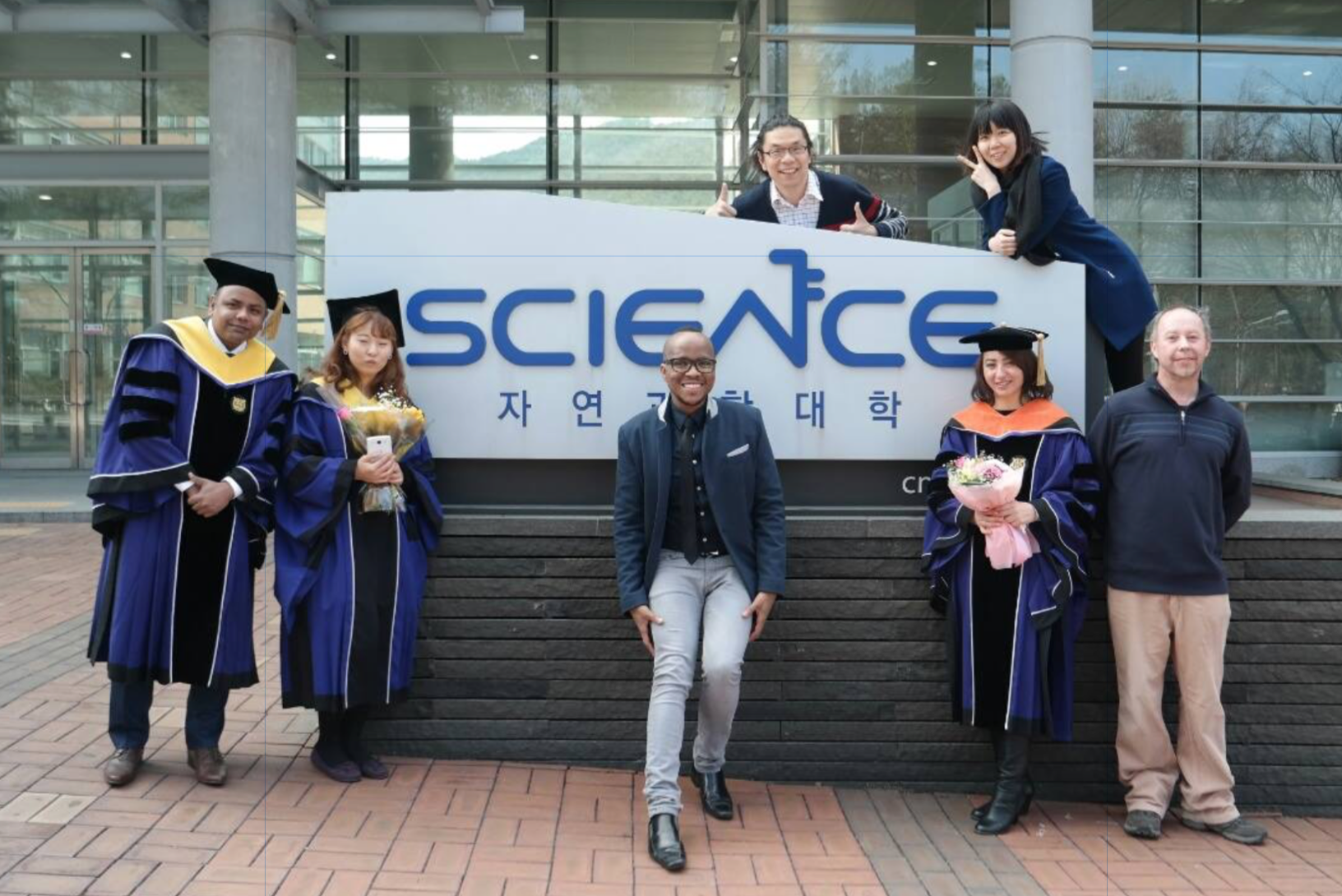
Graduation at Seoul National University

Upon graduation, I began to pack up my life once more and prepare to move to Canada where I would start my Ph.D. I must admit, I love everything about travelling: the airport, new cultures to explore, and — most important — the chance to make new friends. But, I have always said, “I came here with 1 bag and will leave here with 1 bag”. In principle, this rule would serve you well, but when you have lived in a new country for 2 years, you will accumulate stuff. Packing up your life into a 20kg bag arouses feelings of catharsis and reinforces the feeling of excitement about moving to a new place (out with the old, in with the new kinda feeling). Little did I know that moving to a ‘western’ country after being immersed in Asian culture would come with its own challenges, but that’s a story for another blog.


[1] The realisation that a bachelors degree will not suffice and guarantee the kind of job or future that you were day dreaming about during first-year.