Reimagining the Process: Key Lessons Learned

Reflecting on my PhD journey, I am kind of amazed by the significant influence that moving across different countries has had on me. This unique experience has allowed me to hit the reset button on certain aspects of my postgraduate journey that weren’t exactly contributing to my progress and well-being. This month’s blog post focused on what I would change if I could rewind time and restart my PhD degree. In this reflective journey, I’ll be discussing various aspects, including how I’d alter my approach to managing time, handling relationships, and more. So, without further ado, let’s get to it.

Knowing When to Say No

I’ve always had a hard time saying no, particularly when it seemed most crucial for my academic progress or rest – be it lending a hand, lending an ear on lengthy phone calls, being asked to proofread or compile documents, attending functions, or socialising. I was constantly showing up as a ‘yes-girl’, and unsurprisingly, that’s exactly how people treated me. My days were filled with endless requests for favours, leaving me drained and under immense pressure to cater to everyone’s needs. However, I’ve made significant strides in setting better boundaries for myself, a resolution I made before moving to the U.S.. Although I’m still a work in progress, I can’t help but wish I had learned and implemented this valuable lesson earlier.

Keeping Flexibility in Your Routine

In previous posts, I’ve shared how my ability to adhere to a strict routine has been instrumental in my achievements, particularly during my undergraduate studies. However, moving to the U.S. and dealing with significant time differences, poor eating and sleeping habits, and reduced energy levels presented a challenge. My well-curated routine no longer served its purpose, and acknowledging its ineffectiveness was a difficult truth to accept. Despite these obstacles, I had to find ways to get my work done. This experience taught me a valuable lesson: the importance of flexibility in my routine, and the need for guilt-free rest. Sometimes, these elements are crucial for academic success.

One Good Therapy Session Isn’t Enough

Since the onset of my PhD, I’ve been attending therapy sessions, a beneficial suggestion from my sister. It’s worth noting for fellow postgrads that universities often provide counselling services at no extra cost. My therapist even transitioned to virtual sessions when I moved to the U.S., a time when I needed support the most. However, I sometimes misinterpret a successful session as a sign that I can postpone sessions until I’m overwhelmed. If I could change one thing, it would be to maintain regular therapy sessions, rather than sporadic ones, for a healthier PhD journey.

Keeping Regular Communication with Your Supervisor

As an introvert who tends to overthink, I’ve learned a valuable lesson: your supervisor can be a great ally in holding you accountable. It’s up to you to establish the rhythm of your relationship and subsequent progress. Whether that’s weekly check-ins updating them on your progress, communicating your intended submission dates, discussing delays due to your health or other reasons, actively seeking clarity on the feedback received, or sharing new ideas for your research. Regular communication is key. This approach was highly effective during my master’s degree, however, I struggled to apply this to my PhD, which somewhat delayed my progress, and though I’m currently in a much better place, it took time to understand that this was primarily my responsibility.

Letting Things Be, Sometimes

To be honest, in pursuing a PhD, you might encounter many moments where things don’t go as planned. It’s crucial to understand that it’s okay to let things be sometimes. This doesn’t mean giving up; but rather, it’s about finding alternative routes and continuing to make progress. If you don’t, uza kuphambana (you might find yourself overwhelmed). The lesson here is that it’s okay to take a step back, reassess, and move forward in a different direction.

In my recent day-in-the-life vlog, I shared that I was supposed to be in Nigeria, gathering data for my PhD. I had hoped to pen my November blog from Lagos, but due to some visa complications, that plan fell through. However, like dealing with imposter syndrome, these setbacks are part and parcel of the PhD journey. So, I picked myself up, reinitiated my visa process, and used this time to review my literature and other work. 

It’s interesting how these unexpected lessons, which I’d do differently, often teach us more about life than our PhD. So, stay tuned for my next blog post, which I plan to kick off with ‘HELLO FROM NIGERIA!’ 🙂

The Difference Between Being Invited to the Party and Being Asked to Dance

Hi there! It has been some time since we last dived into the depths of my research and field. I must admit that I am feeling quite nervous about this particular blog post, as I am more accustomed to writing in an academic style, so breaking down academic terms rather than using them in their natural habitat is pretty intimidating for me. Nonetheless, let’s explore my list of eight words related to workplace diversity and inclusion and the psychological elements that are commonly at play. The terms “diversity” and “inclusion” are often considered twins, but, in reality, they are more like two sides of the same coin. Still unclear? Don’t sweat it! I am here to guide you through this maze. Whenever in doubt, just remember Verna Myers’ insightful breakdown, “Diversity is being invited to the party; Inclusion is being asked to dance.” So, are you ready to dance? Let’s jump right in!

Workplace diversity refers to who is represented in the workforce and encompasses various dimensions. Whether apparent or not, diversity is about more than just ticking boxes; it’s about recognising and valuing the unique perspectives that everyone brings to the table.

Workplace inclusion is about the overall experience that employees have at work. It’s about how much organisations actively create a work environment where everyone feels they belong and can thrive. Essentially, it’s about ensuring that every employee feels involved and that their voices and opinions matter and will be considered. 

Social identity theory explains that our self-concept and self-esteem are formed by the groups we are part of. We tend to favour our own group (in-group) because of shared traits while viewing other groups (out-group) negatively because of differences. This theory explains why we sometimes prefer those like us and discriminate against those who are different.

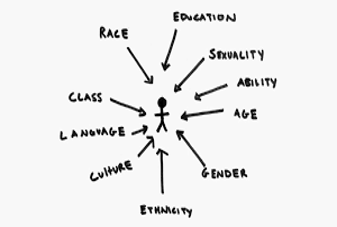
Intersectionality is a term that helps us to understand how different aspects of a person’s identity can affect their life experiences. Imagine you’re looking at a picture, but you’re only looking at one colour. You’re missing out on the full picture, right? That’s what happens when we only consider one aspect of someone’s identity, such as race or gender. Intersectionality tells us that these aspects don’t exist in isolation; they overlap and interact. For example, a woman who is also black may face unique challenges different from those faced by a black man or white woman. This is because she belongs to two social groups that are often disadvantaged. So, intersectionality helps us see the complete picture and understand the complex ways in which different identities interact.

Identity work is all about the continuous journey of understanding and managing the things that shape our self-identity and self-esteem. It’s a dynamic dance between us, our social surroundings, and our efforts to strike a balance between them. In essence, identity work is a mental negotiation that fuels the pursuit of creating and upholding a consistent and meaningful sense of who we are.

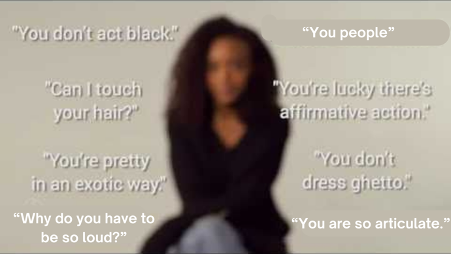
Microaggressions are subtle, daily interactions that can cause people to feel overlooked, underestimated, or disrespected. Often, these microaggressions are related to race or gender. They’re not always verbal – they can be a dismissive glance, a gesture, or a specific tone of voice. These small actions can send negative messages to the target, contributing to their feeling of being marginalised. 

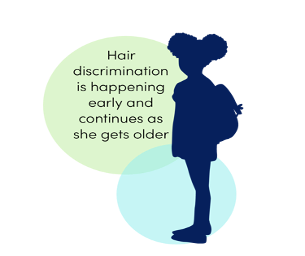
Hair bias is a harmful stereotype of textured/Afrocentric hair. This means that people often unconsciously judge black women and girls negatively because of their natural hair or hairstyles. This often starts when black girls are very young and can negatively affect their self-esteem and experiences in school and work. 

Lastly, regarding psychological burnout, stress levels are shaped by how we perceive and evaluate our surroundings. Imagine you have a physical trait that constantly worries you because it is seen as undesirable and unprofessional at work and in society. This worry is a stressor, and if you’re spending a lot of time trying to change it to fit into societal standards of attractiveness and professionalism, it can lead to psychological exhaustion. Why? Because this stressor feels unchangeable and hopeless. Over time, this can result in burnout. So, it’s not just about the actual trait but the psychological strain and burnout that comes from trying to conform to societal norms.

And there you have it! We’ve twirled through the terms and danced through the jargon. I hope this glossary was illuminating and that I successfully demystified any confusion you might have had about some of the words. Until next time. 🙂