“Education is the most powerful weapon which you can use to change the world.”
Many people are familiar with this quote from Nelson Mandela and understand the power education has, whether you embrace it or fear it. Today, in the post-truth era we live in—where experts are dismissed, where there is a lack of interest in evidence and facts, where alternative facts and the opinions of popular public figures seem to matter more—education is more important than ever!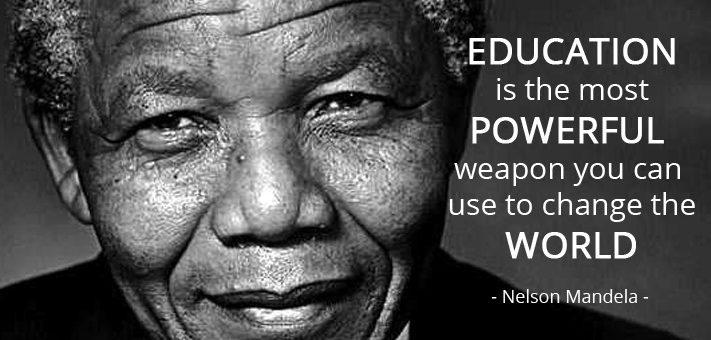
I was fortunate enough to go and listen to former US President Barack Obama deliver the sixteenth annual Mandela lecture at the Wanderers stadium in Johannesburg. He reminded the thousands of people sitting in the stadium (and those tuned in all over the world) of the crossroads we, as global citizens, face—something very similar to what South Africans faced pre-1994.
 The solutions to South Africa’s and the world’s problems, according to Obama, lie with the youth; an undivided youth who love more, who lead and build communities that fight for what Mandela, and others, were and are trying to build. I was inspired by Obama’s messages of hope and the vision he has for achieving an undivided, educated and loving global community. I want, more than anything, to be a part of that community.
A recent piece was published on the Global Citizens website, looking at seven ways Madiba’s legacy still resonates in the world today. I want to highlight four of the seven: his participation in the fight against HIV/AIDS; his dream to bring education to rural students; his fight for children and youth; and his promotion of scientific and environmental education.
Madiba dedicated his life to making a difference in these areas, and while he did more than most, there is still a lot more to do, which we could achieve, largely, through education. Education really is the most powerful weapon in our arsenal and should be used more often to continue Mandela’s fight against HIV/AIDS, to continue to empower young people in the developing world, to develop science and technology to help tackle global issues and more.
Although Obama only mentioned “science” once and “technology” four times during his nearly one and a half hour speech, I know he values both for the advancement of humanity. As a global citizen and a scientist, I thought I’d build on and add to what Obama said with quotes from the lecture.
Obama alluded to the failings of our world leaders and the dangers this has for turning the world backwards. We, as global citizens, need to stop “the promotion of anti-intellectualism and the rejection of science from leaders who find critical thinking and data somehow politically inconvenient” because, “as with the denial of rights, the denial of facts runs counter to democracy, it could be its undoing.” To stop the people and processes eroding democracy, which Mandela fought for, “we have to insist that our schools teach critical thinking to our young people, not just blind obedience.” Our problems aren’t going to be solved by the leaders of this world, who have different agendas, but by the people who think and do for themselves to reach a global agenda—a world for all.

We, as scientists, are armed with the most powerful weapon in the world and we need to do a better job of arming everyone else. When we are educated, it makes it difficult to manipulate us, it makes it difficult to lie to us, it makes it impossible to argue that race, gender, sexual orientation, choice of faith, class, makes us less human than the man, woman or child next to us. When we are educated, we understand our problems better and that there are no quick fixes. When we are educated, we put faith in the facts and not those who would try to deny them. It is time to take responsibility of this world and the state we leave it in. We cannot continue to blame the leaders we put in power for taking us down the wrong road when we have the means to push the world in the right direction.
It begins with us.


 SAYAS BLOG