Call it fashion, but academic…

Dress the way you want to be addressed’ – Tony Taylor

‘If you look good, you look good, and if you feel good, you do good.’ – Georges St-Pierre

One of the biggest and most daunting things to think about as an academic, and particularly as a scientist, is how to dress for an event. This is even more stressful when it is an event full of other academics. This might seem strange – but we are often told in academia that fashion is not important. Why should you worry about your dress code while you can be thinking about your chemical reaction?  I have battled my entire graduate life with what to wear and when to wear it.

I love fashion. I have memories of my undergraduate year when I would carefully think about what I wore each day, expressing myself. One guy friend of mine said ‘Hlapisi, this is not a fashion show, it is a chemistry lecture’. That dampened my spirit and made me wonder why scientists should have to be told how to can express themselves.

I quickly learned though that the dress code for chemistry students is jeans, sneakers and a t-shirt. This was hard at first because I hated jeans, and the outfit felt far too basic. With time I came to understand that wearing sneakers was for my protection in the laboratory against harsh chemicals. However, on days when I was not in the laboratory and just went to class, I did not understand and still don’t. I think culture is created and can be modified, and that is what I always think of science students. The culture of dull and boring fashion has to end, people should be able to stretch and express themselves.

I had the privilege of attending my first conference in medical research. That completely changed my mind and how I saw the research etiquette, and how I understood professional and academic fashion. These doctors and professors wore excellent outfits, so much so that I thought maybe the fashion police were around! It was in Pretoria. I saw women dressed up in makeup who spoke with elegant sophistication and ownership of their work. That is when a light bulb came on that excellence is not defined by how one dresses and whether they enjoy fashion, but rather by the quality of their work, their articulation and their comprehension of their research.

Due to my love for fashion (which has slowly faded), I have discovered some people who invest in academic fashion like a blog by the VOU articulating what academic fashion should look like. One fascinating genre of fashion is called Dark Academia, which draws its inspiration from the Greek arts, writing and architecture. This style is inspired to reflect a subculture on the emphasis on education, learning, and reading. However, the basic phenomenon in this new culture is comfort, passion for art and knowledge.
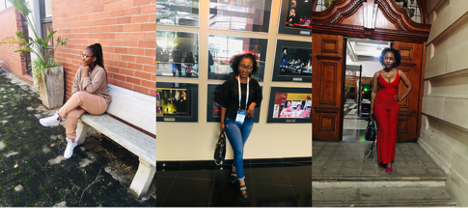
The pictures above show me on different occasions, the first one shows me on a normal chilly Pietermaritzburg day and the second and third ones show me at a conference, the third is the gala dinner at the same conference in picture two.

Maybe I should give a few tips on what to wear as a researcher.

  • Dress appropriately following the Occupational Health and Safety(OHS) regulations.
  • Allow yourself to be human and allow yourself to be fashionable or classy, or comfortable and practical – whichever fits you and helps you to feel confident.
  • Your dress code doesn’t determine your intelligence or how well your research will go.
  • Dress the way you want to be addressed but be excellent in your work.

The question to ask yourself is is your dress code linked to your intellect? Does it make you more intelligent to not think about looking good?

The academic puzzle… Which piece am, I and where do I fit in?

‘We cannot think of being acceptable to others until we have first proven acceptable to ourselves.’ – Malcolm X

Most of us played with puzzles when we grew up. We might have done this for the fun of it, for our personal development and the enhancement of our problem-solving skills, to build our perseverance, or for all of the aforementioned reasons. Some puzzles can be tricky, while others can be easily solved depending of course their connection of the individual pieces to the bigger picture (the number of pieces and the size).  I would like to think of myself as a piece of the puzzle in the bigger picture of academia. While the bigger picture (academic environment) may change and become trickier I have to always find myself a space to fit in and make a difference to fit in and make the picture whole, because without me it wouldn’t.

I recently moved to a new university (UKZN) to start my PhD, and as a piece of the puzzle, I have been trying to find out what my role is and how to fit in the bigger picture. I had spoken to my supervisor over emails for the past six months but, due to the pandemic, we had not met in person. It is only now in 2022 that I had the privilege of meeting him face to face and getting to know him more. And as we spoke, he shared a couple of gems that cemented my outlook on the PhD or even the academic journey. Those were that we all belong, we just have to find out how or where.

We cannot shy away from the media or even just the conversations we have within ourselves as researchers often magnify the bad and problems in academia, and not speak about the good and motivating parts of this space. With this first meeting with my supervisor, my subconscious had a negative attitude, because of course, ‘he was going to tell me how strict he is’ and all the rules he had for his lab I was ready for that, and I was ready to even answer Prof, I know and I am willing to work hard and do all I can to submit in time so that ‘we get along or that I’m not in your bad books.’

It took me by surprise that during our conversation, I saw him as a person and not as a supervisor. I saw his heart and his ambition for life and academia and not his wand and stick to lash me into working. It was a beautiful conversation and I left his office motivated to work and not depressed to think about how hard the journey I was about to embark on would be. He shared some advice that I will share shortly but as he spoke I quickly remembered when I first watched a video of our SAYAS editors Prof Jennifer Fitchett and Prof Roula Inglesi-Lotz… and in their conversations, they asked each other who they were and not what they do but who they were. And this made me realise that we are human before we could be our professions.

One of the pieces of advice my supervisors shared with me was to be teachable and learn from people and what I read. This may seem easy to read but very difficult to comprehend if one doesn’t know which part of the puzzle they represent. Another piece of advice was to practice excellence and not mediocrity. When you solve a puzzle, each shape is different, but each of the pieces makes the whole picture. Being excellent in your way is the same, be yourself but in that do everything with excellence and diligence. The last piece I want to share Is that I should be consistent, with my time and with my work and be simple in it.

Being consistent is part of building habits and it helps in being a masterpiece at what one does. So, which piece of the puzzle are you in the big picture and what new habit will you take into it? With no proper assistance or people, we surround ourselves with this may be difficult and it means for building and academic growth we need to remember that we are part of the bigger picture and working together is also a critical part of our elevation. Working together through networks, collaboration and mentorships is critical and will also help us find our space in the big picture.