Reflections on my first semester as a Masters student

I made it! I survived my first semester as a Masters student! I am exhausted, since the end of the semester consisted of too many assignments due in a very short amount of time, but I am very happy to never have to see a class test or tutorial question ever again.
WhatsApp Image 2019-06-12 at 15.16.36

One of the most important things my first semester has taught me is endurance. Going through a 9-week term with a never-ending workload and no break before the next 5-week term is tiring  – especially while trying to balance research and blogging along with my coursework. I’ve found that having my hobbies and not waiting for the holidays to have some rest and some fun helps me refuel my energy and motivation. Postgrad does not get easier and I’m glad that I’ve learnt how to keep going through the difficult parts.

This semester has taught me gratitude. I’ve come to realise that doing postgrad can bring up a lot of comparison to other students and feelings of inadequacy. Doing a semester of coursework while other Masters students are working on research can sometimes feel frustrating when your classmates appear to be ‘ahead’ and are busy with the exciting parts of research while you’re ‘stuck’ doing assignments.
WhatsApp Image 2019-06-12 at 15.16.35

However, taking time to pause and be grateful for where I am right now has helped ease those feelings. When I stop and think about how much I’m learning from my difficult courses and how those courses will help me become a more well-rounded scientist, and think about how lucky I am to have two fantastic astronomers as my co-supervisors, it becomes much more difficult to feel like I’m worse off than my classmates.

Lastly, I’ve learnt just how much I love to research. I’m looking forward to working on my thesis next semester. I spent a lot of time last year doing research, so going back to coursework has shown me how much I miss it. Although research is challenging in its own ways and I still have so much to learn – it’s a challenge I can’t wait to embrace.

What lessons you learnt from your first semester of postgrad?
Why Astronomers are so excited about the EHT Black Hole image

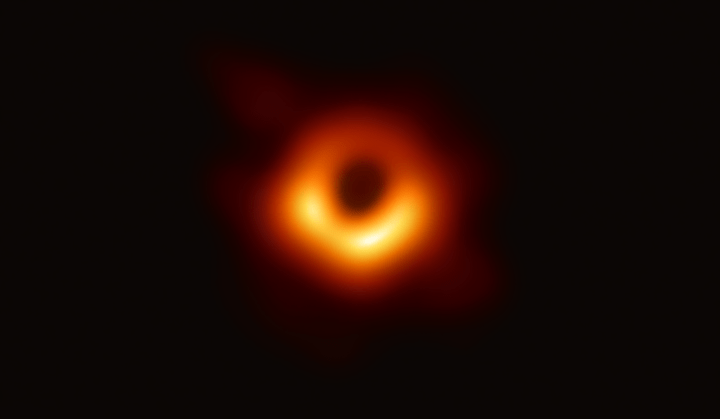
You must have seen the slightly blurry image of a black hole event horizon making the rounds on the internet in April. A bright, orange, cosmic doughnut. As an astronomer, this image was absolutely mind-blowing. In this post, I’ll share why this image is so important for science and its other benefits.

eht_picture
Credit: Event Horizon Telescope


We are not actually “seeing” the black hole

I just wanted to clarify this important point because it is what is so mind-blowing about this picture. We are not seeing the actual black hole. We are seeing the boundary where light can’t escape from any more because of the black hole – called the ‘Event Horizon’. The ‘dougnnut hole’ at the centre is where light has been scooped out by the black hole’s extreme gravity. Because the gravity around a black hole is so strong, the light can’t escape that region and is trapped –  causing the darkness at the centre. Black holes – as well as their event horizons – have a very small size relative to other astronomical objects, which adds to the challenge in observing them.

It shows us that the impossible isn’t always impossible

If you asked me, two years ago, whether we will ever manage to get an image of a black hole’s event horizon, my answer would have been a strong no. For most astronomers, the idea of ever getting this close to imaging a black hole would have seemed impossible. Since black holes don’t emit light and are so small – observing them was – for a long time – thought to be something we would never be able to do.  We are in an era of science where the discoveries are completely blowing away our ideas of what is and isn’t impossible – and this is largely due to the work of many people.

It will help us understand different types of galaxies

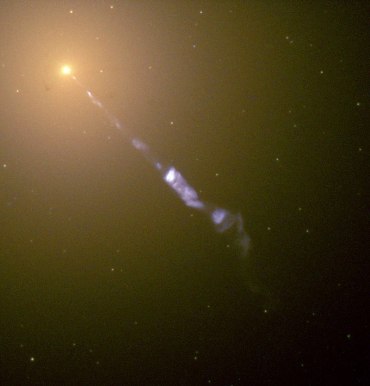
My own studies focus on galaxies, so I find this particularly interesting. Some galaxies, like M87, have what is known as an ‘active galactic nucleus’. In other words, the black hole at the centre of the galaxy being ‘fed’ gas, stars, and other material through the disk surrounding it. This results in extremely large jets, being shot out from the central region surrounding the black hole. Since not all galaxies are active, having a measurement of an active black hole and – eventually when the Event Horizon Telescopes releases the image of our own, Milky Way galaxy’s black hole – a non-active black hole will help us understand the processes that create these Active Galactic Nuclei in a lot more detail.

800px-M87_jet
The galaxy M87, which contains the black hole shown in the image. M87 hosts an Active Galactic Nucleus. Credit: Hubble Space Telescope

We can use black holes to test gravity

Black holes were once only theoretical objects. They test our theories of gravity to the extreme.  Although observations within our own galaxy showed stars orbiting something that could only be a black hole, having a picture of a black hole event horizon, which matches up with simulations and theoretical predictions so well, is a good sign that these extreme objects exist. This image is a strong indicator that Einstein’s theory of general relativity – which is what we use to explain gravity – is correct.

International collaboration is the path forward for science

The idea of the ‘lone genius’ – people like Einstein, Newton and Da Vinci who were thought to have worked on their own on amazing theories, making amazing discoveries – is dying out. The type of questions that we are asking nowadays in science is far beyond the scope of a single, brilliant mind. Taking pictures of black holes, detecting faint gravitational waves, building the world’s largest radio interferometer (a type of telescope that works by linking up multiple receivers), and detecting subatomic particles require many people all working together. Our world is increasingly divided over racial, political, economic and national lines. These big projects show us that when we put our differences aside and work together – we can do impossible things.