A Passionate Nation

What does the youth of 1976 have in common with today’s youth?

As we commemorate Youth month and specifically Youth Day on the 16th of June, I have been trying to search for similarities between the youth of 1976 and the youth of today. The students that led the march against the Bantu education policy must have been extremely courageous and passionate. They knew that their actions would result in severe consequences, yet they still soldiered on. The repercussions of their actions lead to some of the educational privileges African pupils have today.

Even though the older generation has labelled us as the ‘doomed generation’, the passion of the historic Soweto Uprising generation still strongly drives the youth of today. You can see it in the artistic videos that are shared in social media, the faces of our national sports team players, and the students and rise against all odds and excel in (previously exclusive) academic fields such as science. Although sometimes misdirected, passion is alive within us and will drive us to greater victory.

In this blog, I will share stories of young South Africans that truly inspire me and give us a glimpse of the South Africa we can become if passion is harnessed and maximised.

Earlier this year I was invited to the Spirit of light event, hosted by the renowned mama Gcina Mhlophe; I was pleasantly surprised when I found out that I would be sharing the podium with Major Mandisa Mfeka. I had read much about her and watched her documentary; her story was truly inspiring. She radiated passion as she narrated her story that night. A young girl from the township of Ntuzuma in KZN who fell in love with airplanes as a result of frequent visits to the Virginia airport in Durban.
In 2008 she joined the  SAAF and was enrolled at Central Flying School in Langebaan, Western Cape, in 2010, going on to get her wings in 2011. Early in 2019, she became South Africa’s first black female fighter pilot and in May, she was one of the pilots who flew at President Cyril Ramaphosa’s inauguration. Her tagline is ‘the sky is the baseline’, indeed her passion defied all circumstances and launched her in the sky. 

As an astronomy fanatic, I had always fancied having a celestial body named after me, even if it was a mere shooting star (Meteor). Hence, when I heard about a minor planet named after a young science enthusiast, Siyabulela Xuza, I was instantly intrigued by his work. Xuza, born in Mthatha Eastern Cape, is an energy-engineering expert and entrepreneur with a passion for clean affordable energy.

At the age of 16, propelled by passion, Siyabulela Xuza began experimenting with rocket fuel he made in his mother’s kitchen. After numerous failed launches, his experiments lead him to launch a homemade rocket, The Phoenix, which achieved an altitude of over 1 kilometre. This earned him the junior South African amateur high-powered altitude record. Xuza’s project on solid rocket fuel won gold at the Eskom Expo for Young Scientists in 2006, along with the Dr Derek Gray Memorial Award for the most prestigious project in the country. In 2007, his other brainchild, “African Space: Fueling Africa’s quest to space”, was entered into the International Science and Engineering Fair where it won the “Best of Category” award and a “First Award” in the energy and transportation sector. His work has earned him several leadership positions and awards, including a scholarship to the Harvard School of Engineering and Applied Sciences.

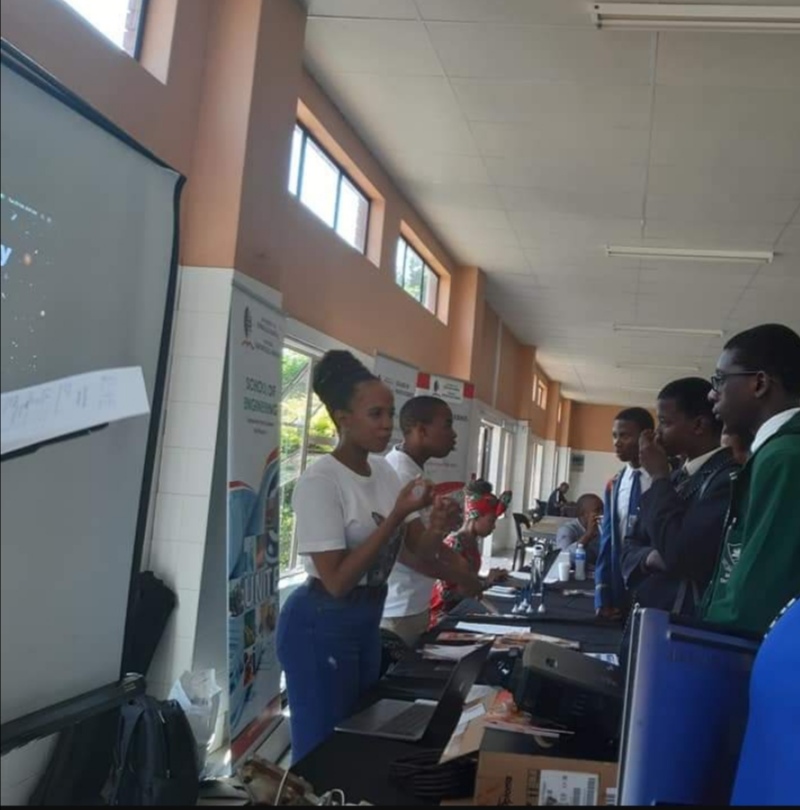
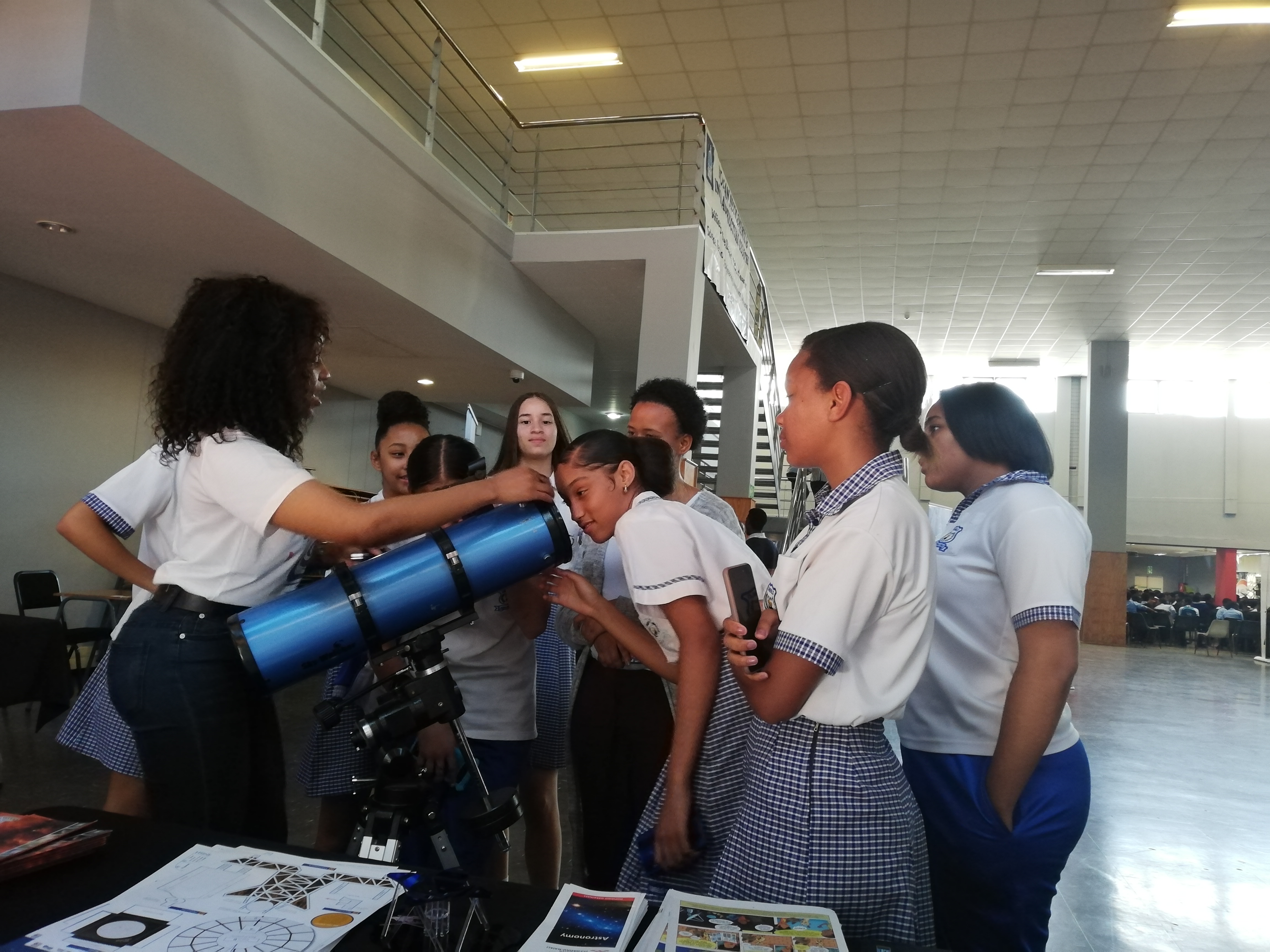
I often get a glimpse of how passionate young South Africans are when I attend career exhibitions. Earlier this year I was part of a team of UKZN staff and students that attended the KZN High Achievers Seminar which was co-hosted by UKZN and the KZN department of education. At this seminar, top achieving learners from schools ranked quantile 1-3 were invited to listen to career talks. During the exhibition, two particular students approached my stand and started asking questions about astronomy and career opportunities. They passionately shared their love for astrophysics and started asking questions about wormholes and space-time dynamics. I was fascinated with the level of knowledge they possessed regardless of the shortage of facilities in their schools. I am certain that these learners, given the support and opportunities, will become the next Einsteins. This conversation left me beaming with pride, indeed, with these kinds of minds our future is in safe hands.

These stories are a testimony of the depth of passion in our youth and how, if cultivated and harnessed, it can significantly transform our nation. ‘Inkunzi isematholeni’; directly translated this isiZulu proverb means that the bull is among the calves. Indeed, the future of this nation is in the hands of the youth; hence, as a community, we need to synchronise our efforts to ensure that the young generation lives to its full potential. This will require the parents to be fully aware of their children’s talents and support them unreservedly, for teachers to impart their knowledge gracefully, and for the government to create a conducive environment for these young minds to flourish.


I Spy With My Little Eyes… A Perfect Supervisor

Is there an algorithm for choosing a supervisor?

If the gods of academia work in my favour, this time next year I, will be a postdoctoral research fellow. While searching for potential postdoc positions, a thought crossed my mind: ‘Could there be an existing algorithm on how to choose a perfect supervisor?’. I then went on a quest to find this hidden treasure, a journal with steps, perhaps a machine learning algorithm that spews out ones’ ideal mentor. To my despair, this journal was non-existent.

However, not all hope is lost because I did discover numerous articles with guidelines on how to choose a supervisor. These guidelines, combined with my personal experience, will surely assist you in your pursuit of a good supervisor. The guidelines outline the best-case scenario where you, as a student, have the power to choose your ideal institution and supervisor. Unfortunately, in some cases, due to funding restrictions or structured study programmes, the student does not have the freedom to choose a supervisor but is allocated one. In the latter instance, one just has to appease the academic gods and hope that they are paired with a good supervisor.

As always, a good starting point is being self-aware. Before pursuing the postgraduate journey, it is essential that you know your working style, work ethics, strengths and weaknesses, hence performing some type of personal SWOT analysis is a good starting point. For example, I knew that I was not a proactive student; therefore, I needed a supervisor with strict working rules. My MSc supervisor had set weekly update meetings, this kept me on my toes and hence worked in my favour compared to a relaxed approach. Doing the personal SWOT analysis will help you find a supervisor who complements your weaknesses and pushes you to be a better researcher. An important aspect of self-reflection is having a bigger picture of the research field you want to pursue. Take note of the broad research field that interests you, then create a list of potential topics that you want to work in.

Once you have a list of topics that interest you, you can now begin to search for a supervisor candidate. An article by the editor of the Prospects website details the steps of actively searching for a potential supervisor. This article indicates that one should start with searching for the most cited papers, published blogs, and recently submitted PhD dissertations in your area of interest. If you are inclined to the social engagement aspect, you should also search for researchers who also do some level of outreach activities. Once you have conducted this search, you should reduce your list to realistic potential researchers. For example, if you have no interest in moving abroad, then all the candidates from other countries should be removed from your list.

Next would be a background check on the list of potential researchers. Although sometimes it is not feasible, a background check is essential, especially for female students (unfortunately, not all researchers have good intentions). One can approach previous students supervised by your potential advisor to understand the type of person they are and their work ethics. Of course, the information will be biased based now the kind of relationship the student had with the advisor. However, if multiple students mention the same thing, especially if it’s sexual misconduct, then you might have to consider removing that person from your list.

An article by the Academic Positions websites clearly outlines how one can then approach the potential supervisors. In summary, you must send an email detailing your research interests, the reasons you would like them to be your supervisor, and ask for a face to face meeting (either personally or virtually) to further discuss the project you are interested in. This email should also include your revamped CV. Once you have made contact, the next phases are out of your control; you can only hope for the best outcome. If the first meeting does take place, make a list of concise questions to ask that will help you in your final decision making. These are the questions you could include: How many students are they currently supervising? Do they have time for more students? What are their expectations of the students under their supervision? If necessary, would they be able to fund you? Do they have affiliations with other institutions?

The academic journey has no guarantees, but make the most of your journey. Postgraduate studies and student-supervisor relationships can be emotionally taxing, as detailed by a previous SAYAS blog; hence it is vital to put in all this effort. Having the ‘right’ supervisor can be a catalyst to your growth in academia and having the ‘wrong’ supervisor could lead to depression. My MSc and PhD supervisor has been a mentor and advisor. In the moments where I felt so defeated and incompetent, he always knew the right things to say to keep me motivated. He has been selfless and transparent when giving advice, even if it meant losing me as a student. As a result, he connected me with multiple international collaborators which immensely advanced my research.

Another SAYAS blog likens supervisors to coffee, funny but very true. Supervisors are very different and have various supervision styles buts once you find your preferential ‘coffee’ it will be magical. It will have a lasting impact on both your academic and personal life.

Even though there are all these ingredients to finding the best supervisor, you as the student have to put in the most effort. There are no guarantees that all these steps will lead you to your ideal supervisor, but you also have to be willing to maximise your potential to gain the most from your postgraduate experience. If the relationship does get toxic, be mindful of the steps you could take to fix it or find another supervisor; hence it is important to be aware of the structures that handle these matters in your institution.