IN-SPUH-REY-SHUHN

When I began my tertiary education, I must admit I had no idea where I would be today. The girl from the dusty streets of eMalahleni surely had coal in her hands, determined to turn it into diamonds. There are many of young people yearning to feed the fire inside of them, wanting to harness it and do the unimaginable. I can see it in the faces of the anxious and excited first-years milling around campus; I can see it amongst the postgrads arriving at institutions early, worrying about deadlines, experiments, chapters to be submitted. What, then, stops us? What leads so many of us to just give up on our grand dreams?

I think it’s a wall; a mental block.

My dream is to ensure that the environment is preserved for future generations, and it might seem strange that I use a stripy little fish, dressed in a Kaizer chief’s jerseyzebrafish-adult, to achieve my dreams. These small fish are quite useful in that they assist scientists to determine whether chemicals will be toxic to people and other organisms. In actual fact, it is their eggs that are used. The fish produce large numbers of these transparent eggs at a time. Being able to look into the egg, seeing the embryo’s heart beating, blood flowing and turning into a proper fish within five days, is what makes them so special. When conditions are less than ideal, the rate at which the eggs hatch, their deformations and ultimately death, are a clear indicator of harmful chemicals and environments.

Zebrafish development

Although very useful, breeding these little zebrafish was not easy: they swim quite rapidly, with my first attempt resulting in snail eggs, which I mistook for zebrafish embryos! Learning that their living conditions including, temperature, amount of day and night, as well as the presence of flowers were important, took me a while. Even more surprising was coming to know that the female preferred two males, battling it out over her! Resilience was important in my year-and-a-half struggle to getting my first 200 eggs!! And most of this struggle happened “behind the scenes” with no-one watching my every more; it’s the stuff that you don’t write about in papers or even discuss in presentations… Which reminds me of another trial I had to overcome –my first oral presentation!!! It was awful, probably because I was extremely nervous and afraid of presenting in front of unfamiliar faces and experts in the field. Let’s just say I was relieved when it ended! Granted, with time, improvements have been made lol…

In hindsight, one would say that higher education does not only build you on paper, but also in character. Participating in research has required me to completely get out of my comfort zone. Much of that growth is built on what I do when no-one is watching, when no-one is there to pat me on the back or help solve a problem. But my point to you is, you need to make this choice — to be what you’ve always imagined you could be — even when you’re alone in the lab or behind the computer. This could be the greatest gift you give yourself. 

It is true that no goal that is worth it is achieved easily… Now that the diamond is in my grasp, it is time to polish it into an even more priceless jewel.

Protecting the Fynbos Biome: South Africa’s greatest natural resource

Is biodiversity more important than oil? Is it more important than the coal we burn for electricity in SA? What is South Africa’s greatest resource?

I want to argue that the fynbos biome is South Africa’s greatest natural resource because of its unique biodiversity, containing thousands of species that are only found in South Africa.

Biodiversity is the harmony of life derived from many years of evolution. It is the product of seemingly infinite natural equations that determine survival and reproduction success, of which, we are only just beginning to explore. Biodiversity is generally measured as the number and variety of species within an environment and it is a race to discover the complexity before our own irreversible actions proliferate.

E.O. Wilson, global leader in ecological conservation, has suggested biodiversity is the planet’s greatest resource.

BiodiversityGreatestResource

Why is it such a great resource?

Conserving biodiversity ensures the continued production of clean water, an abundance of species for exploring as medicinal products, and diverse gene pools for crops and natural resources. Biodiversity facilitates the production of these resources through processes such as soil formation, nutrient cycling, climate regulation, and pollination dynamics.

For example, the Cape Honeybee is endemic to the Cape Floristic Region (AKA Cape Floral Kingdom), meaning it only exists in this area of the world. This species uses fynbos vegetation for about 80% of its hives, where it produces honey. Not only is the production of honey a valuable resource, but the Cape Honeybee also pollinates agricultural crops is in the region, providing benefits to many Western Cape fruit productions. This example demonstrates the indirect benefits of biodiversity to agriculture, through the Cape Honeybee.

picture20140801151740

DSC_9904

The fynbos biome is also a ‘biodiversity hotspot’, being exceptionally diverse (and, therefore, epic in my opinion). It is one of only six biomes in the entire world, and it is the smallest and only biome contained within one country. (More information about the fynbos can be found here.)

Considering only plant species, the fynbos biome contains more than 7000 species, representing close to half of the plant species found throughout South Africa. In order to demonstrate the richness of this resource, I created the graphic below.

FynbosInfo

Along with the unique characteristics of the fynbos biome are unique challenges. As many as 1700 plant species in the Cape Floristic Region are threatened to some degree, representing 3/4ths of the plants in the South African Red Data Book (http://www.plantzafrica.com/vegetation/fynbos.htm). Much of these are threatened by urban expansion or land use change, such as conversion to agriculture, but what else should be investigated and mitigated?

I nominate invasive plant pathogens; a threat we can research with Cape Citizen Science.

DSC_9998

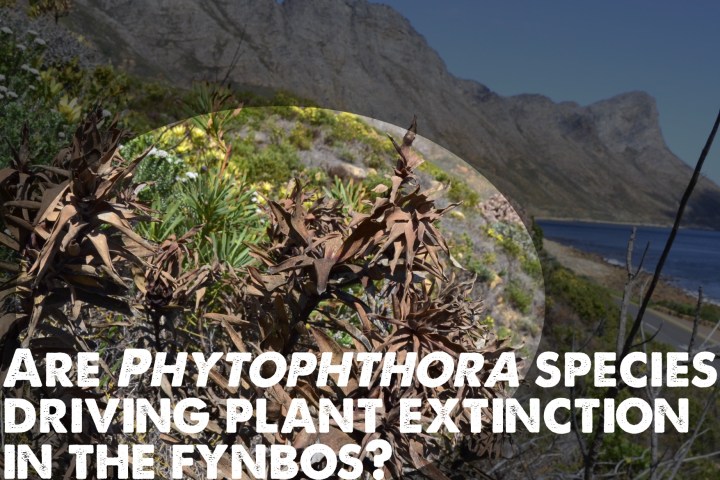
How are Phytophthora species affecting the biodiversity in the fynbos? Phytophthora cinnamomi is a root rot pathogen known to be present in the fynbos, but we have a poor understanding of what it is doing there. Although it has been dubbed as the biological bulldozer in Australia, we havn’t really studied its impacts on the biodiversity in the fynbos. How does one species affect the fynbos? How does it affect us? Does the pathogen kill plants that the Cape Honeybee relies on for foraging/shelter? Would there be different plants on the landscape if this pathogen was absent? All of these questions are still left unanswered.

PhytophthoraPlantExtinctionLowHow many of the 1700 threatened species in the fynbos are battling to survive the biological bulldozer?

There are many examples of pathogens that have nearly eliminated single species from the landscape (e.g. chestnut blight, sudden oak death, Dutch elm disease), but what happens when you have a generalist pathogen in a biodiversity hotspot?

There are also many questions about the diversity of the pathogens in the fynbos themselves. What is the diversity of Phytophthora species? How many species are there and are they native or invasive? How did Phytophthora cinnamomi get to the fynbos?

As you can see there are many unanswered questions that need to be addressed with more research. Understanding the effects and the diversity of Phytophthora species will help us conserve species in the fynbos. However, research is not free and life is short. That is why we are calling on you to release the inner scientist in you. You can contribute to research to help conserve the biodiversity in the fynbos biome by participating in Cape Citizen Science. More information about Cape Citizen Science is available here http://citsci.co.za.