Doing research is quite an interesting way of spending one’s time. Come to think of it; we wake up every day to identify problems in our respective fields and hope to solve them, partially if not completely. If somebody has already proposed a solution for such a problem, we hope to make it better than they did and often to fit it into our own geographical context. In my opinion, this is also what keeps the world going. I look in my own little world and in Africa and I see my peers who, like me, are very ambitious and are also looking to transform our world. What happens though when such potential and drive becomes restricted by elements that are impossible to change overnight?
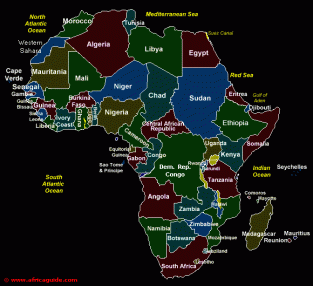 In my previous blog I looked at how Africa is lagging behind in research compared to the rest of the world. It became apparent that, even though I was just looking at ecotoxicology as my field, Africa is still trailing behind in research entirely. Interestingly though, when I looked at what might be the common denominator in all fields of research, there was just one major thing that is keeping Africa from progressing – resources. These resources may be in terms of funding, laboratories or technology. Many of the labs have to depend on outsourcing processes because they cannot afford to just buy what they need and even if they can, space becomes a limiting factor. This is the reality that most researchers have to deal with and quite frankly, it is my reality as an upcoming potential researcher.
At my institution and my department specifically, there is only one ecotoxicology lab which is the size of an average kitchen. This same lab is used by honours students, other master’s students, senior researchers and postdoctoral fellows. There is also only one molecular lab which can accommodate three people at most. The equipment that I need for the simple analysis which is critical for my research is not available at this institution. As such, I have to use the laboratories from other institutions and pay for the analysis – outsourcing processes.
I am positive that by now you are probably thinking, “Why are you still there?”
Well yes, this is the story for most emerging researchers in Africa. However, most of the established researchers have been able to, against all odds, do exceptional research and contribute more transformatively to their respective fields. It’s a no-brainer why this is. As a person facing this reality every day, I can tell you with absolute certainty that the small labs and limited resources actually create better researchers that are critical thinkers. Instead of following a procedure that was developed somewhere in Asia or Europe, you have to read up on tons of literature and figure out a way of delivering the same results utilizing an alternative, affordable method. Rather than focusing on just producing a paper, you get to dive deeper into the processes that you follow to ensure that whatever that you do can be done again. This is how we create credible research with reliable results. This is how we also produce the best researchers that appreciate the value of every piece of information and those that develop with simple, affordable, ecologically-friendly yet reliable research methods that will ensure that Africa gets to live to see the next century.
As I said in my previous communication, we are still very far from where we need to be. I don’t think, however, that lack of resources should be the reason why we don’t better our lives through research. One of the greatest things I have learned in research this year is that collaboration works. Let us go back to the African way of being – Ubuntu; doing everything as part of a collective whole. If one lab has what another researcher needs, there can be no reason why Africa is not moving forward in research.
 following your postgraduate research field for the rest of your life! It thus becomes important to follow your passion or to find love in what you do. This month I just felt it was worth highlighting the field of study that I am in and why I find joy in what I do.

 SAYAS BLOG