“Read this and call me in the morning”

-Darryl Herron, Tree Doctor

The forest floor may not always seem as impressive as the giant trees that congregate around it but it is probably one of the more interesting places you’re likely to come across. During certain times of the year, if you’re lucky, have patience, and timed your visit after some rain, you will see a once plain forest floor come to life with wonderful colours and weird shapes, like the glowing pale green cap of Mycena chlorophos; the bird’s nest fungus, Cyathus novaezelandiae (yes, resembles a bird’s nest with eggs); and the characteristic creamy star-shaped earthstar, Geastrum triplex. My friends call me a tree doctor, and that’s what I am, sort of…


Side note: Before mycology was a recognized field, fungi were thought of as plants and were even grouped with them. The first scientists studying fungi were really botanists; so if we were living in 17th century, my friends would have been right.

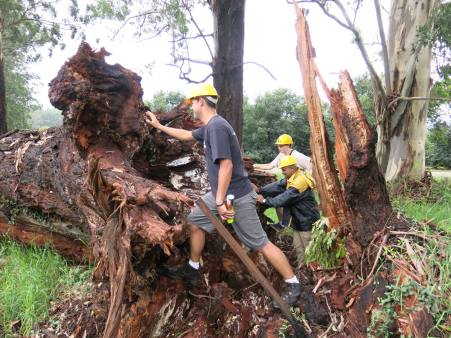
I’m actually many things. I am a microbiologist by training; that is my broad field of study. The core focus of my PhD is on a fungus, which also makes me a mycologist (I study fungi). The fungus I work on kills pine trees and is a huge problem for the forestry industry, globally. Because I study a tree disease and work, part-time, in a plant clinic which diagnoses tree health issues, it also makes me a forest pathologist. I could call myself any one of these (and more) but I have adopted the title tree doctor. Like human doctors need to know about human physiology, the diseases which affect them and the medicines to remedy them, I need to understand that about plants.

Herron_Eucalyptus_2
A tree doctor in action

Tree doctors are as awesome as — no, wait — are more awesome than medical doctors because a tree doctor has (or will have, in my case) the title “Dr” without having to worry about medical malpractice. We face a tougher challenge, however: tree doctors, like veterinarians, work with “patients” that cannot tell you what is wrong and the medical research for plants is far behind anything we have for humans and other animals. I essentially treat plants in the medical Stone Age! Yes, there are high mortality rates.

The knowledge gap is wide and that makes my job both interesting and disappointing. A few weeks ago I was called out to give some advice on a beautiful 100-year oak tree that was dying. The owner— having grown up with this tree, like her father before her—was willing to do anything to save this tree. Unfortunately, this oak was suffering with a root rot that was quite advanced and would eventually kill it. Had I the chemotherapy equivalent, the technology to safely cut out the diseased tissue or the knowledge of synthetic root growth, we could have done something to save this tree. But yeah, we’ve focused on animal health for millennia, and we still almost nothing about green living things.

Some individual trees have great sentimental value to people, but generally we seem to take them for granted. We should not. Trees quite literally provide the air that we breathe, and many animals (birds, squirrels, various pollinators) rely on them for safe spaces or food. We need healthy trees. As a farmer or forester, you realize the value of plants because you sell the plant or its products for a living. While these commercially important species are well protected and somewhat studied by many plant doctors, there are far too many plant species that do not receive the same attention—unless there are small pockets of them left, like many of our cycads or the redwoods in the US. Because our knowledge and the technology for plant health is so far behind, should these precious plants ever become diseased, it’s going to take a miracle to save them.

When you walk out of your house tomorrow morning, take a moment to look at what’s around you. Look at the plants in your garden, the trees on the street and those lining the horizon. Now, imagine if the only plants you’d ever see were grown in commercial plantations or massive, monotonous farms.
Herron_Eucalyptus

Research shows that green spaces in cities boost our own mental health, that getting out into nature (not just well-tended gardens or farms) restores balance in our own rushed lives. It’s not just the green spaces, but the pale green, bird-nest lookalike, star-shaped spaces too—trust me, I’m a doctor.

Plants may not always seem as impressive as the humans that congregate around them but they are the lungs of our planet, and keep us mentally rooted (pardon the pun). We need a few more tree doctors to make sure that they don’t simply disappear and turn to dust under our feet.

An Outbreak of inspiration

After one of our Professors, Sanushka Naidoo, challenged us to think about what it is that inspires us and what we aspire to be, I stumbled onto an opinion piece titled, “Why Universities need to tell better stories.” You might be wondering what aspiration and communication have to do with one another and I hope to make that clear by the end of this blog.

Like many of my fellow scientists, I was inspired to do science. The inspiration came not from a wonderful biology teacher or a visit to a local lab but rather from a movie called “Outbreak,” starring Dustin Hoffman and Morgan Freeman. I was ten at the time (I know, where were my parents?) and after watching “Outbreak” five or six times, I decided I wanted to be just like the scientists I had seen on TV, working for the Centers for Disease Control and Prevention (CDC). I was going to rid the world of HIV and Ebola.

Outbreak
Credit: https://www.empireonline.com/movies/outbreak/review/ 

This kept me going for years! After I completed my undergraduate degree in microbiology, I applied for an Honours hoping to get a project with a Professor of virology, someone who studies viruses. Unfortunately, at that time they were only accepting female students. I then had to change my focus and ended up, thankfully, working on plant pathogens instead. You see, shortly after I started my Honours, I learned that I couldn’t handle blood all that well, and seeing that Ebola is a haemorrhagic disease that makes one bleed (a lot), I was lucky to have made the switch. Nine years later, I am a PhD candidate still working with plant pathogens and I haven’t looked back since.

While “Outbreak” isn’t strictly science communication, it did do a lot to inform me about what some viruses can do, how they spread and the risks they pose; even if it was a little “Hollywood.” Yes, it was a work of fiction shot in a studio in the United States but some of the images portrayed in the film reminded me of some of the photographs that captured the tragedy of the 1995 Ebola outbreak in Zaire. The release of “Outbreak” at the time of the Zaire outbreak popularized our concerns about a deadly virus spreading and so also created awareness about these deadly Ebola-like viruses. Remember this happened at a time when social media did not exist. If you didn’t learn about the outbreak from the TV, radio or newspaper, then the cinema was going to show it to you.

My work may seem less exciting to some, especially when you’re standing in a conversation with someone who works on cancer therapies or has found new ways to harness energy from the sun, but I have some wonderful stories waiting to be told. So do many others. Much of the world’s research happens at institutions of higher learning, by the researchers and students who work there. They research everything from HIV and evolution to cyber security and politics.

At the University of Pretoria, they have recently started something called “Research Matters.” This is one way of showcasing some of the most relevant research happening in South Africa, on its campuses. With the help of social media, the university is trying to generate a larger audience to share these stories with. While this is a start for research communication at our university, I often wondered if it shouldn’t be us, the scientists, getting ourselves and our work out there to the people who fund it and benefit from it.

There are journalists, or science journalists, for that. Yes, there are, and they have a role to play in communicating science but I think there are other ways for us to share our science too. Beyond communicating with the scientific community through scientific papers, posters and talks I have learned to get in touch with a broader audience about my work and other topics using my drawings, cartoons, creative pieces and even blogs. If I had the budget and the time, I think I would even make a film about it.

I have been told that I do not fit the typical scientist mold but I doubt anyone would be happy fitting a mold. We are all unique. Just because we are scientists doesn’t mean that we are only good at science. Some of my colleagues also sing, dance, rap, act, write, summarize talks in three minutes or less and, believe it or not, do it well; sometimes better than the science bit. Using these and other talents in innovative ways can create unique avenues for us to share our research and communicate these stories.

During my PhD, I really started to see what being a scientist was like. After struggling to communicate with friends and family about my work, I realized that I was like Motaba, the virus in “Outbreak.” The scientists “got me” but no one in the general public wanted me. If I didn’t evolve my way of thinking, my work would “infect” just a few and that’s when it clicked, I need an outbreak. If we are to share the wonderfully infectious world of science, we are going to need to be more infective!