Boosting brainpower: drinking your way to success

The past month has been a whirlwind of scientific activity- starting new experiments, conferences, and writing manuscripts. In my recent blogs, here and here, I discuss how I navigate the scientific twitterverse and the power music has on my mental health and acuity. Notwithstanding all of these, in this blog I want to discuss how maintaining a healthy diet helps me stay focused and calm under pressure. Please note – I am neither a dietician nor a health professional and the tips that I share are what works for ME and may not necessarily apply to you.

 When you visit any graduate student lab there is always a coffee pot brewing, and our office is no exception. But, I remember during my masters I only drank green tea and coffee was never my thing– how things have changed! Coffee culture has become an integral part of the academic machinery; I am convinced that coffee and tears of graduate students fuel the whole machine. I have found that drinking a healthy dose of coffee (about two pots a day for me) keeps me focused and I do not have any adverse side effects. Coupled with my coffee, I find snacking on raw vegetables/fruits keep my system alert and functioning optimally. Also, I find that being a vegetarian gives me more snacking options and energy than my meat-eating counterparts (well, the ones I know ).
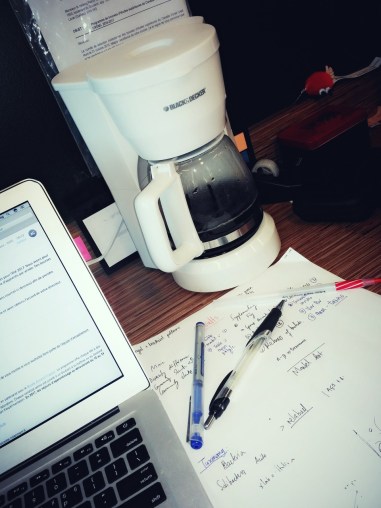
coffee
The desk of this caffeine-dependent postgrad

In recent years, there has been a growing concern amongst academics regarding the use of brain-enhancing drugs to improve performance. Melinda Wenner Moyer (@lindy2350), a science journalist, wrote a brilliant article for Scientific American, here. In it, she focuses on the issues concerned with the use of Modafinil– a drug prescribed to people who suffer from narcolepsy/sleep apnea, but in healthy individuals, it has been shown[1] to heighten alertness and provide cognitive enhancements. Another report from the UK indicated that 1 in 5 academics have admitted to using Modafinil. However, before you start running to your pharmacy to get the drug- it is worth noting that many neuroscientists are concerned about the long-term effects of these drugs on a healthy brain. Furthermore, the ethical issues that surround the use of these medications are yet to be resolved.

To return back to topic, I am fascinated about what people use to stay awake when ‘burning the midnight oil’ so to speak. For me, it is coffee + snacks, and for my some of my colleagues it is simply taking vitamin B12 supplements and that suffices. A friend of mine can only write when they are in the library – maybe the musty smell of books is a boost? What are some of the techniques that you use to stay alert? Is there a special diet or supplements you take?

[1] Results varied across different studies

A WATER HUNGRY NATION: Yearning for fire-pool downpours from heaven

We must pray for His divine intervention!!!… But we must not pray like those who do not have faith…” While you may think that this is a sermon, it is a cry from the Minister of Water Affairs to the nation to pray for the heavens to open up, the rains to kiss the barren African soil. I must say that while this approach amused me, it is astounding that in 2017 we still experience water shortages – there is water available.

Let us be frank in that these issues culminate from historical recklessness of a nation vying for economic growth. Still trekking towards development, the country relies heavily on mining, coal power and agriculture to sustain the economy. Our progress is, ironically, messing with our most basic of human needs – the need for clean water. The Olifants River, which meanders through the Mpumalanga Province, lined with mining operations and coal power stations flanking the banks, serves as an appropriate example. Massive crocodile and fish deaths were reported in 2006 in the Olifants tributary running through the Kruger National Park; shortly afterwards, the same was reported at the Loskop Dam. The areas affected by this tragedy are national heritage key-points, highlighting the importance of resolving these issues.

The quality of our water is a tremendous issue – humans, plants, and animals rely on clean fresh water, and researchers who investigated the Olifants River tragedy could not pin-point the cause of all these mysterious deaths. So, what is to prevent the tragedy from repeating itself elsewhere?

Crocodile and fish mortalities reported at the Kruger National Park, as well as Crocodylus niloticus and C. gariepinus with white and brown spots in fat (from Olifants gorge on Mozambique border and Letaba confluence)

In efforts to find the cause of these mysterious deaths, the research I have undertaken through my  Master’s into Doctoral studies is aimed at assessing the risk and levels posed by persistent organic chemicals at the Loskop Dam, using zebrafish as a model system. Preliminary findings have revealed high levels of these compounds and their contribution to the toxicity of the system.

This 18th year of the twenty-first century is marked as one where I get closer to the answers that have boggled many a scientist and national parks authorities. Why are our aquatic organisms dissipating, who and what is responsible, how is the wider population affected by these incidents, what can be done to prevent and revive the ecosystem!? Through the eye of a fishy needle, if you will, I will highlight some hard-hitting truths… And perhaps the final chapter of my thesis will be named REVELATIONS, rather than CONCLUSIONS!!!