The future of intelligence

Humans are born inventors – we keep on devising new technologies to (supposedly) make our lives easier and have a deeper understanding of how things work. There exists a collaborative relation between the human input and artificial intelligence, transforming our thoughts into tangible results. Computers are the closest form of technology that strives to ultimately match the human mind, albeit with much effort. Of course, this revolutionary equipment, introduced in the 80s and 90s, has changed our lives forever. Moreover, we now carry little computers in our pockets — the worst invention, according to parents — but it has improved our lives none the less. I would think that without applying technology effectively, researchers would be finding it quite difficult to make the leaps they have. In fact one would say that technology is both the fruit and the root of research. Our aim as researchers, broadly, is to investigate and discover, answering unanswered questions, if you will. The tools we use that aid us toward this are constantly evolving, trying to reach an age of high efficiency and turn-around time. 
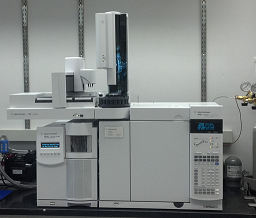
mathapelo-agilent-gc-ms
Oh, if only you could speak…

In a chemistry context, chromatography, a traditional method used to determine different kinds of chemical compounds in a sample, has evolved quite significantly over time. Before engineers built an instrument that could do this, many researchers used thin layer chromatography, which uses a sheet of glass, plastic or aluminium foil, coated with a thin layer of an active substance. Think of what happens when a piece of tissue and dip it in water; the water moves up the sheet- that is a form of chromatography!! In the former the ink would move with the “water”, leaving a trail behind it from the starting point, while in practice, the sample would separate into its individual compounds. Well, what my point is: as long as my explanation was, so were the processes one would have had to get through long before getting the results. But now, technological advances have improved the selectivity, efficiency and difficulty in carrying out all operations. I am not saying that we should over indulge and let it run wild, but use it within limits. I have come to know, that while it may be nice to have a machine that analyses your samples while you are at home, unsupervised technology has its disadvantages. I’ve sometimes returned to my beautiful machine and found a bent needles, upside-down sample containers and no results!!! In these cases, I would have preferred a talking instrument that could tell me what went wrong… Alas, we are in the age of discovery, I may be lucky with that one!!

Technological advancement is unavoidable and the debate of whether people will be replaced by machines is controversial. But one thing is clear, technology is there to make our lives and research easier, faster, more efficient. Whether we reach an age where instruments think for themselves, is for us to see in the future! Without people, the thought processes and emotions behind these creations would not be possible!

Writing your first paper: start with the basics

By Karen J. Cloetekaren

iThemba Laboratory for Accelerator Based Sciences, National Research Foundation, kcloete[at]tlabs.ac.za; kaboutercloete[at]gmail.com


One of the most important outputs in a researcher’s career is the number of publications in high impact, international peer-reviewed journals. Getting published leads to promotions, the development of new ideas, sometimes instigates new collaborations, and – importantly – advances the scientific field. If your work is not published, you may as well never have done the research. However, writing a research paper is often an anxiety-provoking and daunting task, so that many important research findings never reach the print stage.

The most important barrier to writing is the lack of writing skills, which are often not taught at undergraduate or postgraduate level. So what do you do if you, as a young researcher, also never received this vital training?

Improve your writing skills: Don’t do it alone.

Before taking on a first big writing assignment, ask for guidance and advice from colleagues, co-authors, mentors, or supervisors. Supervisors often offer invaluable advice when it comes to writing papers at the masters or doctoral level. Even colleagues from other fields will be able to help you develop your paper, as an “outsider” not deeply involved in the study can easily spot where your writing and ideas are unclear.  However, beware of submitting a lengthy piece of badly written work to another busy researcher – rather submit a small piece of writing (like the introduction) for thorough review and comment.

Another approach to improve your writing skills is by joining a writing group. Just beware: transforming writing into a social activity may only be suited for those with a certain personality type. In such writing groups, draft versions of your paper may be disseminated among the group members for comment and discussion. Some universities may also offer a tutoring service for writing in which experienced students tutor or mentor inexperienced students in drafting a dissertation or first paper for publication. Offering your skills in such a way may be an invaluable learning experience for reviewing your own work.

It is also important to be exposed to diverse opportunities for learning and publishing research. This should be done early in the research career. Attend as many writing workshops as possible, covering different topics related to the writing and publishing of research. Even if you think you know how to write, you will always gain new ideas from good workshops or tutorials.

Work a bit differently.

Technology can also help. Software tools and resources for academic writing may be an invaluable resource in assisting with the writing process. I have listed a few useful tools below:

Mindnode

Software tool develop for structuring ideas when brainstorming

Freemind

Free software tool to assist with mind-mapping

Rationale

Software developed for argument mapping that enables the structure of an argument to be displayed graphically

LaTeX and LyX 

Software developed to serve as document preparation tools

Research Writer by ActiveScholar

A writing tool developed for academic writing enabling you to capture, maintain, and organize research information

Docear-The Academic Literature Suite

An open source tool that assists you in organizing, creating and discovering academic literature

Mendeley

A free bibliography and academic social networking tool

After you have honed your writing skills, you can use your time more efficiently when writing up a paper. It will also become easier to publish good papers, have successful grant applications, and enable you to become a good reviewer or editor of a journal. Most importantly, being a good writer will generate respect from your peers.


“Either write something worth reading or do something worth writing.”

– Benjamin Franklin