The Fitz family

By Davide Gaglio

I am sure most of you experience the lack of money that comes with being a student. While I was a masters student at the University of Bologna in 2006, I had the opportunity to work part-time as a postman. But when my short career as a postman unexpectedly ended, I would never have dreamed of doing a PhD in South Africa, or being involved in an extended academic family in the truest sense of the word.

During my farewell at the post office, I had a long chat with a girl that had just returned from a trip South Africa. “South Africa?” I said, “Yes… but which country of South Africa?” 🙂 🙂 Well, that was when I realised I needed to fill some gaps in my geographical knowledge, but I blame my high school teacher 😉

Soon after, I started to gather information on this fascinating country and I decided that South Africa would be my next destination! I rapidly looked for an opportunity as a field assistant in South Africa and ended up applying for a field assistant job for a project run by the Percy FitzPatrick Institute of African Ornithology at UCT – mostly because I LOVE birds. But I had no idea how much the people here would make ornithology, academia, research and conservation come alive to my mind.

From August to October that year I spent a great time in the field and had the opportunity to get a glimpse of the “Fitz Institute”: the students, the post-docs, the staff members, the professors. I was particularly taken by the “Niven,” one of the most important libraries on birds worldwide. I attended some seminars there, and started to daydream about one day presenting my own research in that beautiful setting!

I was also intrigued by the social aspect of the Fitz’s people, particularly on Friday afternoons. Students, lecturers and other members meet at the pub most Fridays and discuss a wide range of topics (rugby, photography…but of course mainly birds!). I joined them on one such occasion, fresh from the field, hiking shoes still caked in mud. Over some well-deserved drinks, I became engaged in a delightful conversation about Oystercatchers, with the late director of the institute, Professor Phil Hockey. Would I have been able to chat so happily with such an august person if I’d known beforehand who he was? Probably not – I only discovered his identity after the pub visit. Phil unfortunately passed away 2 years ago. But informal meetings like this drives intellectual curiosity, and inspired me immensely. It’s probably a large reason why the Fitz is such a research powerhouse, and has been designated as a DST-NRF Centre of Excellence.

The Fitz promotes and undertakes scientific studies, primarily involving birds that contribute to the theory and practise necessary to maintain biological diversity and sustain the continued use of biological resources. Here is a photographic glimpse of the Fitz’s main research:

www.uct.ac.za/news/multimedia/photo_albums/weeklygallery/#BirdsEyeView

And a few years later…here I am…doing my PhD about one of the most, elegant, photogenic and mysterious coastal seabirds in southern Africa, Swift Terns!

However, being a foreign student, I have faced a few challenges. My family and friends are very far away and they are very much missed. Building new relationships is always challenging, especially when every year you have to renew your visa and you don’t know in which country you’ll be… or even if they will let you return! Moreover, to be socially involved is important for our species 😉 Since the beginning, I have been welcomed by the entire institute and step by step I’ve been privileged to make many friends, which share with me the same passions and dreams. Yes… I feel “like home”. Today, I like to call the institute and the people working there the “Fitz family”. Here I feel appreciated as part of a team, I can have long chats with the other students, be and wisely suggested by staff members when problems arise and am passionately guided by my supervisors. In the last few years, being proudly part of the Fitz, I did my part, giving talks about my research and the issues of our marine ecosystems to various bird clubs. I also wrote some articles to environmental magazines and attended a conference, where I was awarded runner-up with the best student oral presentation! Along with publishing scientific articles, semi-scientific articles … and recently representing the Fitz with Dr Rob Little at the launch of the 2015 National Science Week of the Department of Science and Technology at the North-West University’s Mafikeng campus.

Exciting opportunities for students arise from the passion of the people working in institutes like this. There is a wonderful sense of cooperation, which is shared amongst the different disciplines and academic roles. Many of my colleagues have become great friends, which is often a rarity. I am doing my best to make the most from my research in an institute which believes in my capabilities and I am sure the results of my PhD will make the difference! How you ask? Well, I will tell you next entry!
Animal rights and liberation: A Christian and Animal lover/ Scientist’s opinion

By Yonela Z. Njisane

As my academic mentor always says, it’s important that we tolerate each other, otherwise the wars and destructions in the world will never end. It’s good that you know who you are as a person and stick to it; it’s also good to realise that we are all different and our beliefs and morals differ.

While I was busy with various meat sample analyses in the lab the other day, I recalled a shocking comment I once heard about us (meat scientists and those who eat meat). Apparently, we tend to cover up our cruel actions by saying we are eating “meat” instead of calling it what it actually is, “Body parts”… My first reaction to this statement was laughter

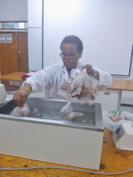
Putting meat samples in the water-bath in prep for tenderness analysis

with disbelief. I found it quite funny…

But, I attended a seminar on “critical animal studies” earlier this year and I later found this video on YouTube, which basically covers the main points the vegans and/or activists raised in the seminar that day. It turns out; this animal activism is a worldwide movement. One of the speakers that day said there should be no hierarchy placing some lives above others; everyone and everything is equal on this planet. This made me think, rather than laugh.

And then I realised:

As a Christian, I don’t think I should even be debating this issue. It is obviously a matter way outside my league. The Bible clearly states in the book of Genesis 1:28 that from the beginning God granted humans dominion over all creatures on earth. I know that even back then, the Israelites followed this idea, and so did early Christians. So there is a certain rank order, which I was even taught in primary school.

My background taught me:

Growing up, I knew that livestock and poultry are food animals. As strongly as I feel about animals, I never had problems with that fact. There was a time I was even eager to learn how to slaughter a chicken, mostly to impress, and I did it. I’m still capable of doing it, I just choose not to.

My animal science journey exposed me:

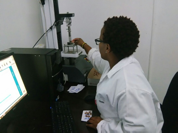
Harvesting the sub-samples for the Instron machine (tenderness determination)

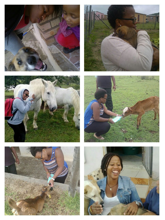
Through my studies and career, it’s only recently that I grew fond of other domesticated animal species apart from dogs and cats. I almost missed out on how cute they are in nature; I just never looked at them that way. But still, that doesn’t change the fact that they are food animals.

My point of view through knowledge and education:

Of course, that does not mean we have a right to abuse and ill-treat these animals. Our responsibility is to ensure their good well-being from birth till the end. We are their shepherds and a shepherd looks after his own. The Bible does not just say humans are the bosses, but that we are stewards of the earth – everything on this earth still belongs to God – we are just managing the planet for Him. So, we may be placed at the top, but we have been given a large responsibility with this rank; it’s not just a case of ruling and doing as we please.

Maybe I am saying all this because I love meat so much (chicken and pork) or maybe it’s because I am a fan of eggs and milk. I don’t know. We were born omnivores after all.

The famous Instron machine, in the process of tenderness analysis... meat or body parts?
The famous Instron machine, in the process of tenderness analysis… meat or body parts?

But does this really mean that I don’t love animals? Does this mean a farmer does not love his flock/herd? Does it mean that, because I am an animal scientist working on animal production, as they put it, a murderer? Is it ok to label the scientists working with animals murders? Aren’t we being hypocrites in all this?

Despite it all, I vow to love all animals (ok, most animals) the best way I know how, till death do us part.

For me, it boils down to some important thoughts:

  • Some of the medication we use, how did its approval come about? Or should we stop taking medication for conditions like Alzheimer’s and other diseases that still require the use of live animals to test different cures?
  • The leaves and vegetation we eat; how do we know it’s not needed by some hungry animal, or that its harvesting didn’t cause hundreds of tiny deaths?
  • What if these plants also have feelings, as some people believe? Are we going to say they are crazy?
  • How do we think a cow feels when she loses her new-born calf in the freezing weather outside while we are locked inside our houses by the fire place?

Think about it…

The truth is:

No one is perfect, and somehow you are missing the point if you try forcing your beliefs onto other people. We all have a way, a system, and morals we were brought up by. The world has plenty of grey areas, and the more we learn about this beautiful planet, the more we realise that there are two sides (or 10!) to every issue. I think we are building a better world if we remember:

“Religion is like a pair of shoes…..Find one that fits for you, but don’t make me wear your shoes.” (George Carlin) (More quotes on tolerance)