Who would I be today without traveling? Well… I cannot imagine it! I’ve always been willing to discover new places, people, and the wilderness. I’ve loved experiencing new challenges and through them, learn more about myself. In the last 10 years, I’ve been lucky enough to join several research projects as field assistant, which has allowed me to visit parts of the world that otherwise I would never have seen. I have worked in Europe, New Zealand, Australia and South Africa…what great experiences!! While traveling, I’ve met awesome people, learned several life lessons, found out what I really like about research and last but not least, I met my girlfriend, who will become my wife in four months’ time!
Field assistants are crucial for the collection of data of a research project, especially for a research like mine, where my focal species only breeds for a very short period of time during which I need to gather as much data as possible. If I don’t grab all the data that I can get, I can’t just re-run an experiment like lab scientists do – in fieldwork, you can never turn back time to the start of a breeding season, and the animals can disappear, never to be seen again. So, I really want to thank all the field assistants that have helped with my project over the last 3 years.
I would like to share with you the experience of Maël, who was my assistant for a few months in the last field season:
Hello! My name is Maël Leroux, I’m a 21-year-old French student in zoology. I came to South Africa last September in order to add some practical experience to my theoretical skills. After few months around South Africa trying to find an internship, I was spotted by Davide, who offered me a position as field assistant for his PhD project. He told me I was supposed to work on Robben Island (Cool!) studying the behaviour of Swift Terns (what tern??? I have never heard about them before!!) Well… I was very curious and intrigued so I accepted immediately! Davide explained to me a bit about the project by email and I knew from the beginning that it would be a fantastic experience. I meet him a few days after I arrived in Cape Town, and not even a week later, I was on a boat, direction …Robben Island…wow!
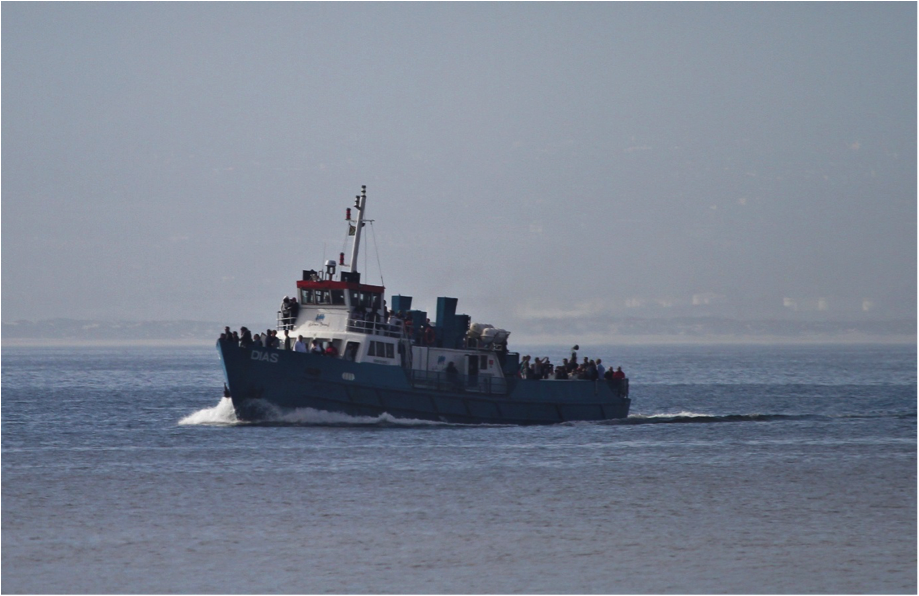
As soon as the boat left the waterfront, I was fully into this adventure, and as a good start I saw a whale for the first time in my life…(wow again!)!
Spot the whale!
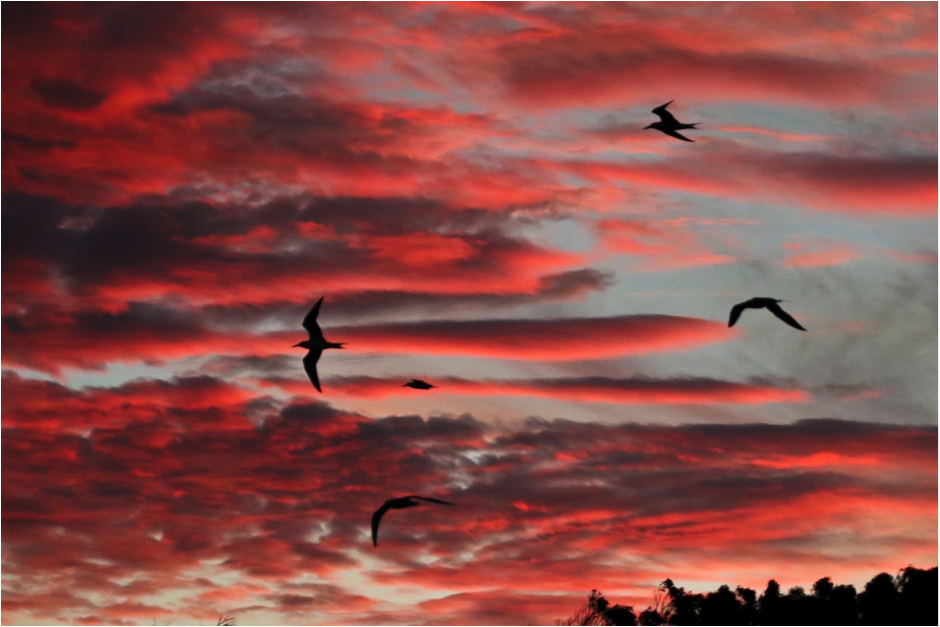
I arrived to Robben Island in the evening, and Davide decided to take me immediately to the colony. There I met those wonderful terns in the light of a stunning sunset. From this very moment, my journey in South Africa became magical!
After I met my study species, I met the team living at research house. I enjoyed my time sharing the house with the “penguin people” … especially for dinner, when everybody would come back from their long day and always have some funny penguin story to tell (in front a nice glass of wine, of course). I have to say, between Italians, Frenchies, Brits and South Africans, the dinners were diverse every day and I loved it! Braai, pasta, frogs (no, I’m kidding!), cakes and pureed, sooooo good! Food for the belly, not just for the soul. Obviously, it wasn’t only beautiful landscapes, nice dinners, or discovering the wild side of Robben Island. I had to work, a lot, and hard. During the first month, I had to analyze the data we collected using video cameras, which was interesting, but long and tough. To bring the video equipment in the field was a long journey every day as the bakkie was not working, so we had to use a wheelbarrow…
A WHEELBARROW!!!…
But luckily after we banded the chicks, I started to work in the field all day long. It was so interesting that I didn’t even realize time was passing! (Ok, perhaps this wasn’t true every day…) Studying their behaviour, observing some unusual interactions, which often Davide had to explain to me, combined to form a very unique working experience. My work in the field was intense and really stimulating, with plenty of surprises. Like the first time I saw a hartlaub’s gull brutally steal a fish from a baby tern! Well, I didn’t know those neighbours could be so nasty ☹.
After this experience I am now thinking to continue my studies and start a PhD myself. Thanks, Davide!”
I respond to Maël in French “de rien!” I really enjoyed my time with him in Robben Island.
In the last few years I have grown as researcher, switching from working as a field assistant myself to having my own project with my own field assistants. It gave me the opportunity to receive help from other people and in return help fuel their skills and passion for research. It’s not only for the data collection or for the PhD project itself. It’s sharing time with interesting people, it’s learning something new every day, it’s sharing dreams and fears, it’s the life of a biologist!
Social writing: Through this blog, I have been receiving very positive comments about my writing. Apparently I write so well, mmmh! I am flattered, really. I remember I used to get similar feedback in high school (Sehole Combine School) from the dialog stories/books I used to write… I wonder where they are now. At the time, the stories got a lot of attention from all the different social groups residing in the boarding premises.
Even my tutor from the S.A. Writers College has been really impressed with my writing on the tasks they’ve been requesting for a blog-writing course. “Your writing is great and fresh and original, I love your stories” she says. I have been enjoying all the praise, I must say ☺. With all this positive reinforcement, I really should have no writing “issues.” However… Scientific writing: I can’t say the same about my scientific writing skills; it’s been a nightmare. Ever wrote something and felt “Yeah! I nailed it,” only to find out that you didn’t? LOL, at least not as great as you thought. Yup! That’s the story of my life. You see, I can strip down someone else’s document and suggest this and that to improve it, but it seems I am failing when it comes to my own.
Maybe if I cleared my desk, things would get better…
I have been trying to write a publishable review paper for almost two years now and my supervisor is not pleased at all. I am not too happy with myself either, and I am not taking it well. How could I take this long with a single paper? ☹ You would think reviewing literature is the easiest thing to do; I mean, you are supposed to just be analysing information that has been generated over the years: everything is there already. Or not, since you are actively trying to identify a sensible gap.
I honestly think it’s the most challenging type of paper to write, and yet has the most potential to boost your research profile once it’s out there. Everybody reads and cites review papers! But rejections and vague, mysterious comments by anonymous reviewers are not helping me with this. Exposing yourself to criticism is part of the job, but it’s so hard to go back to a manuscript after your masterwork has been rejected. It makes me feel like a complete failure and trust me, I know that is a very bad way to respond to the challenge.
Or maybe if I get out of my comfort zone and allow Mother Nature to speak to me while I’m at it…
I am even considering putting it aside and concentrate on writing the experimental papers instead; maybe I will get inspiration afterwards. There are four of them and each of them individually includes an Introduction, Materials and Methods, Results and Discussion, Conclusion and list of references. I even have an unfinished experiment from lab work. Maybe I should do all that so long — get something done in the little time that’s left to me.
However, a wise man once told me that publishing a review as early as possible at PhD level is more like building your thesis on solid ground. I think it was something along those lines. Don’t forget, it can’t be just any old publication, but a world class paper that will be suitable for a high impact factor journal. I mean this is where you prove yourself as a scientist, right? And we all want a bigger RG score (ResearchGate) through citations and contributions.
I don’t think I like my desk this way, makes me feel empty. Maybe I’ll just stick to my mess…
I guess it’s time I pull up my socks, stretch them out if I have to and learn every trick in the book on how to overcome this review threat. That “finding your motivation or inspiration” I spoke about last month must now come to the rescue. “Njisane et al., 2016″ suits me, right? ☺ I know hahaha! If you have any trick for me, please don’t be shy to share (I promise to read them VERY quickly before returning to my scientific writing).
My name is Maël Leroux, I’m a 21-year-old French student in zoology. I came to South Africa last September in order to add some practical experience to my theoretical skills. After few months around South Africa trying to find an internship, I was spotted by Davide, who offered me a position as field assistant for his PhD project. He told me I was supposed to work on Robben Island (Cool!) studying the behaviour of Swift Terns (what tern??? I have never heard about them before!!) Well… I was very curious and intrigued so I accepted immediately!
journey every day as the bakkie was not working, so we had to use a wheelbarrow…




 SAYAS BLOG