Pipetting for dummies

By Keafon Jumbam

PracticingI’m back in the lab once again to hone my skills on faecal hormonal assays. The unsuccessful ending to my first lab visit didn’t deter me from trying again. If anything, the lessons I gathered from that experience made me more determined to succeed in my analyses this time around. Besides, I’m surrounded by several lab experts who are always happy to offer support and guidance; starting with this – relax and develop a pipetting rhythm that works for you.

And on that note, I plunged into the fundamentals of hormonal assays.

Back to basics

The prerequisite for me to obtaining a good assay was to master the steps and types of reagents needed as well as brushing up on my pipetting techniques. So I set aside a couple of days for these tasks but the monotony of the mundane exercise – and in particular, pipetting – started to get to me by day two. I needed to persist through it for two main reasons: To get a ‘feel’ of the different assay liquids and subsequently handle them better and secondly, to develop that all too important pipetting rhythm!

Finally tackling the real deal – hormonal assay

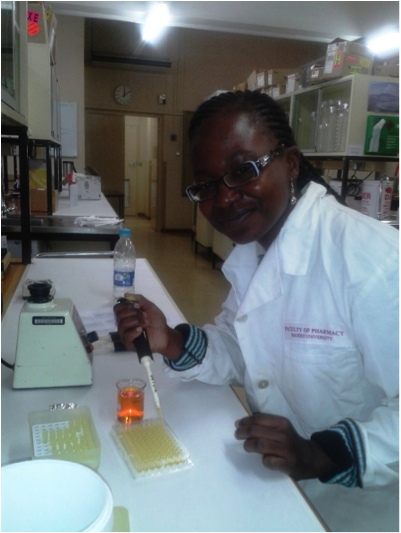
By day three, I had a firm grasp of the basics and was confident in my abilities to pull off a good assay. The assay involves preparing a standard curve from a serial dilution of different volumes of liquids and reagents, which are then pipetted into a “plate” of 96 tiny wells. The wells are closely packed and certainly require your utmost concentration during pipetting. In fact, it is not uncommon to completely ignore visitors when busy with a plate; unless of course it’s an emergency.
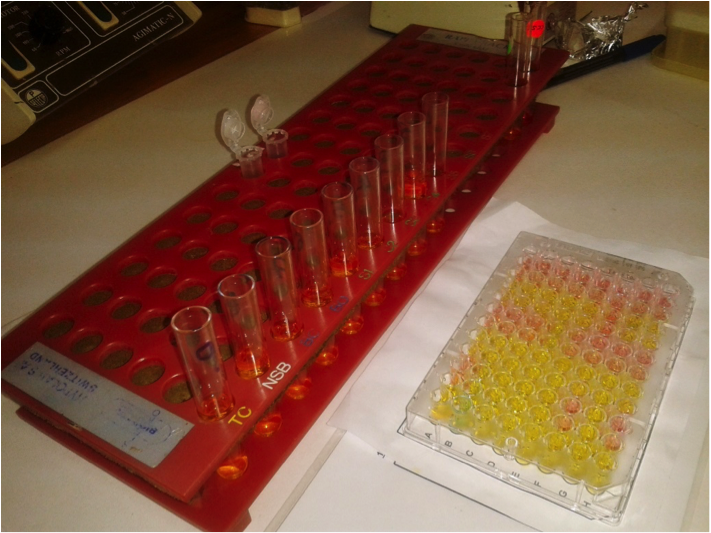
pipettes

Three’s a charm

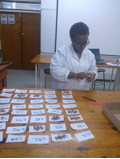
You would think that with all those days of practise I’ve had, surely I would nail the first assay but it turned out to be a disaster – and the second one too – both plates had HUGE outliers spanning the length of the standard curves. Was I already re-establishing my previous pattern of disappointment? Self-doubt was slowly setting in…But I thought to approach this non-academically and perhaps a bit more like a sportswoman. This is a physical feat, and after all, expert runners benefit from having somebody critiquing their technique.

The moment of truth... my hard work about to be interpreted...
The moment of truth… my hard work about to be interpreted…

So I solicited the help of an expert to invigilate my every step and it paid off – she quickly identified the mistake – yes, it was my pipetting technique! Another bout of training later and I was geared up for a third assay plate. I could hardly contain my excitement when it came out a success! The standard curve was on point as were the rest of my results. Practise does make perfect. I know it’s too soon to claim total victory but as I head back to the field to collect more faecal samples, I’m more confident in my abilities to analyse them in the nearest future. Watch this space…

A thing of beauty -- not a single outlier on my standard curve!
A thing of beauty — not a single outlier on my standard curve!

Animal rights and liberation: A Christian and Animal lover/ Scientist’s opinion

By Yonela Z. Njisane

As my academic mentor always says, it’s important that we tolerate each other, otherwise the wars and destructions in the world will never end. It’s good that you know who you are as a person and stick to it; it’s also good to realise that we are all different and our beliefs and morals differ.

While I was busy with various meat sample analyses in the lab the other day, I recalled a shocking comment I once heard about us (meat scientists and those who eat meat). Apparently, we tend to cover up our cruel actions by saying we are eating “meat” instead of calling it what it actually is, “Body parts”… My first reaction to this statement was laughter

Putting meat samples in the water-bath in prep for tenderness analysis

with disbelief. I found it quite funny…

But, I attended a seminar on “critical animal studies” earlier this year and I later found this video on YouTube, which basically covers the main points the vegans and/or activists raised in the seminar that day. It turns out; this animal activism is a worldwide movement. One of the speakers that day said there should be no hierarchy placing some lives above others; everyone and everything is equal on this planet. This made me think, rather than laugh.

And then I realised:

As a Christian, I don’t think I should even be debating this issue. It is obviously a matter way outside my league. The Bible clearly states in the book of Genesis 1:28 that from the beginning God granted humans dominion over all creatures on earth. I know that even back then, the Israelites followed this idea, and so did early Christians. So there is a certain rank order, which I was even taught in primary school.

My background taught me:

Growing up, I knew that livestock and poultry are food animals. As strongly as I feel about animals, I never had problems with that fact. There was a time I was even eager to learn how to slaughter a chicken, mostly to impress, and I did it. I’m still capable of doing it, I just choose not to.

My animal science journey exposed me:

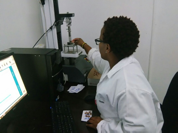
Harvesting the sub-samples for the Instron machine (tenderness determination)

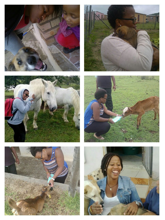
Through my studies and career, it’s only recently that I grew fond of other domesticated animal species apart from dogs and cats. I almost missed out on how cute they are in nature; I just never looked at them that way. But still, that doesn’t change the fact that they are food animals.

My point of view through knowledge and education:

Of course, that does not mean we have a right to abuse and ill-treat these animals. Our responsibility is to ensure their good well-being from birth till the end. We are their shepherds and a shepherd looks after his own. The Bible does not just say humans are the bosses, but that we are stewards of the earth – everything on this earth still belongs to God – we are just managing the planet for Him. So, we may be placed at the top, but we have been given a large responsibility with this rank; it’s not just a case of ruling and doing as we please.

Maybe I am saying all this because I love meat so much (chicken and pork) or maybe it’s because I am a fan of eggs and milk. I don’t know. We were born omnivores after all.

The famous Instron machine, in the process of tenderness analysis... meat or body parts?
The famous Instron machine, in the process of tenderness analysis… meat or body parts?

But does this really mean that I don’t love animals? Does this mean a farmer does not love his flock/herd? Does it mean that, because I am an animal scientist working on animal production, as they put it, a murderer? Is it ok to label the scientists working with animals murders? Aren’t we being hypocrites in all this?

Despite it all, I vow to love all animals (ok, most animals) the best way I know how, till death do us part.

For me, it boils down to some important thoughts:

  • Some of the medication we use, how did its approval come about? Or should we stop taking medication for conditions like Alzheimer’s and other diseases that still require the use of live animals to test different cures?
  • The leaves and vegetation we eat; how do we know it’s not needed by some hungry animal, or that its harvesting didn’t cause hundreds of tiny deaths?
  • What if these plants also have feelings, as some people believe? Are we going to say they are crazy?
  • How do we think a cow feels when she loses her new-born calf in the freezing weather outside while we are locked inside our houses by the fire place?

Think about it…

The truth is:

No one is perfect, and somehow you are missing the point if you try forcing your beliefs onto other people. We all have a way, a system, and morals we were brought up by. The world has plenty of grey areas, and the more we learn about this beautiful planet, the more we realise that there are two sides (or 10!) to every issue. I think we are building a better world if we remember:

“Religion is like a pair of shoes…..Find one that fits for you, but don’t make me wear your shoes.” (George Carlin) (More quotes on tolerance)