Scientists should unlock the Mandela in them

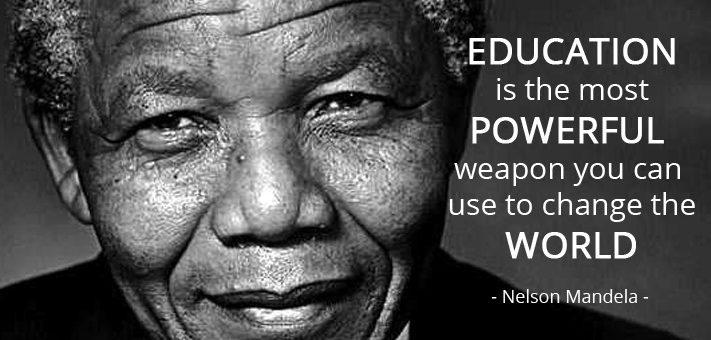
“Education is the most powerful weapon which you can use to change the world.”

Many people are familiar with this quote from Nelson Mandela and understand the power education has, whether you embrace it or fear it. Today, in the post-truth era we live in—where experts are dismissed, where there is a lack of interest in evidence and facts, where alternative facts and the opinions of popular public figures seem to matter more—education is more important than ever!mandela-education
I was fortunate enough to go and listen to former US President Barack Obama deliver the sixteenth annual Mandela lecture at the Wanderers stadium in Johannesburg. He reminded the thousands of people sitting in the stadium (and those tuned in all over the world) of the crossroads we, as global citizens, face—something very similar to what South Africans faced pre-1994.

Obama_Nelson Mandela LectureThe solutions to South Africa’s and the world’s problems, according to Obama, lie with the youth; an undivided youth who love more, who lead and build communities that fight for what Mandela, and others, were and are trying to build. I was inspired by Obama’s messages of hope and the vision he has for achieving an undivided, educated and loving global community. I want, more than anything, to be a part of that community.

A recent piece was published on the Global Citizens website, looking at seven ways Madiba’s legacy still resonates in the world today. I want to highlight four of the seven: his participation in the fight against HIV/AIDS; his dream to bring education to rural students; his fight for children and youth; and his promotion of scientific and environmental education.

Madiba dedicated his life to making a difference in these areas, and while he did more than most, there is still a lot more to do, which we could achieve, largely, through education. Education really is the most powerful weapon in our arsenal and should be used more often to continue Mandela’s fight against HIV/AIDS, to continue to empower young people in the developing world, to develop science and technology to help tackle global issues and more.

Although Obama only mentioned “science” once and “technology” four times during his nearly one and a half hour speech, I know he values both for the advancement of humanity. As a global citizen and a scientist, I thought I’d build on and add to what Obama said with quotes from the lecture.

Obama alluded to the failings of our world leaders and the dangers this has for turning the world backwards. We, as global citizens, need to stop “the promotion of anti-intellectualism and the rejection of science from leaders who find critical thinking and data somehow politically inconvenient” because, “as with the denial of rights, the denial of facts runs counter to democracy, it could be its undoing.” To stop the people and processes eroding democracy, which Mandela fought for, “we have to insist that our schools teach critical thinking to our young people, not just blind obedience.” Our problems aren’t going to be solved by the leaders of this world, who have different agendas, but by the people who think and do for themselves to reach a global agenda—a world for all.

Science-March

We, as scientists, are armed with the most powerful weapon in the world and we need to do a better job of arming everyone else. When we are educated, it makes it difficult to manipulate us, it makes it difficult to lie to us, it makes it impossible to argue that race, gender, sexual orientation, choice of faith, class, makes us less human than the man, woman or child next to us. When we are educated, we understand our problems better and that there are no quick fixes. When we are educated, we put faith in the facts and not those who would try to deny them. It is time to take responsibility of this world and the state we leave it in. We cannot continue to blame the leaders we put in power for taking us down the wrong road when we have the means to push the world in the right direction.

It begins with us.

Supervisors are like coffee…. See why!

By Roula Inglesi-Lotz

As a student, I thought the most important element towards completion of a PhD is… Who else? The student. Only after wearing the famous red cape at my PhD graduation, did I started realising how much a supervisor is a “make it or break it” factor. No, it is not because nowadays I play for the other side! It’s mostly due to discussions with other doctorate holders or PhD students. I found out that my progress and excitement for my PhD was highly due to my supervisor (thank you Prof James Blignaut!); others also identified mentorship as the reason for completing their PhD fast, or slow, or enjoying the process (from a 2017 postgraduate experience survey).

From the other side of the field now, we heard as academics many times the statement, “We are the lecturers or supervisors we had.” I find more inspiring, “We strive to be the lecturers or supervisors we always wanted.” For a few years now, hence, I have been wondering what type of a supervisor I am and what my style is. I compared myself with my supervisors, my experienced colleagues, and I analysed my personality to understand better. Within this introspection and analysis, I concluded that supervisors are like coffee… Let me explain myself.

They come in different varieties.

If you thought, that all supervisors are the same, you will be in for a surprise. Supervisors are human beings (surprise?!?!?!) and they come with their own experiences background and beliefs. The Ethiopian coffee blend is not the same as the Kenyan, for example. One is not superior to the other; they are all different. Do you remember the last time in your life that you became obsessed with drinking that special macchiato from a specific shop EVERY SINGLE DAY for months because you loved it and you swore that is the best for you, and then you did not want to even see it? That is sometimes the case with supervisory (and lecturing) styles too – you might swear that this one is the ultimate for you until you try another one.

They can be stronger, weaker or even decaf.

Continuing within the concept of diversity, the strength of the coffee or the choice of decaf can also be linked to supervisors. Some are definitely stronger and more disciplined. They expect the students to work autonomously and take criticism and upsets in the research process with equal strength. The “espressos” plan in advance, work on schedules and are not flexible. They can work well with students that are equally structured, but might restrict a free spirit. The “decafs” on the other side tend to be more relaxed, give more freedom both in context and in time, and do not check on progress regularly.

Same coffee, different preferences (milk or sugar)

Most academics have established through the years their own supervisor personas (variety of coffee and strength of the blend). BUT, what helps tremendously is the adaptability of the coffee to the consumer’s personal preferences: sugar or not, and how much, brown or white sugar, or milk, maybe cremora? In essence, the supervisor has some core characteristics, but they do adjust (somewhat) to the needs and particular conditions of the student. When the student is an introvert and likes to work independently, the supervisor will not assist much if he/ she checks the progress frequently; on the other side, a student might need a constant support both academically and personally (add some sugar and milk extra, please).

 They get bitter if you do not stir.

Self-explanatory characteristic of the metaphor, right? Disappearing for months and then trying to pick up where you left it might create uneasiness with your supervisor (same from the other side, of course). Frequent communication and collaboration is essential in the relationship supervisor- student. “Like a marriage”, says Darce Gillie, from the University of Sheffield, a supervisor-PhD student relationship needs “honest communication, trust, understanding, shared goals, and the ability to compromise”.

If you don’t have one, you get headaches.

From the coffee-side, the doctors might diagnose caffeine addiction, while from doctoral studies perspective; there is absolutely no way to complete a PhD without a supervisor, or with an absent one. If the student knew everything in advance or had confidence that can surpass all the uphills of research, then why do a PhD? Ready-made academic! Some will argue here that their supervisor was mostly absent from the process and hence, no particular contribution should be attributed to them. I have one thing to tell them: the days I do not drink coffee, I drink tea or water, meaning some way or another, we all had a mentor whose experience, advice, and knowledge contributed to our PhD research.

Choosing coffee is of course much easier than choosing a supervisor.

Firstly, it is the start of a long-term relationship and secondly, you do not know someone until you get to work with them. If you need to choose your supervisor, the first step is to have an idea of the research topic that interests you, even broadly. Next, look for the experts in this field that are willing to supervise PhD students. If the topic interests the supervisor as well, mission accomplished. Supervisors tend to work more with students when they are also interested to answer these questions AND the extra bonus, the students learn more from informal discussions.  If you find one or two that have what you want, go see them all. You will get a better feeling of them as people, and personal chemistry plays a role. (Find your supervisor Table)

Finally, just remind yourself, a PhD journey is difficult. It has ups and downs, that is a given. As a PhD student, make sure you choose the right coffee to give you energy, excitement, inspiration, and keep you awake and focus. However, the coffee is not really, what makes you accomplish anything that day – it’s your own drive and persistence.

Dear fellow supervisors, my suggestion is not to be stiff “coffees” that leave their drinkers with the jitters. Try to be warm and boosting ones.

Let’s serve coffee with a little – or even better, over cake – to make the journey enjoyable.

coffee
source: giphy.com