Confronting the Imposter in the Mirror

This season of my life has been particularly challenging; not only was getting my manuscript out of the way difficult, but also establishing myself as a researcher has been frightening.   Part of my problem is feeling like a fake and as if I don’t really belong.

As I mentioned in SAYAS profile, I took time to be a homemaker for a few years before deciding to embark on my doctorate and I felt that I was re-entering the field on the back foot. To be honest, the processing of getting a supervisor who believed in my project was gruelling, as most people I approached were put off by the fact that there was such a large gap in my resumé. The look on the faces of several illustrious professors when they found out that I was actually a stay-at-home parent was indescribably disheartening. Many a time I was ready to give up. My lowest moment came when I was outright rejected by my intended supervisor without him even asking about my proposed project or even reading a single thing I wrote. I eventually found someone who was willing to take me on but that was just the first part of the several hurdles I would have to face — the largest being my own insecurity.

Gill Corkindale describes the imposter syndrome as being “as a collection of feelings of inadequacy that persist despite evident success”. I think her definition is pretty accurate but doesn’t capture something that is making academia a particularly unfriendly environment – the academy as a whole does not easily accommodate outsiders. And women are still the primary outsiders. I say this because I realised over the years that as a woman, you are constantly trying to prove your intelligence in male-dominated fields, and in a millisecond, the value of your contribution can be diminished by a senior male colleague making careless statements such as “the doors would fly open because there are few women in the field” or “we need a female to meet our gender requirement”. Such remarks lessen the value of your contribution and creates the impression that the only reason that you are there is because you happen to be a woman and not because you are capable. Moreover, if you are not careful, such insidious remarks bury themselves deep in your psyche and you begin to doubt your ability.

I believe the academy at times frowns on outliers. Even though universities are the supposed homes to critical thinkers, I have personally seen higher education institutions repeatedly shoving people into epistemic and behavioural boxes. It is only when you have a truly progressive dean or head of department, that you are able to explore your research and self-presentation from non-traditional angles. Without such overt support, your self-esteem will be further eroded: at the best of times it’s difficult to think in a new way, and critical thinking needs nurturing.

I recently had to present my paper to a room full of academics and policy practitioners and I spent days hoping that I would fall sick so that someone else read my paper. Luckily, I came across TED talk on YouTube by Professor Amy Cuddy titled “Your Body Language Shapes Who You Are”. She basically argued that how you carry yourself affects not only how you feel about yourself but also your ultimate performance. In the remaining 48 hours before the talk I decided to put some of her suggestions into practice, I worked on some of the power poses that she suggests and I must admit that I felt very authoritative (but still a tad nervous) when the day came. I was confident on the podium, and for the first time in a long while I felt as if I belonged. And I started to see a change in myself.

I know it will be a while before my new-found confidence will become truly part of me. But right now I’m walking the walk, and it’s really boosting my self-esteem. Call me an optimist but I do believe that there will be a future in academia where women  will not have to pretend confidence in the face of constant micro-aggression and bias. Change starts with refusing to suffer in silence.

The role of research in eradicating food insecurity

The beauty of being an Animal Science researcher is having to attend the South African Society of Animal Science (SASAS) Congress, which was hosted by the Stellenbosch branch of the Society from 1-6 July 2016. During the congress, I was lucky enough to be part of the exceptional group that was in charge of blogging about the SASAS Congress. If you want to visit the blogs, you can go to http://sasas.co.za/sasas-gala-dinner-2016 and http://sasas.co.za/49th-sasas-congress-kick. Working with Dr Yonela Njisane, Sipokazi Nyeleka and Mzuvukile Mcayiya was a fun and humbling experience.

SASAS Bloggers
The SASAS Congress Bloggers 2016 – Dr Yonela Njisane, Mzuvukile Mcayiya, Sipokazi Nyeleka and I


I only attended as a “visiting professor” – I never had time to submit an abstract. Oh, but the joys of attending a conference where you aren’t actually presenting is that you get to enjoy all the presentations without having chest pains every time you think about yours!


A typical congress provides a platform where respective researchers can show off their research and findings. Having industry (farmers, feed, premix and additive manufacturers etc) and scientists in the same venue is always great because it is bound to raise much-appreciated questions and debates. These questions and debates in particular helped me to think about the context of research in the world that we live in. Mostly looking at the socio-economic ills facing our beloved Rainbow Nation.  The gist of the debate was the role that research could potentially play in solving the problems faced by the Agricultural Industry. When trying to contextualize the role of scientific research in our community, a few questions need to be posed by yours truly.

Dr Nkukwana (Supervisor), Sipokazi Nyeleka and I (the "visiting professor")
Dr Nkukwana (Supervisor), Sipokazi Nyeleka and I (the “visiting professor”)

What is research?

What purpose does it serve? Is it about simply about finding a plant, feeding it to an animal and testing a few parameters, or is it about identifying problems faced by the South African agricultural industry and helping solve those problems through novel solutions?

For a number of years, I have always believed research to be a tool that can be used by scientists to find solutions to the world’s problems. Currently, South Africa is facing the harshest drought in decades. This is undoubtedly related to global warming and climate change that scientists have been talking about for a number of years. Furthermore, the world population is growing exponentially, which means that food production needs to keep up with that growth. It’s however a sad reality that the conventional means of food production that have been used for the past millennia are becoming less and less effective due to climate change. This is where I think research can play a critical role in developing farming strategies that can help mitigate the adverse effects brought upon by global warming and climate change.

I believe that researchers should conduct research that will ultimately help improve the socio-economic status of the country. How do we do this? How do we make sure that scientists are conducting vital and relevant research that will benefit the South African citizens?

Collaboration is the answer for me. There needs to be a partnership between bodies such as SASAS, Industry and Government to ensure that applied and interdisciplinary research is being conducted. Currently we have a system where Industry conducts its own research with a respective institution of learning and when there is a breakthrough, the company will claim Intellectual Property Rights (IPR) to the results and they will only publish the findings after 3 years or so. This is fair enough because the companies invest a lot of money in that research. The only problem is that this type of partnership tends to benefit only corporations and not every Jacob, Julius and Helen in South Africa.

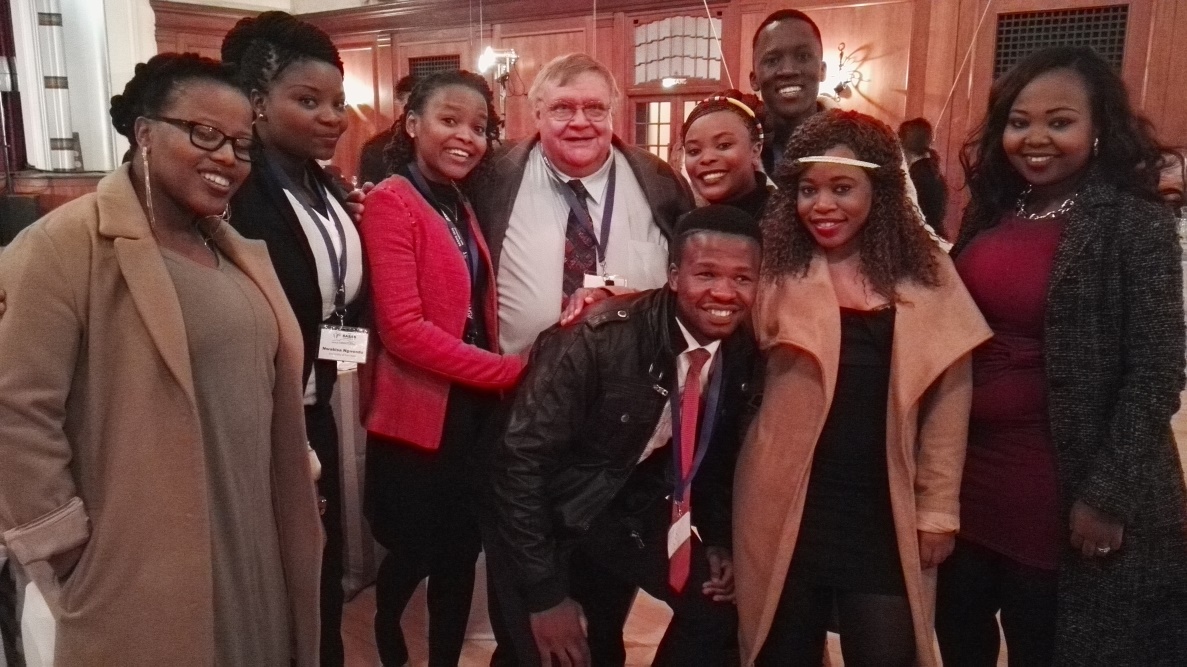
Photoshoot with Professor Michael Scholtz - President of the South African Society for Animal Science
Photoshoot with Professor Michael Scholtz – President of the South African Society for Animal Science

Perhaps there should be a council or commission where Industry, Scientists and the Government are equally represented. This council would be tasked to identify problems in South Africa (which shouldn’t be hard) and assigning those problems to Research Institutes and providing funding. An example from Europe would be, “Improving knowledge transfer between research institutions and industry across Europe”. This document not only deals with the issues of IPR but it also ensures that the associations — businesses and farmers — who are in charge of producing local food will also benefit. All South African citizens will end up benefiting because our country will be not only be food secure but that food will also be affordable to everyone who lives in it. Perhaps a step further would be for the Government to utilize its Extension Officers to ensure that scientific breakthroughs get relayed to all the farmers. This would not only ensure that farmers do not suffer from problems that the country has already solved but it will also ensure that the money spent on research funding doesn’t end up in library shelves collecting dust.