Nothing like your first time!

Most things that you do for the first time are scary. The fear comes from not knowing if you’re doing the right thing; whether you will to meet your own expectations — and everybody else’s! It becomes even scarier if you believe first expectations will last.

Every researcher reaches a point where they have to share their findings for the first time, share with the world what they found and what their conclusions were. For postgraduate students that may come in the form of a dissertation or thesis. But if your research is ready for the real test, you submit to a peer reviewed journal, where the rest of the world can see what you’ve done and judge it.

For me that’s where the real fear starts, having to submit your hard work to an editor and reviewers to scrutinize and tear it all apart. I’ve heard that eyes are windows to the soul, but I believe that writing is the window to the soul. When you have passion for your work, you can’t help but pour your heart and soul into writing — so the thought of someone just crushing that work is no different from someone pulling out your heart and soul.

And even for that horrifying experience, there is a first time…

You have to put yourself out there and have faith in your work, believing that no editor will have your soul for lunch (chuckles).

So… since my previous blog post, what have I achieved? Well, I have managed to complete and submit my MSc dissertation. That’s pretty cool, right? This is one milestone that I am happy and proud to have achieved.

My next mountain to climb is writing a manuscript and submitting it to a peer-reviewed journal.

I’ve never written a manuscript before from scratch, although I have co-authored some. So I do consider this manuscript as my first. To tell you the truth, I have mixed emotions about it, I’m excited that finally I’ll get to share my work but at the same time, I’m scared that it might get rejected. But if you never try then you’ll never know.

So where do I start? Summarizing your 100 page MSc Dissertation into an eight page manuscript is not a simple task! One thing Prof Muchenje normally says is, “Choose a few articles that are similar to your work and use them as your guide”. I’ve found this to be helpful because although you want your work to be novel, it still needs to conform to the laws of scientific writing. So, I went with this approach, and first identified the journal to which I want to submit. This has helped me with the formatting and style.

In the effort to compress my dissertation, the literature review was the first to go, followed by a big chunk of the introduction. The next step was to merge both chapter 3 and 4 — this wasn’t as easy as I’d imagined. Chapter 3 looked at the effect of Moringa oleifera whole seed meal on layer performance and egg quality. Chapter 4 looked at the effect of Moringa oleifera whole seed on fatty acid profile, shelf life and health indices of eggs.

The initial plan was to split these two chapters into different manuscripts but it seems better to merge the two and create one strong manuscript as opposed to having two manuscripts that don’t have much substance. The problem however, is trying to create a single and concise and robust introduction for these two different chapters without leaving out the background and rational of running this study. This is where the template article comes into play. A number of articles have managed to merge these two ideas, so I should have this little conundrum solved in no time.

For me, the template article not only helped me with the shrinking of the document but also the table and figure formatting. Sometimes you hear a supervisor asking, “Where is the science?” Seeing how others visualize results also helps me to show the science better.

So far I have made progress with the manuscript and hopefully I can gather enough courage to send it to my supervisor. Let’s hope the cuts don’t bleed too much.
You will never influence the world trying to be like it

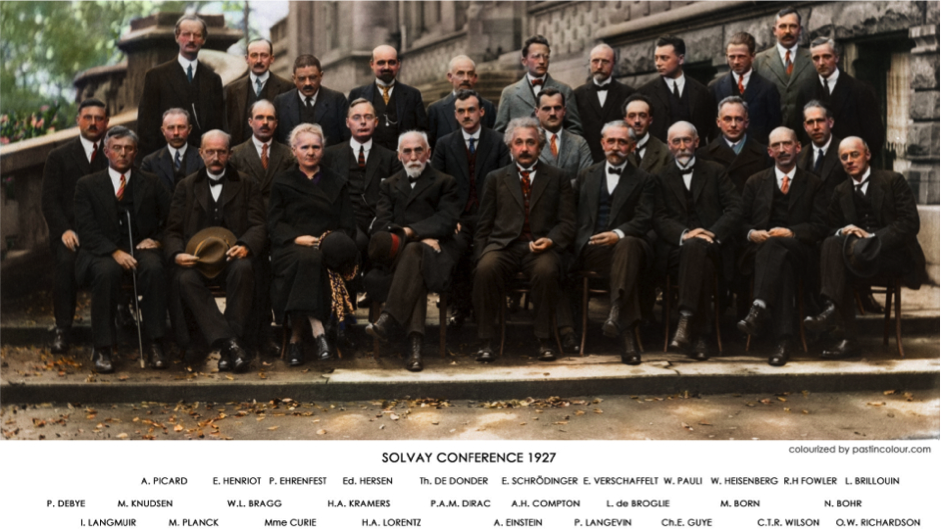
In October 1927, the Solvay conference (a prestigious invite-only Physics meeting) was in session. In one room were Marie Curie, Albert Einstein, Niels Bohr, Max Planck and even Erwin Schrödinger. 17 of the 29 attendees would go on to win Nobel prizes, with Marie Curie achieving that honour in two fields. Pictured below is the historic photo (recently colourised by Sanna Dullaway) to serve as proof that those coffee breaks must have been the greatest in history.

Solvay conference


These individuals would decide the course of quantum physics at this meeting, what was to come and what the field is now was down to them.

Why do we oooh and ahhh at the guest list of the Solvay conference? People have an obsession with genius. And as scientists, perhaps we have a wish to emulate them. One of the ways to do this is to look at those individuals that have managed to completely distinguish themselves from all other scientists by winning the Nobel Prize.

So what are the trends? Well for a start, it is best not to be a woman. Of the 900 Nobel laureates, only 49 are of the fairer sex. Furthermore, it’s best to be an American, as a whopping 257 individuals have been born there (29%, as compared to 1% of the winners being South African). It is also best if you have a birthday on 21 May or 28 February and happen to be 61 years old at the time of the award. Oh, and be a Harvard affiliate (26 were). The Curie family had 6 Nobel Prizes in the extended family (Marie received 2, Pierre her husband, shared one with her in 1903; their daughter Irène Joliot-Curie and her husband Frederic shared one in 1935 and in 1965 Marie’s second daughter’s husband received the Nobel Peace Prize. There have been 5 married couples, 1 sibling and 8 parent-child pairs of laureates – so perhaps working with family is the best thing to do. Basically, your best chance of winning a Nobel Prize, statistically, is to be a 61 year old male physicist who works for Harvard or Caltech (who have so many Nobel laureates they have their own parking space) and is related to a Curie.

What one must consider is that out of the estimated 108 billion people that have ever lived, only 900 have won this prize. Clearly this is not the best indication of genius. There must have been a good number of other inventors and problem solvers that have lived throughout our time, and not all of them were 61 year old Harvard alumni. It is interesting that humans always look at the exceptional, when really everything we currently understand about human intelligence is based on the average. We tend to think genius is based on how much you’re above the average IQ. Albert Einstein and Stephen Hawking had MENSA IQs of 160. But Richard Feynman, widely regarded as a genius, only had an IQ of 120. In addition, last year, a 12 year old girl got an IQ score of 162. Does this mean she will develop the next theory of relativity? Unlikely. Child protégés do not typically remain that way as IQs change over time. In a great article “What your IQ score doesn’t tell you”, the writer goes on to describe that the test doesn’t tell one about the ability to perform tasks or make things work – a pretty big part of life really. IQ is not the same as “common sense” and is certainly not the same as intelligence.

“Intelligence” as defined by Dr Robert Sternberg is made up of 3 facets: analytical skills, practical ability and creativity. You need some common sense to make that IQ work. But perhaps what truly distinguishes genius is not just a Nobel prize, crazy hair and marrying your cousin (something Einstein did) but how creative you can be with the world around you. Einstein and Max Planck were accomplished musicians (violin and piano respectively), Richard Feynman was an acclaimed artist and Marie Curie, well she liked to cycle. Creative people are generally polymaths, they have a wide variety of knowledge and skills and potentially we should focus more energies on other creative pursuits than just work. And while you certainly can’t learn to be a Caucasian bearded man, one can encourage creative behaviours. While some imagine that the coffee breaks during the Savoy conference were packed with Physics, its highly probable that Albert whipped out his violin and Max joined in on piano, while Erwin Schrodinger made a few bits of furniture for his latest dollhouse, Marie went for a brisk cycle and Niels Bohr played a bit of footie.

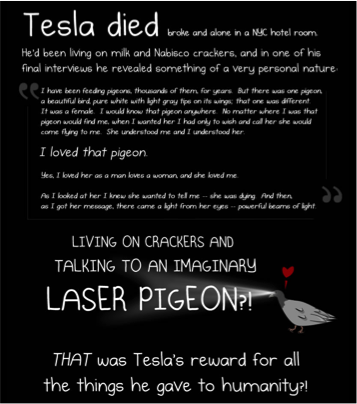
You will never influence the world trying to boost your exceptional IQ, or fitting into the “workaholic” mould. Be different; feed your creative side. Heck, keep pigeons if you have to; it worked for Tesla (well sort of)!Tesla Oatmeal

An excerpt from “The Oatmeal’s” cartoon“Why  Nikola Tesla was the greatest geek that ever lived”, a truly great read!