Celebrate the stories in science, no matter how small or great

Imagine you are back in the mid-1700s. You are walking the usual five kilometre route it takes you to get to school but instead of following the other children, you cut through a field. Running, because you got distracted by some playful tadpoles in a nearby creek and now you’re late, you trip over a rock and fall. While getting up and dusting yourself off you notice that the rock you tripped on wasn’t a rock but rather the badly weathered top of a skull. Quickly, forgetting about the scrapes on your hands and elbows, you dig around the skull. You notice that this isn’t any normal buck or cow skull, this skull is much too big. Seven year old you, along with many others, wouldn’t know that this skull belonged to the extinct mammoth, not until the mammoth was formally described in 1799, anyway.

It is 1928, a regular day. You have just come back from a holiday with the family and you return to your lab to find some old bacterial cultures you prepared before you left lying in the corner. On them, a bacteria you’ve looked at a thousand times, Staphylococcus aureus—the causal organism of staph infections, should be growing. Instead, you notice that some of the agar plates have less of the bacteria. “That’s funny,” you say. On these plates, there is something else growing, a mould.  You isolate this mould and soon identify it as Penicillium notatum. Studying its interactions with Staphylococcus and other bacterial pathogens, you quickly realize that the fungus produces some kind of “mould juice” that inhibits the bacterial pathogen’s growth. This “juice” has some sort of antimicrobial property. A few months later, you rename it to what we know it as today, “penicillin.” Twenty years later, just in time for the Second World War, colleagues of yours develop a better method of extracting penicillin from the fungus, a different fungus, and penicillin becomes a commercially used product—beginning the age of antibiotics.

Alexander Flemming
Alexander Fleming

Now, imagine you’re a scientist in 2018; the naming of the mammoth by Johann Friedrich Blumenbach and the discovery of penicillin by Alexander Fleming are long in the past; as are so many other past landmark discoveries, like learning the structure of DNA, electricity and the ancestors of humans. As we have advanced our understanding of nature and the universe, these kinds of world-changing discoveries are stumbled on less and less. Of course discoveries are still being made every day but most of them go unnoticed, as do yours.

Generally, scientists seek to make some sort of difference in the world, whether it’s by providing some understanding through knowledge, developing something or discovering something else. It is easy to lose sight of that when you compare your discoveries to your role models and other well-known scientists who came before.

Why do scientists become well-known; why are people well-known?

Because there is a story about them doing something great or something incredibly wrong.

All science should be widely celebrated; scientists are making the unknown known, the difficult easy, the impossible possible—not matter how “small” the finding, it moves humanity forward. It does not matter if you think the stories about your discoveries or the discovery itself are ordinary, tell it; but tell it well and tell it to everyone. Science and unity is all that can save this world and, for the moment, science appears to be our best shot. Let’s unite in the celebration of science and continue our stories forward, proudly, and, should the opportunity present itself as a skull in the ground or contaminated plate, be prepared to trip or stumble onto greatness.

Pint of science, tell your story where you can.jpg
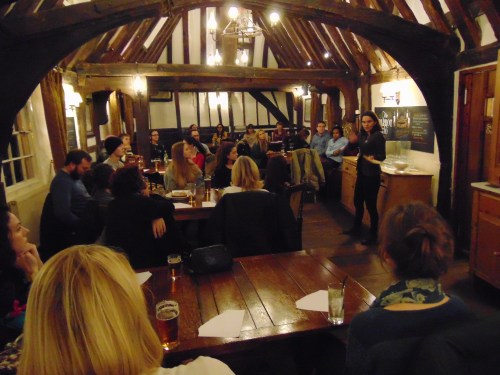
Pint of science, tell your story where you can
Pint of science, tell your story where you can.

Supervisors are like coffee…. See why!

By Roula Inglesi-Lotz

As a student, I thought the most important element towards completion of a PhD is… Who else? The student. Only after wearing the famous red cape at my PhD graduation, did I started realising how much a supervisor is a “make it or break it” factor. No, it is not because nowadays I play for the other side! It’s mostly due to discussions with other doctorate holders or PhD students. I found out that my progress and excitement for my PhD was highly due to my supervisor (thank you Prof James Blignaut!); others also identified mentorship as the reason for completing their PhD fast, or slow, or enjoying the process (from a 2017 postgraduate experience survey).

From the other side of the field now, we heard as academics many times the statement, “We are the lecturers or supervisors we had.” I find more inspiring, “We strive to be the lecturers or supervisors we always wanted.” For a few years now, hence, I have been wondering what type of a supervisor I am and what my style is. I compared myself with my supervisors, my experienced colleagues, and I analysed my personality to understand better. Within this introspection and analysis, I concluded that supervisors are like coffee… Let me explain myself.

They come in different varieties.

If you thought, that all supervisors are the same, you will be in for a surprise. Supervisors are human beings (surprise?!?!?!) and they come with their own experiences background and beliefs. The Ethiopian coffee blend is not the same as the Kenyan, for example. One is not superior to the other; they are all different. Do you remember the last time in your life that you became obsessed with drinking that special macchiato from a specific shop EVERY SINGLE DAY for months because you loved it and you swore that is the best for you, and then you did not want to even see it? That is sometimes the case with supervisory (and lecturing) styles too – you might swear that this one is the ultimate for you until you try another one.

They can be stronger, weaker or even decaf.

Continuing within the concept of diversity, the strength of the coffee or the choice of decaf can also be linked to supervisors. Some are definitely stronger and more disciplined. They expect the students to work autonomously and take criticism and upsets in the research process with equal strength. The “espressos” plan in advance, work on schedules and are not flexible. They can work well with students that are equally structured, but might restrict a free spirit. The “decafs” on the other side tend to be more relaxed, give more freedom both in context and in time, and do not check on progress regularly.

Same coffee, different preferences (milk or sugar)

Most academics have established through the years their own supervisor personas (variety of coffee and strength of the blend). BUT, what helps tremendously is the adaptability of the coffee to the consumer’s personal preferences: sugar or not, and how much, brown or white sugar, or milk, maybe cremora? In essence, the supervisor has some core characteristics, but they do adjust (somewhat) to the needs and particular conditions of the student. When the student is an introvert and likes to work independently, the supervisor will not assist much if he/ she checks the progress frequently; on the other side, a student might need a constant support both academically and personally (add some sugar and milk extra, please).

 They get bitter if you do not stir.

Self-explanatory characteristic of the metaphor, right? Disappearing for months and then trying to pick up where you left it might create uneasiness with your supervisor (same from the other side, of course). Frequent communication and collaboration is essential in the relationship supervisor- student. “Like a marriage”, says Darce Gillie, from the University of Sheffield, a supervisor-PhD student relationship needs “honest communication, trust, understanding, shared goals, and the ability to compromise”.

If you don’t have one, you get headaches.

From the coffee-side, the doctors might diagnose caffeine addiction, while from doctoral studies perspective; there is absolutely no way to complete a PhD without a supervisor, or with an absent one. If the student knew everything in advance or had confidence that can surpass all the uphills of research, then why do a PhD? Ready-made academic! Some will argue here that their supervisor was mostly absent from the process and hence, no particular contribution should be attributed to them. I have one thing to tell them: the days I do not drink coffee, I drink tea or water, meaning some way or another, we all had a mentor whose experience, advice, and knowledge contributed to our PhD research.

Choosing coffee is of course much easier than choosing a supervisor.

Firstly, it is the start of a long-term relationship and secondly, you do not know someone until you get to work with them. If you need to choose your supervisor, the first step is to have an idea of the research topic that interests you, even broadly. Next, look for the experts in this field that are willing to supervise PhD students. If the topic interests the supervisor as well, mission accomplished. Supervisors tend to work more with students when they are also interested to answer these questions AND the extra bonus, the students learn more from informal discussions.  If you find one or two that have what you want, go see them all. You will get a better feeling of them as people, and personal chemistry plays a role. (Find your supervisor Table)

Finally, just remind yourself, a PhD journey is difficult. It has ups and downs, that is a given. As a PhD student, make sure you choose the right coffee to give you energy, excitement, inspiration, and keep you awake and focus. However, the coffee is not really, what makes you accomplish anything that day – it’s your own drive and persistence.

Dear fellow supervisors, my suggestion is not to be stiff “coffees” that leave their drinkers with the jitters. Try to be warm and boosting ones.

Let’s serve coffee with a little – or even better, over cake – to make the journey enjoyable.

coffee
source: giphy.com