Becoming unstuck: how to keep on writing

I am approaching the halfway checkpoint of my doctoral training and research. As I previously mentioned (here and here), I am doing my Ph.D in biology and my work is deeply rooted in the hologenome concept of evolution. I consider myself to be very fortunate to have a supportive/encouraging mentor and amazing technical support to excel in my work. At this stage in my programme, I have my comprehensive exams in a few weeks and it is a very stressful period for any student. In my recent blog, I discussed tips and methods that keep my awake and focused. Here, I want to discuss how to become unstuck when you have been writing for too long and you feel like your brain is about to unhinge 😉 .
phd 2 copy

Of all the aspects of the scientific process- I thoroughly enjoy the writing processes and I find it to be very cathartic to see your ideas on paper, or on your computer screen. However, like many before me, mental fatigue can take its toll on my writing capability. This is my fourth attempt at putting the blog post together! One of my favourite scientific bloggers and academic Raul Pacheco-Vego (@raulpacheco) wrote a brilliant piece on how to become unstuck. In it, he discusses the five strategies that he uses: 1) write an outline, 2) set writing targets, 3) answer questions regarding your work/topic, 4) read a paper and synthesise it, and 5) go for a walk with a pen and jot down ideas as they come to you. As always, he gives pertinent advice on how to increase productivity and writing. I have spent the past week experimenting with different approaches/strategies to get myself unstuck and get back to writing.

It was only when I stepped away from my work/writing for a whole day that the words started coming back to me. Now, I must confess the dreaded ‘monkey demon of PhD guilt’ — eloquently summarised by Katherine Firth (@katrinafee) — is a reality. And, it was only when I understood and tamed my monkey demon that I was able to relax and come back to my work more focused. I take a day off work and I do not think about my work or even discuss it. I find that keeping active and doing tasks that do not require a lot of thinking helps. Now, I hear you asking yourself- what does he do on his off day? Well, I love the being outside and I also take this time to clear up things at home. Often, we get so consumed with work and we tend to let some things at home fall behind. For instance, I use this day to separate my recycling garbage bin and some ironing. I also go for extended walks and picnics in the botanical garden near my house.

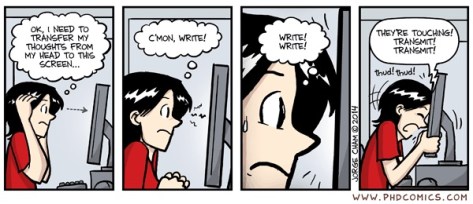
One of my friends uses this day to catch up on movies and TV series; frankly, I have never been one for TV. Some draw inspiration from comics… How about you, dear reader, how do you break your writer’s block? Is there a special hobby or regimen you follow to get yourself back in your writing zone?

PhD comics copy

Coping mechanisms

I have been reflecting on the lessons I’ve learned through my interaction with crucibles and chemicals, but also with the people that are with me on this academic adventure. By now, I have come to appreciate the true meaning of the African proverb “If you want to go fast go alone, but if you want to go far, go together.” For someone with a twin, you’d think I was born knowing the importance of other people! But it took me some time to fully appreciate how important the people, not just the science, has been in my journey. So allow me to share with you the ways in which the human element has been more important than the facts and figures in my path to a PhD. See, I have several teams…

The guidance team  

IMG-20170614-WA0001
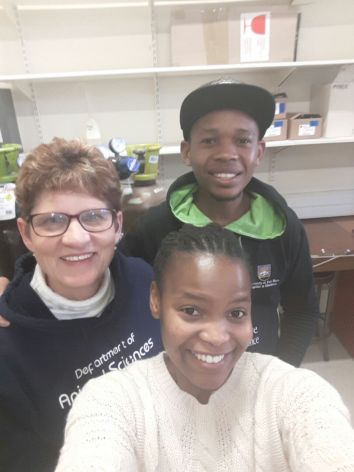
Tannie Bev and us, “her children” 

I sincerely believe that these people exist solely for my sustained mental wellbeing on my academic journey. Through their guidance and extensive knowledge I have been given the freedom to make and learn from my mistakes. Beverly, for example (okay, I can’t help calling her “Tannie Bev”), does not allow me to begin any analysis without reading its protocol — no matter how many times I repeat the analysis. I must say in the beginning I thought it was exaggerated caution; however, one fateful Thursday when I almost did half the analysis I was supposed to do because I did not mix one of the two reagents I needed, she was the first and only person I thought of. There is also Mr Mlambo, affectionately referred to as “BRO- Mike” because though he is much more experienced than me in lab analysis I still can relate to him as a brother who will always protect his little sister. He sure does discipline like father though (laughs). Michael is that one person who will double-check the experimental procedure even when you have read the protocol twice! He will even help with some of experiments when he is not busy and as an added bonus he doesn’t mind keeping you company in the lab while you wait for crucibles to dry and cool down. The guidance team is in my life for a particular time and task but the love they show me lives on forever. When I grow up, I want to be just like them.

The destiny helpers

You get those people who are there for the purpose of propelling you closer to the finish line.  They are not really interested in your personal life, but just want to see you doing well in your academics (and your social life… if it exists).  They also don’t ask much beyond “are you alright, Sipo?” My destiny helpers are always available in my time of need. For instance, when I don’t know how to initiate my next intellectual or practical move, or get stuck along a path I thought I had figured out (which feels like the norm these days), they help me to stay focused and true to the ultimate goal.  More than anything I am grateful for them because they are vested in my dream, too.

 Crazy but cherished moments


The personal assistants

Often I have heard my younger sister refer to her friends as “the squad.” I must say the first time I heard it I was amazed by such a militant definition of people who actually like each other’s company but then (me being me) I went and found the definition of this word and to my liking I found “A group of people with a particular task.” Interesting, isn’t it.  Based on these findings (laughs), I can confidently conclude that I, too, have a squad.

These are the people who have handled my diary, read important emails I should have read but didn’t have the time to do so, helped me stay up at night because they don’t want me missing a deadline, and shared their 500g of chips in the middle of the night when I had nothing else to eat and shops were closed. Many of my deadlines would never have been met without their irritating (!) text messages like “Are you awake” and “You know you have to finish with that data analysis tonight right”… The squad has become my speed dial list. I now know them to be my “lab assistants” in the analysis of life.

Perhaps it is possible to work alone but I now know that the load is more bearable when I am willing to accept the help that is generously offered to me.