Could I make it as a studytuber?

Could I make it as a studytuber? : Mauro Lourenco

2021, another year of lockdown and the continuation of “unprecedented times”. Despite being a full-time registered PhD student, I have not set foot into my University, Wits, since March of 2020, but the show must go on. Anyone that has completed their PhD will tell you how much it consumed their life. And so, I was surprised to find out that there is a community of students called “studytubers” across the world that are filming their student life from home, and posting their videos on YouTube with a massive following.

In light of this, the SAYAS blogging team was encouraged to create our own studytuber video, sharing a day in our PhD lives during lockdown. This is not my first time on camera, I was an extra in a cricket-themed Indian cell phone commercial produced at the Sandton Convention Centre. The commercial was shot in 2017 with famous players from the Indian national cricket team. It never aired on South African TV, but it is on YouTube, click here and see if you can spot me within the first 10 seconds. In my high school days, I was the amateur cameraman for a friend that enjoyed filming pranks, where I featured in a few videos.

My intention before the production was that my video should accurately reflect a day in my student life from home, with the thoughts “it must be authentic” ringing in my head. However, it is difficult to film a truly authentic day when I do not ever film myself in the first place, and so I felt that capturing exactly what happens on a normal day is impossible, as so much of this ‘day in the life’ would be spent setting up camera angles, and deciding on time lapse speeds. I decided to film on a Thursday, a day that is usually quieter compared to the others, as I was worried that I would struggle to both film and succeed in my duties if I chose a busier day. To my surprise, I managed to get a lot of work done even whilst filming. I have big expectations for my PhD during 2021, and so it is clear that these slower days will be few and far between. 

Working from home, or as someone more appropriately put it “living at work”, has become a new way of life for everyone. We can all admit that lockdown workdays are extremely varied, with the only constant being at home. You have breakthrough days, and you have nightmare days, especially when undertaking research. Although sometimes out of my control, my nightmare days are as a result of a lack of planning, laziness and becoming distracted with the comforts of home. To counter this, I try to be as organised as possible and plan each day, and so avoid taking too many unnecessary breaks . The rollercoaster that is a PhD is something that takes time getting used to.

Whilst watching the video back I realised that I am truly fortunate to have a stable home environment from which to work. I can only imagine how difficult other home situations may be. As far as the video making goes, it was enjoyable, and I thought I would be more nervous about it. On reflection, I was not as self-conscious as I have been in my past, perhaps due to the “it is what it is mentality” adopted by many these days. Hopefully you have enjoyed an example of a more relaxed day in my PhD life, complete with snack guides – including cake, some personal literature review advice, and a home workout routine.

 

A bumpy but successful academic journey

After completing high school, many students aspire to move on to the next step of their academic journey. My path took an unfortunate turn, as the marks I attained were too low for admission into the University degrees I intended to study. As a consequence, I found myself taking some languishing three involuntary gap-years, sitting at home in the township, with a seemingly stagnant career. However, like every fairy tale, my journey continues ‘happily ever after’, as I have managed to obtain three degrees amongst other numerous accolades. I am Keith Ncube, a doctoral student in Pharmacology at the University of Pretoria.

During my high school studies, I found the complex structure of chemicals such an intriguing concept. Our chemistry teacher narrated how some of these chemicals are used in the treatment of various diseases, and this ignited a passion within me to pursue a career in health sciences. However, this zeal quickly diminished, as the grades I obtained during my final exams were not sufficient for admission into programs such as Pharmacy and Medicine. For three consecutive years, I tried applying for alternative degrees at various universities without any success. Just as I had lost hope, I received admission to study a BSc in Medical Sciences at the University of Pretoria, a turning point which I reckon was the true birth of my academic journey.

Transitioning from a period of inactivity, I found the acceptance into University to be a privilege, and I prioritized my studies. As a result, I managed to pass most of my modules with distinction during my first year. This enabled me to work as a tutor for chemistry (my old forgotten passion) during my second year of studies. Engaging with students during tutoring made me realize the massive gap between the content taught during matric, and the more complex concepts that students encounter during University studies.

Myself, with some of the students we mentored in the Yakhanani High School mentorship program.

Then, I came together with individuals from various fields of study to start up and serve as a coordinator for the Yakhanani High School Mentorship Project, which is aimed at grooming and preparing high school students from disadvantaged backgrounds for the transition from high school into the tertiary environment. I have continuously utilized this platform to share my journey and inspire young students, and to advise them on how to maneuver around potential hurdles that they may encounter in their academic journey.

Upon completing my undergraduate degree with distinction, I was introduced to the world of academic research through admission into an Honours degree in Pharmacology. I was assigned with a project that aims to develop laboratory models of breast cancer that optimally mimic the attributes of cancer in the human body. These models are then used to study the potential effect of new anti-cancer drugs.

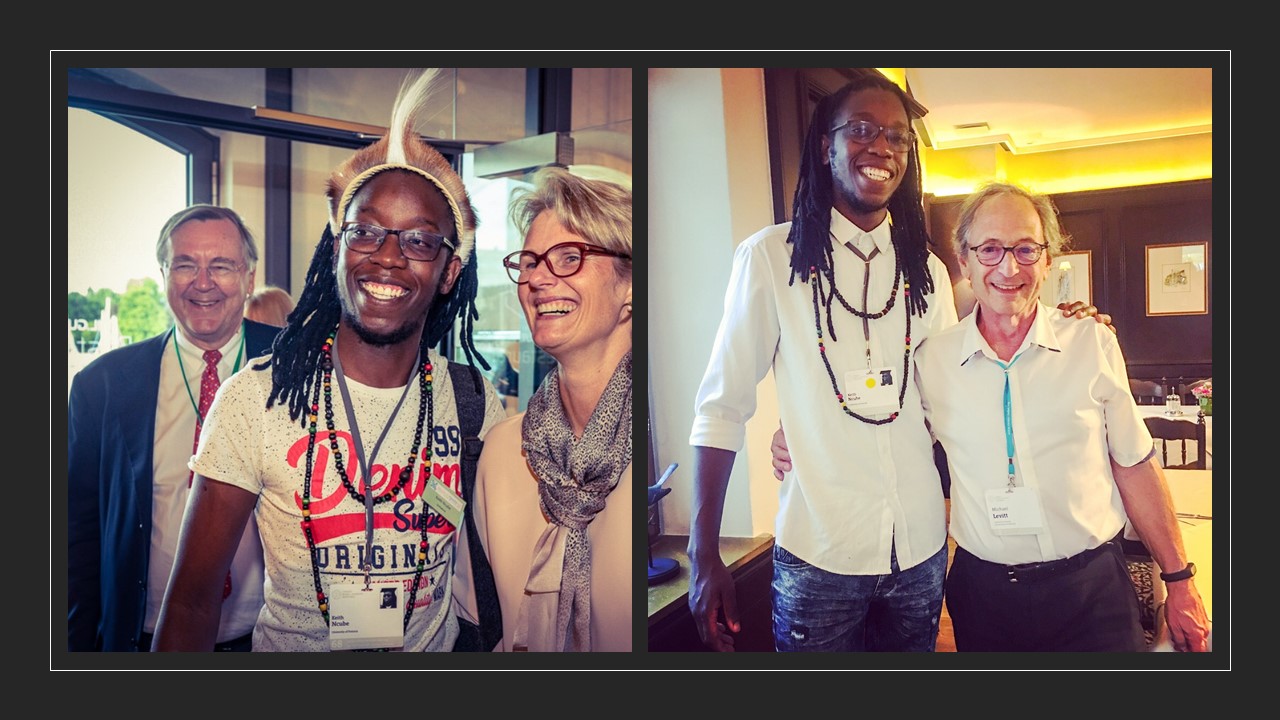
I passed the Honours degree with distinction, and as a result, I was accepted as a Masters student received an NRF scholarship which afforded me an opportunity to continue with the research and sharpen my skills as a Master’s student within the same field. With support from my supervisors, I managed to grow as a young researcher, and scooped several accolades within the country and internationally. The most significant of these was being chosen to be amongst 600 students across the globe to meet and engage with Nobel Prize winners at the prestigious Lindau Nobel Laureates meeting (Germany) in 2018. In the same year, I presented part of my research results at the 18th World Congress of Basic and Clinical Pharmacology in Kyoto, Japan. In addition to presentation in various national conferences within South Africa, I also got the opportunity to act as an academic supervisor for junior students within our Department of Pharmacology. I have since completed my Master’s degree (Magna Cum laude), and I am pursuing my Doctoral degree in Pharmacology.

Myself, posing for a picture with Anja Maria-Antonia Karliczek, the Federal Minister of Education and Research in Germany (left) and Professor Michael Levitt, a Pretoria-born Nobel Prize winner (right), at the Lindau Nobel Laureates meeting in Germany (2018).

My shift from a seemingly futureless young teenage boy to an established health scientist has ignited a passion within me to inspire upcoming academics that ‘failure is sometimes a necessary detour, and not a dead end’. This journey within the past decade has offered me a wealth of experiences which I would like to share with academics and individuals who are aspiring to pursue a career as an academic. Some of these experiences include transitioning from high school into tertiary education, how to select a good supervisor, maintaining resilience, and the craft of scientific writing and presenting amongst other additional topics. I look forward to using the SAYAS blog to share these experiences.