Respect goes a long way: why all research fields matter

Agricultural extension is one of the oldest forms of information dissemination methods that are used in the public space. It is the application of scientific research and new knowledge of agricultural practices through farmer education. The practical application of Agricultural extension encompasses a wide range of communication and learning activities that are purposefully made suitable, acceptable and relatable for farmers particularly those in rural communities. It is these learning activities and communication methods that I am most interested in and would love to contribute to the growing knowledge of keeping them relevant to changing technology times and information requirements. Over the years I have learned the importance of the Agricultural Extension discipline. I have also come to understand the fundamental principles upon which it was founded which have cultivated a visceral sense of appreciation in me. 

However, over the years I have been ridiculed a lot in the discipline that I have chosen. I have learned that respect for various disciplines within the agricultural space as well as other academic spaces goes a long way. In fact, it does not show respect only for the field but also for the people who are in the field that I have learned. I often hear people ridicule certain study fields that they believe are inferior to theirs because they are not “Hard Sciences” which makes me wonder whether it is plain ignorance, or do they just assume that they are better or is it straight up arrogance with a huge dose of disrespect. I may never know but I do know that it is has a lasting impression on the minds of those to whom the disrespect is thrown.

Consequently, I developed an inferiority complex which stuck with me for quite a while. Initially, I thought I had the imposter syndrome but now I understand that the years of taking in the ridicule and disrespect led to the development of an inferiority complex deep within myself. When I registered for my undergraduate degree I was excited and hopeful until I started attending classes and I realized my classmates (the agricultural extension class of 2012) and I were treated differently by the “hard science” group of students. Reason being we had registered a Bachelor degree instead of a “Bachelor of Science degree”. According to them a bachelor of Agriculture was not worth their respect, the disrespect was real. 

july 1

My classmates and I were bombarded with sinister remarks such as “the dumb peoples’ degree” or “are they even scientists really?  “If they are what on earth are they doing?” This treatment continued until our Honors year.  By the time we got to Honors level, a number of us had changed the degree for various reasons of course but sometimes I cannot help but wonder whether the disrespect was part of the major influences that convinced my classmates to change their degrees to “hard science degrees” Those of us who of course decided to stick with our choice in life continued to endure the demining remarks.

Needless to say, it is not only within the agricultural disciplines that such behaviour is prominent. More-often-than-not academics in various disciplines exhibit disrespect towards each other in one form or another. For example, differences in opinion about which field is more demanding and more important exist between natural science and social science scholars. Just like how one is considered to have worked less or is inferior if they are a “Doctor of Philosophy’ rather than being a “Medical Doctor”.

I am glad I stayed…

I have said this before that I have come to love and respect the discipline because of the rudimentary principles it was founded and still functions on.  But this liking and being certain that I want to stay in agriculture did not come without me doubting whether or not I should continue in it. It is true that “life will test your choices” and through my experiences as a Bachelor of Agriculture graduate, it has.

So for the longest time, I have questioned my belonging in the academic space. I wondered whether pursuing a career in academics was worth it because academics for me was that one space where I experienced a lot of self-doubtsjuly 1. Fast forward to now, I work on an interdisciplinary study and I strongly believe that healthy interdisciplinary study and work environments where we as individuals make the informed, civil and kind decision not to undermine, and make sinister jokes about each other professions are the kind of environments we need to grow the body of knowledge.  Truth is we need each other to co-exist.

The mysteries of the universe: What do astronomers do?

The other day I stumbled across a question on twitter. “How do astronomers know all of this”, in response to a post showing the scale of the universe and different objects within it. I replied with a simple explanation about how we use large telescopes to observe various objects and simulations to understand the physics, but I thought I would write a longer blog post on this topic. With the South African government investing heavily on some of these large telescopes, it is even more important for people to understand why this undertaking is so important.

There are two main types of astronomers or astrophysicists. On the one side the theoreticians: the ones that mainly work through complicated mathematical equations and creating mind-blowing simulations; but what I am going to talk about here is observational astrophysics, which I focus on, and where South Africa has shown great interest with the development of the Square Kilometer Array and the successful Southern African Large Telescope.

WhatsApp Image 2019-03-19 at 10.26.39
Image of spiral galaxy M101 in four X-ray, Optical, Ultraviolet and Infrared Light taken using different telescopes

What exactly do we do?

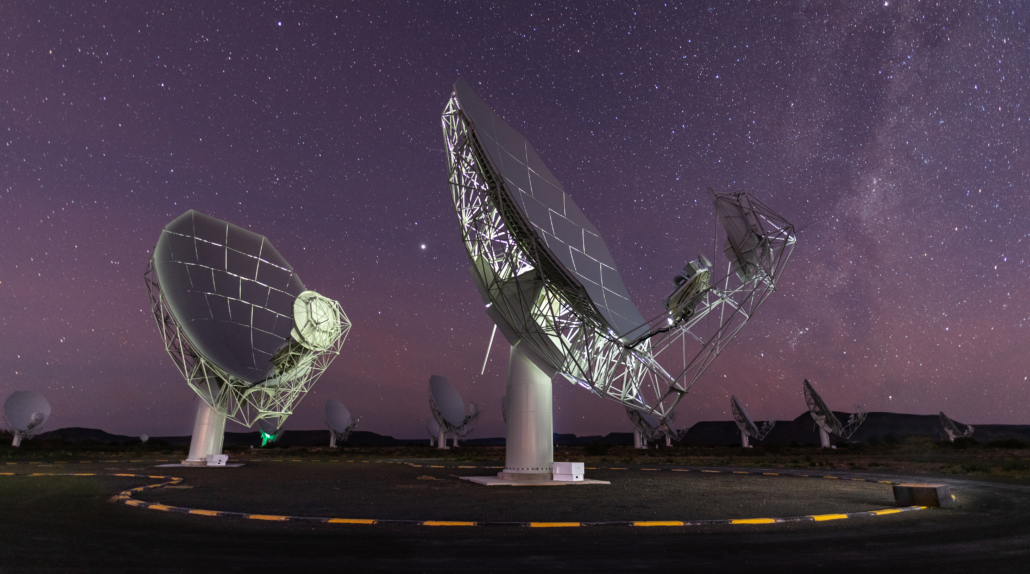
Observational astronomers use telescopes (like MeerKAT, the Southern African Large Telescope, and several others) to study the night sky. These telescopes function as “light buckets” and collect information in the form of optical (visual) or radio light. Most land-based telescopes operate in optical or radio light because the atmosphere prevents any other light from reaching the earth, but space-based telescopes (like the famous Hubble Space Telescope) can detect X-rays, Infrared, and ultraviolet light.

This light can be used in a few different ways. We can take a picture of distant objects like galaxies to study things like their shape, structure, size and position. We can track how the light in an object like a star changes with time – which is how planets around distant stars are often discovered. Or, we can break the light up into a spectrum, which allows us to probe deeper into the chemical makeup of an object. Different types of light reveal different aspects of astronomical objects. While optical light is really good at detecting stars, the faint gas that fuels galaxies is only visible in radio wavelengths and hot, energetic events pop up as X-rays or gamma rays.

Bigger telescopes allow us to observe objects that are fainter and further away. This allows us to see further back in time, to understand the universe at earlier stages of its evolution. The further away an object is (and often the fainter an object is), the longer it takes for light to reach us here on Earth. Therefore, the light we collect with our telescopes essentially lets us look back in time to when the universe was much younger and smaller than it is today.   

WhatsApp Image 2019-03-19 at 10.28.22
MeerKAT telescope dishes. Credit: SARAO.

Why does this matter?

Aside from being able to detect asteroids that might crash into Earth, astronomy has many benefits. Studying objects in space allows us to work on answers to some of the mysteries of physics. Gravity – something we all interact with on a daily basis (unless you are reading this from the International Space Station) – is something physicists thought we understood since Isaac Newton’s days. Until some astronomers looked at the motions of galaxies and realised that there was something invisible causing these galaxies to move in unexpected ways. This led to the discovery of dark matter – which we are still trying to figure out!

Just two years ago, the groundbreaking observation of a neutron star merger (which our very own SALT contributed to) revealed where heavy elements like gold are originally created. This event, which was detected through gravitational waves and various wavelengths of light simultaneously, was one of the most important discoveries of this decade.

Astronomy teaches us about how the universe works. Although not every discovery will have implications for our everyday life, we have a natural curiosity about the universe we live. Many people experience a sense of appreciation and wonder when they look up at the night sky, especially in the absence of city lights, and wonder what’s out there. Astronomy allows us to explore that curiosity and appreciate our universe.

(At the very least, astronomy gives us a bountiful amount of pretty pictures. You can find a new one every day on the Astronomy Picture of the Day website.)

If you are curious to learn more about how specific fields in astronomy contribute to scientific questions, I have a post on Medium that goes into much more detail! You can also learn more about astronomy through Crash Course: Astronomy and by following NASA on social media.