A bumpy but successful academic journey

After completing high school, many students aspire to move on to the next step of their academic journey. My path took an unfortunate turn, as the marks I attained were too low for admission into the University degrees I intended to study. As a consequence, I found myself taking some languishing three involuntary gap-years, sitting at home in the township, with a seemingly stagnant career. However, like every fairy tale, my journey continues ‘happily ever after’, as I have managed to obtain three degrees amongst other numerous accolades. I am Keith Ncube, a doctoral student in Pharmacology at the University of Pretoria.

During my high school studies, I found the complex structure of chemicals such an intriguing concept. Our chemistry teacher narrated how some of these chemicals are used in the treatment of various diseases, and this ignited a passion within me to pursue a career in health sciences. However, this zeal quickly diminished, as the grades I obtained during my final exams were not sufficient for admission into programs such as Pharmacy and Medicine. For three consecutive years, I tried applying for alternative degrees at various universities without any success. Just as I had lost hope, I received admission to study a BSc in Medical Sciences at the University of Pretoria, a turning point which I reckon was the true birth of my academic journey.

Transitioning from a period of inactivity, I found the acceptance into University to be a privilege, and I prioritized my studies. As a result, I managed to pass most of my modules with distinction during my first year. This enabled me to work as a tutor for chemistry (my old forgotten passion) during my second year of studies. Engaging with students during tutoring made me realize the massive gap between the content taught during matric, and the more complex concepts that students encounter during University studies.

Myself, with some of the students we mentored in the Yakhanani High School mentorship program.

Then, I came together with individuals from various fields of study to start up and serve as a coordinator for the Yakhanani High School Mentorship Project, which is aimed at grooming and preparing high school students from disadvantaged backgrounds for the transition from high school into the tertiary environment. I have continuously utilized this platform to share my journey and inspire young students, and to advise them on how to maneuver around potential hurdles that they may encounter in their academic journey.

Upon completing my undergraduate degree with distinction, I was introduced to the world of academic research through admission into an Honours degree in Pharmacology. I was assigned with a project that aims to develop laboratory models of breast cancer that optimally mimic the attributes of cancer in the human body. These models are then used to study the potential effect of new anti-cancer drugs.

I passed the Honours degree with distinction, and as a result, I was accepted as a Masters student received an NRF scholarship which afforded me an opportunity to continue with the research and sharpen my skills as a Master’s student within the same field. With support from my supervisors, I managed to grow as a young researcher, and scooped several accolades within the country and internationally. The most significant of these was being chosen to be amongst 600 students across the globe to meet and engage with Nobel Prize winners at the prestigious Lindau Nobel Laureates meeting (Germany) in 2018. In the same year, I presented part of my research results at the 18th World Congress of Basic and Clinical Pharmacology in Kyoto, Japan. In addition to presentation in various national conferences within South Africa, I also got the opportunity to act as an academic supervisor for junior students within our Department of Pharmacology. I have since completed my Master’s degree (Magna Cum laude), and I am pursuing my Doctoral degree in Pharmacology.
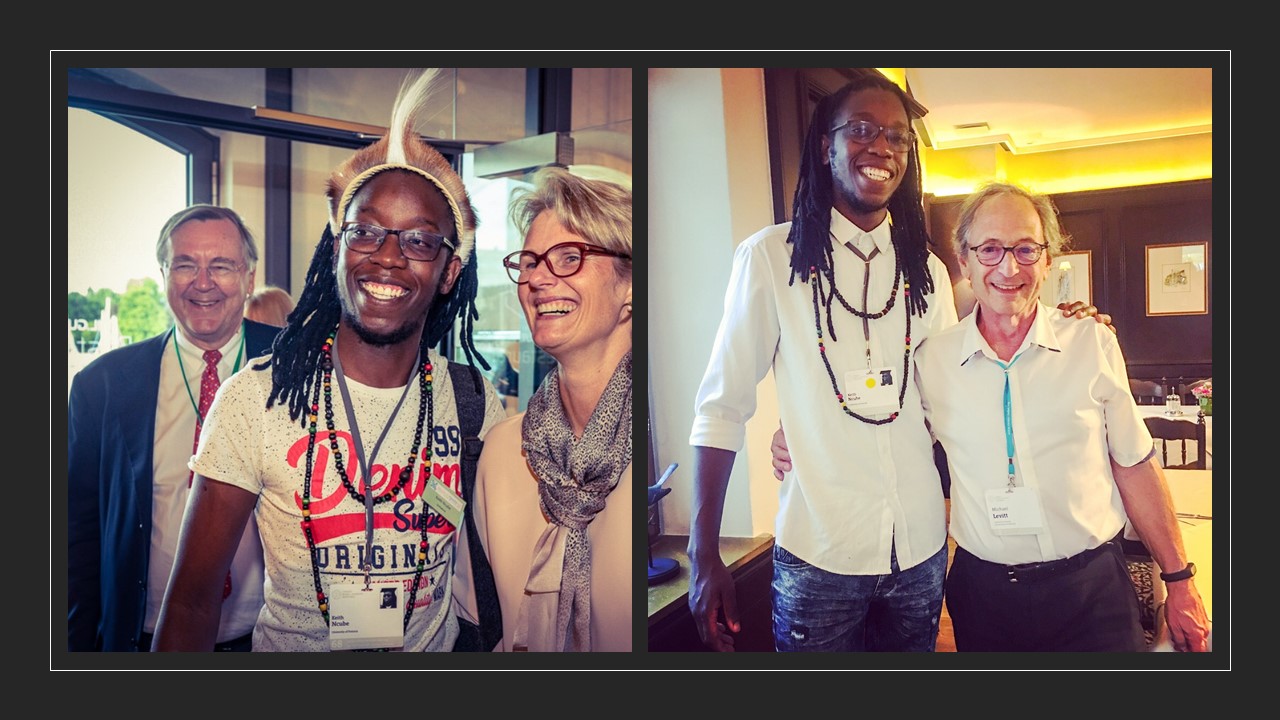
Myself, posing for a picture with Anja Maria-Antonia Karliczek, the Federal Minister of Education and Research in Germany (left) and Professor Michael Levitt, a Pretoria-born Nobel Prize winner (right), at the Lindau Nobel Laureates meeting in Germany (2018).

My shift from a seemingly futureless young teenage boy to an established health scientist has ignited a passion within me to inspire upcoming academics that ‘failure is sometimes a necessary detour, and not a dead end’. This journey within the past decade has offered me a wealth of experiences which I would like to share with academics and individuals who are aspiring to pursue a career as an academic. Some of these experiences include transitioning from high school into tertiary education, how to select a good supervisor, maintaining resilience, and the craft of scientific writing and presenting amongst other additional topics. I look forward to using the SAYAS blog to share these experiences.

Conferencing Toolkit for Postgrads

Are you ready to conquer your fears?

Covid-19 robbed me of my most favourite part of postgrad life: Conferencing. The lockdown regulations came with strict restrictions on all local and international travel; this meant that for the first time in a very long time, I was not going to attend any local or international conference. All I could do is reminisce of the good all times when I was booked into fancy hotels and fed all in the name of conferencing! Jokes aside, attending conferences has been one of the key aspects that shaped my career outlook and my perception of academia on a global scale. 

At my first conference, it felt like I was thrown in the deep end and left to drown. It was intimidating! But with the right mindset and preparations, I am now a conference wizard (yes I’m blowing my own horn). In this blog, I will share useful tips on how to gain the most from attending conferences.

PRE-TRAVEL PREPARATIONS

Step 0 of the pre-travel preparations is choosing a conference that is relevant to your field, and that will positively impact your research. To gain maximum impact from the conference, presenting your research findings is highly recommended. The conference organisers select presenters based on an abstract submitted during registration, so the abstract has to standout if one wishes to present. These are the key ingredients for a brilliant abstract: Give motivation on why your research is relevant to the field. Highlight the methodologies you used. Emphasise the results you obtained. Then, outline what you have concluded from your study.

If you have a poster presentation, it is best to print your poster before travelling. For oral presentations, one can always neaten up the presentation during the conference. However, knowing your audience in advance will help you structure your presentation so that it speaks to the audience (e.g. if the audience is well informed about your topic then you won’t spend a lot of time on the introduction). Finally, prepare a two-minute elevator pitch which is a summary that highlights the importance of your research; this comes in handy for the brief coffee break encounters.

Many conferences offer travelling or registration funding for students, be sure to apply early. Once you are registered, keep check of the list of attendees and invited speakers. Knowing your attendees is advantageous because you can have a strategy for your networking engagements and you might find a student from your country or is also attending and hence might be a potential conference buddy. Brief research on the invited speakers will help with planning which sessions to attend if the conference has plenary sessions and who to approach during the breaks.

LOGISTICS

Sharing basic logistic information might sound tedious for frequent travellers, but my first international conference was my first international travel experience, and there are a few things I wish I knew before boarding the plane. Different international border gates require various documents upon arrival, ensure that all these documents are printed (Invitation letter, hotel reservation, a letter from your institution, etc.). It is always a good idea to have some cash with you, if you plan to change currencies at the airport they will require proof of residence so carry that with you. A student’s life is dependent on having a functioning laptop so when travelling note that various countries have different charging ports and adaptors be sure to pack the correct charger/adaptor (I’ve learnt this the hard way). Always check if the conference provides transfer from the airport, if not book a cab in advance. Lastly, download or save a map in your phone that you will be able to use even without data so that you don’t get lost.

AT THE CONFERENCE

As much as there is pressure to be seen and heard, always relax and be yourself. Conferences are the best places to find potential collaborators and supervisors, so all the preparation is worth doing. The elevator pitch will be essential on the first day of the conference as everyone is getting to know each other. The following days should be used for networking and putting your research out there. Don’t be intimidated in the coffee and lunch breaks. Speak to people and initiate discussions; not all conversations have to be based on your research interests. Be open with everyone and don’t shy away from making (appropriate) jokes or hopping onto discussions you are passionate about. You also have the chance to meet researchers that you have been referencing in your papers. It is not always about telling them about your current article, maybe just introducing yourself and make a comment that they will remember you when you send them an email afterwards.

In preparation for your presentation day, ensure that you have an early night, wear comfortable clothes and thoroughly go over your slides/ poster (try to prepare for possible questions). For oral presentations, check your slides at the presentation venue to see if they are clear and compatible with the venue systems.

Unfortunately, not all people attending conferences have pure intentions, be alert, and if you plan on going out, it is advisable to always have a trusted companion with you. Some attendees (young and old) can behave most inappropriately, don’t be afraid to speak out and report to the relevant committees.Most importantly, have fun! Conferences are a working visit, but they also offer cultural experiences which are first time experiences for many students. For me, each conference has always resulted in friendships that lasted far beyond the academic encounters. Once the conference craze is over, and you are back at work, you should follow up with the people you met at the conference to further cement your engagements and start collaborations.

Preparing For A Virtual Conference

The advise I shared will come in handy when things return to ‘normal’; however, for now, we are stuck with virtual conferences. Although virtual conferences may seem less demanding, one still needs to prepare. Most of the pre-travel preparations I above mentioned still apply; however, the logistics and networking differs slightly for the virtual conference.Before the conference starts, go through all the conference material and ensure that you have successfully downloaded the platform that will be used for the conference. Familiarise yourself with the different functionalities within the platform (e.g. How to raise your hand, how to join breakaway rooms, etc. ). You then need to prepare a suitable work environment that will enable you to fully participate at the conference with minimal disturbances. Ensure that your workstation has relatively reliable internet connection! For networking, don’t be afraid to reach out to participants (through individual chat boxes or emails), engage during breakaway sessions, and spark conversations always ask questions to presenters or panel members.