The year is 1 BD, it has to be

As this year comes rushing to a close, there are a lot of stressed-out postgraduate students trying to squeeze every last little bit out of 2018 so that they might get their work done to try and hand in their thesis now or early next year. I am one such postgraduate. I am counting down the days!

Counting is something humans do to keep order and monitor progress. The B.C./A.D. system is a good example and is based on the traditional reckoning of the year Jesus was born. Since 1988, it has been adopted as an ISO 8601 standard, allowing all of us to keep record the past, present and future.

Marking calendars for special occasions is one thing, but creating your own designation for something really special is next level. Therefore, in my life, I have decided that 2019 will be 1 A.D., or After Doctorate, which would make 2018, 1 B.D.  Note: There is no 0 B.C. or 0 A.D because Roman numerals, which was commonly used at the time, did not have a zero number.

There is some method in my madness. This designation, like the B.C./A.D. system, marks a significant moment in my life. Life after getting my doctorate, I feel, is going to change completely. I’m told that having a PhD opens more exciting doors, even though those recent graduates are doing postdoctoral fellowships that don’t seem too different to what they were doing before. Granted, there are more freedoms in a postdoc… and the title is a hard-earned badge of honour.

From 27 B.D. till now, I have felt a little lost navigating a path that has been remarkably different to the ones my childhood friends ventured down. Many of them went to school, then University or College for three to four years, got a job afterwards and started their families. Since I was six years old, I have been on a journey that is based, almost entirely, at institutions of learning.

They say Life is the greatest teacher of all but if you have been at school for most of your life, the greatest teachers are… teachers and lecturers. They taught me where to find my compass, how to use it, and when to follow it. There is no doubt that after my PhD I’m going to learn a lot about life in the ‘real’ world but I think studying has allowed me to wade in already.

As I prepare to cross the B.D./A.D. line, to submerse myself in the world post PhD, I can’t help but feel a little nervous. I have made a commitment to finish in the next few months. I can’t make this statement and not hit my deadline. My friends and family are as excited as I am, I can’t let us all down.

A big part of my life is coming to an end. It feels like the end of a long pilgrimage but I know that it is just the beginning. With the PhD at my side, who knows what the future holds. I hope it is great. After all this, it is the start of a new era.


What is at the Centre of Excellence?

In 2004, the Department of Science and Technology (DST) with the National Research Foundation (NRF) established the first seven Centres of Excellence (CoE). These Centres, based on the successful CoE models implemented overseas, were adopted to build on existing capacity and resources but also aimed to bring researchers together to collaborate across disciplines and institutions to drive science excellence.

I joined the Forestry and Agricultural Biotechnology Institute (FABI)–the host institution of the Centre of Excellence in Tree Health Biotechnology (CTHB)–in 2008 when I started my Honours degree. At the beginning on my Honours, I didn’t quite understand what the Centre of Excellence was or why it even existed. How “excellent” was this programme? Was there a need for tree health research in South Africa? I was really only concerned about doing well and learning as much as I could so that I would be a better candidate for a Master’s. But my eyes have opened up since then.

Between my classes and research project, I was encouraged to get more involved in the CoE’s activities by volunteering to be a mentor for the undergraduate mentorship programme, working in the Diagnostic Clinic (which services both the CTHB and TPCP), attending workshops run by Dr Marin Coetzee, who conducts some of his research in the CoE, and so on. The CTHB–true to the purpose of the Centres–made more room for excellence; more postgraduates could complete their studies through FABI, more essential equipment could be bought, research could include other sectors and not threaten industry-specific funding, opportunities through workshops and collaboration started to grow, leveraging funding and excellence became more important, etc. The CTHB – a virtual centre run through FABI – became a critical part of FABI and because of that, the CTHB absorbed some of its excellence, built on it and delivered its own excellence.

449rw-ho35g
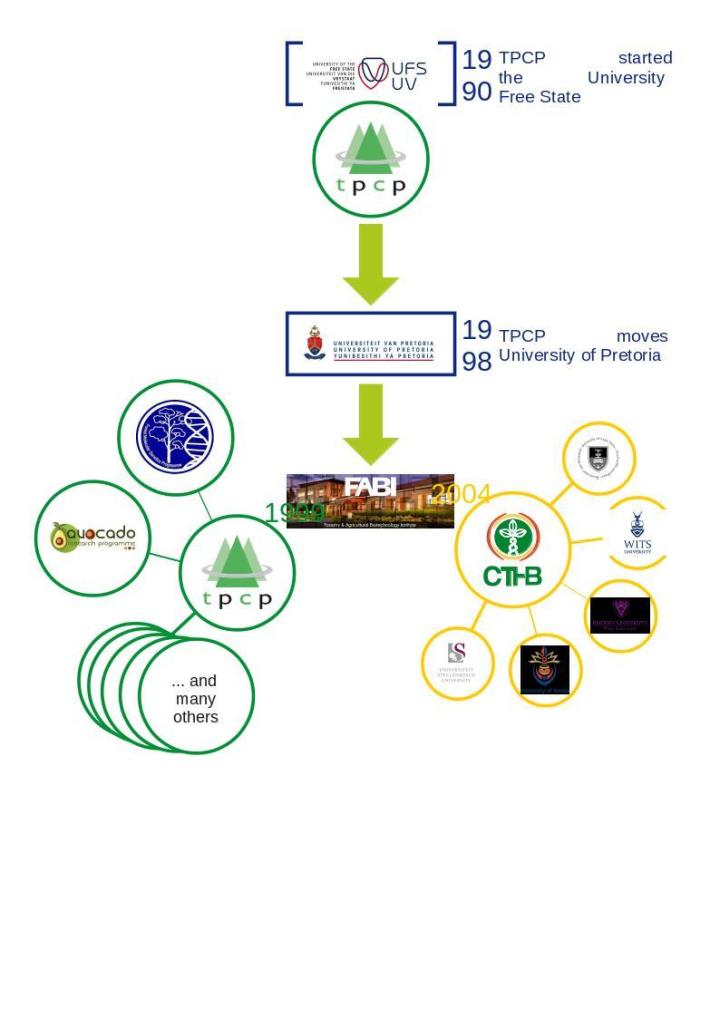
The TPCP began at the University of the Free State before moving to the University of Pretoria, where it became the founding programme for FABI. The TPCP helped start a number of other research programmes that are run out of FABI.  The CTHB started at FABI in 2004 and has linked a number of institutions to FABI and the University of Pretoria. 

I experienced how research can truly grow and have international reach. As the CoE’s research net widened, we started to identify more and more problems of concern to plant health in South Africa—many of them brought on by climate change and globalization. Because of the limited capacity in the country, back in 2004 to deal with pest and diseases that were arriving from other parts of the world, the importance of national and international collaborations and knowledge exchange became a priority. These close connections–that are still being built and expanded today–have led to growth in South Africa’s capacity; not just around FABI but at all the institutions linked to the CTHB. In 14 years, the CoE has produced 786 publications, 125 students, and really changed the ways in which we understand diseases of our native plants.

As a student associated with a CoE, I have had better opportunities for funding, wonderful teaching, mentorship, collaboration, and international exposure. Like those that have come before me, I plan to contribute to the science excellence in the country and grow more excellent people. No matter what happens to these Centres in future, as funding continues to dry up, we need to remember to keep excellence at the centre of anything we do—for us, for our country and for the world.