After the first storm

I was born in the Eastern Cape, to parents that are both educators. Which kind of explains why I love being in the know. They gave me the name Siphokazi, which directly translates to “a very big gift” 🙂 Awesome is it not? I guess that is what I am to the Nyeleka family, my clan. Growing up, my siblings and I were not allowed to be without a book (school books didn’t count!) and school was non-negotiable, unless of course we were feeling under the weather.

My parents have always encouraged me to pursue postgraduate studies – following in their footsteps. So by the time I graduated with BSc Animal Production Science, I needed very little encouragement to continue with my studies. I was already hooked by academia! With the final persuasion coming from my supervisor, I decided to enrol for an MSc degree in Animal Production Science with special interest in broilers.

Why broilers? You may ask… Well, back in the day my grandmother ran a poultry farm for more than a decade, but she had to shut it down due to ever rising feed costs. The whole experience was frustrating for me because I watched her let go of something she truly loved, particularly because she used the farm as means to give the village women financial security. So when the opportunity came for me to try and find alternative ways to help people like my grandmother, I grabbed it with both hands. Thus, my MSc research focuses on using alternative protein sources in broiler diets, with the ultimate goal of feed cost reduction.
Developing a proposal...
Developing a proposal…

To my surprise, though, the whole process of developing a research concept has been very challenging for me. Developing a proposal was supposed to be as straight-forward as writing that final exam at the end of the year… What I found to be exceptionally challenging was that I knew what I wanted to do, however developing a research concept around it was very tricky. How could I distill my thoughts into an idea that was testable, workable, valuable, in the space of a single degree…?
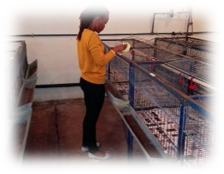
Preparing for my "babies"
Preparing for my “babies”

What kept me going back to the drawing board was and still is the ultimate goal and that is to make a difference. Giving up would not only be letting myself down, but my grandmother too and that is something I would never be able to live with. I guess it is true that “Anyone who says sunshine brings happiness has never danced in the rain,” because the happiness I felt after an approved proposal is beyond description.

My second year promises to be an interesting adventure, with more trials and some lab work. I look forward to it, really. Do I still think I can solve the world’s problems? Yes! But like RJ Benjamin says in one of his songs “Changing the world, One day at a time…” I guess in my case its one broiler at a time.


A WATER HUNGRY NATION: Yearning for fire-pool downpours from heaven

We must pray for His divine intervention!!!… But we must not pray like those who do not have faith…” While you may think that this is a sermon, it is a cry from the Minister of Water Affairs to the nation to pray for the heavens to open up, the rains to kiss the barren African soil. I must say that while this approach amused me, it is astounding that in 2017 we still experience water shortages – there is water available.

Let us be frank in that these issues culminate from historical recklessness of a nation vying for economic growth. Still trekking towards development, the country relies heavily on mining, coal power and agriculture to sustain the economy. Our progress is, ironically, messing with our most basic of human needs – the need for clean water. The Olifants River, which meanders through the Mpumalanga Province, lined with mining operations and coal power stations flanking the banks, serves as an appropriate example. Massive crocodile and fish deaths were reported in 2006 in the Olifants tributary running through the Kruger National Park; shortly afterwards, the same was reported at the Loskop Dam. The areas affected by this tragedy are national heritage key-points, highlighting the importance of resolving these issues.

The quality of our water is a tremendous issue – humans, plants, and animals rely on clean fresh water, and researchers who investigated the Olifants River tragedy could not pin-point the cause of all these mysterious deaths. So, what is to prevent the tragedy from repeating itself elsewhere?

Crocodile and fish mortalities reported at the Kruger National Park, as well as Crocodylus niloticus and C. gariepinus with white and brown spots in fat (from Olifants gorge on Mozambique border and Letaba confluence)

In efforts to find the cause of these mysterious deaths, the research I have undertaken through my  Master’s into Doctoral studies is aimed at assessing the risk and levels posed by persistent organic chemicals at the Loskop Dam, using zebrafish as a model system. Preliminary findings have revealed high levels of these compounds and their contribution to the toxicity of the system.

This 18th year of the twenty-first century is marked as one where I get closer to the answers that have boggled many a scientist and national parks authorities. Why are our aquatic organisms dissipating, who and what is responsible, how is the wider population affected by these incidents, what can be done to prevent and revive the ecosystem!? Through the eye of a fishy needle, if you will, I will highlight some hard-hitting truths… And perhaps the final chapter of my thesis will be named REVELATIONS, rather than CONCLUSIONS!!!