You will never influence the world trying to be like it

In October 1927, the Solvay conference (a prestigious invite-only Physics meeting) was in session. In one room were Marie Curie, Albert Einstein, Niels Bohr, Max Planck and even Erwin Schrödinger. 17 of the 29 attendees would go on to win Nobel prizes, with Marie Curie achieving that honour in two fields. Pictured below is the historic photo (recently colourised by Sanna Dullaway) to serve as proof that those coffee breaks must have been the greatest in history.
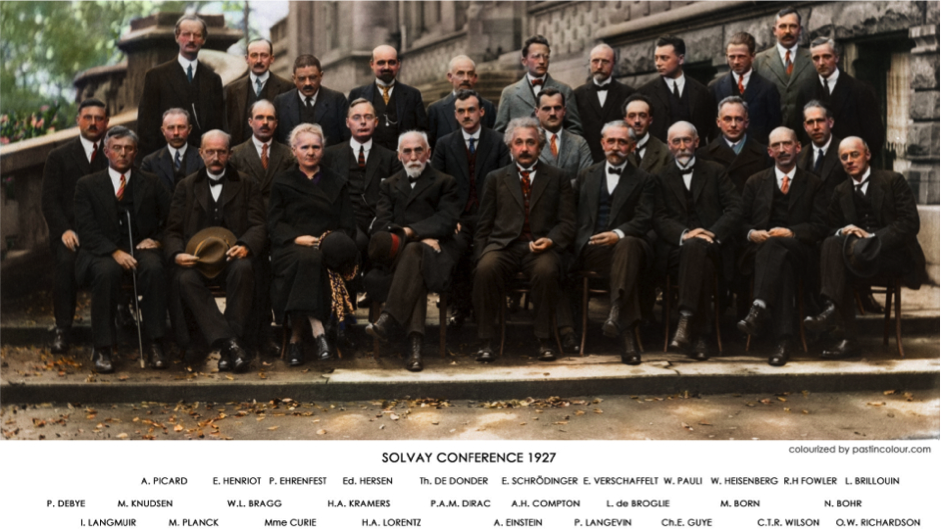
Solvay conference


These individuals would decide the course of quantum physics at this meeting, what was to come and what the field is now was down to them.

Why do we oooh and ahhh at the guest list of the Solvay conference? People have an obsession with genius. And as scientists, perhaps we have a wish to emulate them. One of the ways to do this is to look at those individuals that have managed to completely distinguish themselves from all other scientists by winning the Nobel Prize.

So what are the trends? Well for a start, it is best not to be a woman. Of the 900 Nobel laureates, only 49 are of the fairer sex. Furthermore, it’s best to be an American, as a whopping 257 individuals have been born there (29%, as compared to 1% of the winners being South African). It is also best if you have a birthday on 21 May or 28 February and happen to be 61 years old at the time of the award. Oh, and be a Harvard affiliate (26 were). The Curie family had 6 Nobel Prizes in the extended family (Marie received 2, Pierre her husband, shared one with her in 1903; their daughter Irène Joliot-Curie and her husband Frederic shared one in 1935 and in 1965 Marie’s second daughter’s husband received the Nobel Peace Prize. There have been 5 married couples, 1 sibling and 8 parent-child pairs of laureates – so perhaps working with family is the best thing to do. Basically, your best chance of winning a Nobel Prize, statistically, is to be a 61 year old male physicist who works for Harvard or Caltech (who have so many Nobel laureates they have their own parking space) and is related to a Curie.

What one must consider is that out of the estimated 108 billion people that have ever lived, only 900 have won this prize. Clearly this is not the best indication of genius. There must have been a good number of other inventors and problem solvers that have lived throughout our time, and not all of them were 61 year old Harvard alumni. It is interesting that humans always look at the exceptional, when really everything we currently understand about human intelligence is based on the average. We tend to think genius is based on how much you’re above the average IQ. Albert Einstein and Stephen Hawking had MENSA IQs of 160. But Richard Feynman, widely regarded as a genius, only had an IQ of 120. In addition, last year, a 12 year old girl got an IQ score of 162. Does this mean she will develop the next theory of relativity? Unlikely. Child protégés do not typically remain that way as IQs change over time. In a great article “What your IQ score doesn’t tell you”, the writer goes on to describe that the test doesn’t tell one about the ability to perform tasks or make things work – a pretty big part of life really. IQ is not the same as “common sense” and is certainly not the same as intelligence.

“Intelligence” as defined by Dr Robert Sternberg is made up of 3 facets: analytical skills, practical ability and creativity. You need some common sense to make that IQ work. But perhaps what truly distinguishes genius is not just a Nobel prize, crazy hair and marrying your cousin (something Einstein did) but how creative you can be with the world around you. Einstein and Max Planck were accomplished musicians (violin and piano respectively), Richard Feynman was an acclaimed artist and Marie Curie, well she liked to cycle. Creative people are generally polymaths, they have a wide variety of knowledge and skills and potentially we should focus more energies on other creative pursuits than just work. And while you certainly can’t learn to be a Caucasian bearded man, one can encourage creative behaviours. While some imagine that the coffee breaks during the Savoy conference were packed with Physics, its highly probable that Albert whipped out his violin and Max joined in on piano, while Erwin Schrodinger made a few bits of furniture for his latest dollhouse, Marie went for a brisk cycle and Niels Bohr played a bit of footie.

You will never influence the world trying to boost your exceptional IQ, or fitting into the “workaholic” mould. Be different; feed your creative side. Heck, keep pigeons if you have to; it worked for Tesla (well sort of)!Tesla Oatmeal
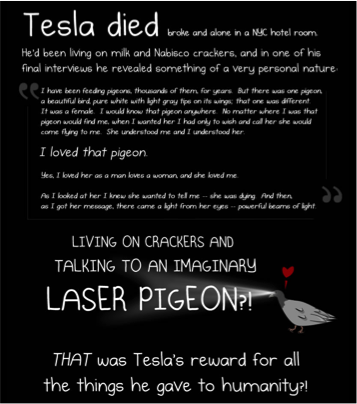
An excerpt from “The Oatmeal’s” cartoon“Why  Nikola Tesla was the greatest geek that ever lived”, a truly great read!

Decolonisation of Thought

Over the course of 2015, and going into 2016, the decolonisation of the university has become a major topic of discussion amongst academics and activists alike. I must admit that I didn’t completely understand what ‘decolonising’ meant. Until recently, my understanding was superficial and many of the explanations I came across were from people I found to be self-interested and superficial. In other words, I wasn’t convinced that it’s important.

A shift in my thinking happened few weeks ago, when an old high school colleague posted a meme on social media, that on the surface seemed simply rude, originating from a neo-Nazi website. This was not the first time that this person posted something questionable but it was the first time I gave it any thought and made me question the origin of that type of thinking; even more so because the person in question is currently a university lecturer.

Few events have changed the course of human history as much as colonialism has. European values, knowledge systems and thought occupied and displaced the indigenous across the globe: Africa, North America, Australia… The practice of natural science research is heavily based on Western trains of thought – not as “impartial” as it claims to be. For example, Dorothy Roberts has written extensively on the way race has been used harmfully in determining medical treatments. Yet, our academic institutions remain steeped in colonial thought patterns. In a recent presentation at the University of Johannesburg Professor Siphamandla Zondi, termed such death of other knowledge systems as the “epistimicide”.

This brings us to why the decolonisation debate is so important.

It is not about erasing colonial-based knowledge systems but rather acknowledging that there are other ways of knowing. In the 21st century the world is faced with tremendous challenges that cannot be solved by individual researchers, and funding agencies encourage international collaborations to help solve these problems. But all these researchers remain steeped in western thoughts, in colonial approaches. Are we really making the biggest possible impact if we actively throw out what is left of indigenous knowledge systems instead of building on them? Or ignoring the source of some of the knowledge, as is seen with the ignoring of the input of Mesopotamian and Babylonian thought in the development of Greek science and technology. Greece is often understood as the basis of ‘modern’ western society.

Why are we so afraid, now, to admit that colonial thought patterns alone are not the only way to solve the world’s grand challenges?

It is critical that as academics we challenge and disrupt the current norms. How do we know which aspects of indigenous knowledge are helpful and which harmful, if we hardly acknowledge the existence of such systems? Can the bloody-minded individualism that characterises colonial thought really be applied fruitfully to a continent and its people, who live Ubuntu? If we only try to view our continent’s challenges in a narrow Eurocentric manner, we potentially miss out on solutions that are appropriate for our environment. And people like my former schoolmate keep on posting their narrow-minded ideals as the way things should be.

There is room for different ways of thinking and teaching. Decolonised teaching goes beyond teaching in indigenous languages and inclusion of non-European writers. Laila Boisselle notes that most often, indigenous forms of science are relational rather than ‘objective’. This means that for modern day use, we would need to relook at indigenous knowledge systems, often dismissed as folklore and ethno-philosophy, and find ways to incorporate them into the curriculum.

The pre-colonial empire of Benin, in modern day south west Nigeria, provides a perfect example of how much can be gained from non-Western sources, if it is not ignored. It was one of the most technologically sophisticated cities in existence, that even the first European visitors were astounded  at that advanced level of architectural and mathematical technology in use. Today, much of that knowledge is lost. However, in all societies, both the natural and social sciences, have much gain from indigenous knowledge.

On a practical level, this would mean not only developing and using, for instance isiZulu terminology in teaching, but, also re-engineering our curriculum to include our indigenous knowledge. How exactly this can be done successfully is still a matter to be worked out; however, it is completely necessary. Imagine the wealth of information that can be garnered in the culturally varied Southern Africa alone!

We live in an era where the Internet has radically changed access to contemporary information. But now we cannot afford to lose the patterns of thinking, and wealth of information that existed before Vasco De Gama, Pinto or Van Riebeeck ever crossed the sea.