
Doing a PhD is a bit like walking into a blinding light- there is brilliance everywhere but mostly you are walking around bashing into things as if it were pitch dark. It can feel like that blinding light is actually a bullet train, but sometimes it is like a million little light bulbs all clicking on at once. While I wade through piles of data every day, trying to find meaning, I am always grateful for the one thing that makes late nights and failed experiments worth it: I am working on the biggest health crisis in this country and my work will make a difference.
While other kids dreamed of being astronauts and firemen, at age 8 I envisioned myself in a HAZMAT suit careering around in the jungles of Borneo collecting virus specimens and detailing the breakout of the latest disease to have jumped species. While I haven’t ended up in Borneo, 18 years later I find myself in the urban jungle of Johannesburg working on a disease that certainly is the most devastating to have crossed the species division in this century, HIV/AIDS. Incidentally, I do wear a HAZMAT suit on occasion, which raises my scientist ‘street cred’ considerably.
HIV is something the human race has learnt to coexist with, but it should never have had to. We have made great progress in the last 30 years. South Africa has the biggest antiretroviral roll-out programme in the world and has reduced mother to child transmission to less than 2%. Those are two incredibly impressive statistics that have impacted on millions of lives. We have all the tools to make an AIDS-free generation a reality: condoms, pre-exposure prophylaxis, and if infected people take their ARVs they protect their sexual partner. However, HIV is intertwined with a string of social complications that mean that all of these tools are not sufficient in our specific situation. The only viable way to ensure that HIV is eradicated is a vaccine; one that has as few boosters as is possible. This is easy to say and a ridiculous conundrum to solve.
Measles was first documented in detail in 1676, the virus isolated in 1954, and the vaccine licenced in 1995 — a full 43 years. In the year 2000, endemic measles was eradicated from the US and then in 2015 there were over 100 cases because anti-vaxxers allowed their children to walk into Disneyland unvaccinated (for more on anti-vaxxers and why they exist check out this nifty cartoon by artist Maki Naro). The polio virus was discovered it in 1908. A massive vaccine trial undertaken in 1955 resulted in the deaths of 11 people and paralysis of hundreds, but a working vaccine was finally licensed in that year. Again, thanks to vaccines, smallpox was eradicated from the world in 1980, but the disease has been around since at least 1000. The path to a vaccine is never easy but boy, is it worth it. The journey will take many, many years in HIV, just like all of those vaccines that have come before. Are we close? Well, we are working on it.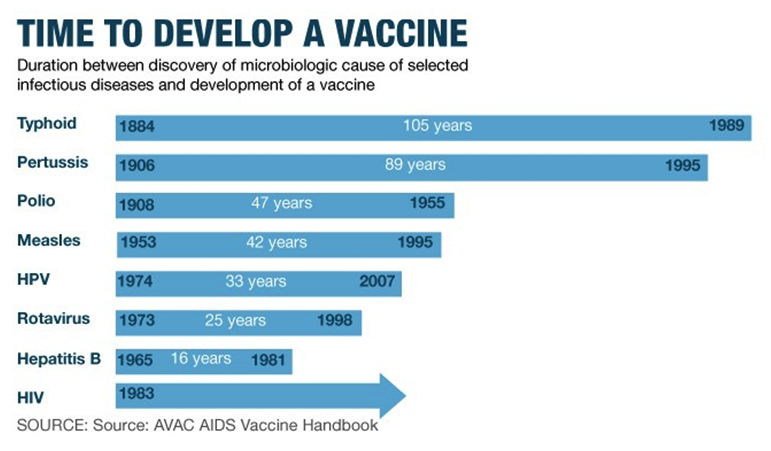
While the goal of vaccine is to ensure a potent response to protect, there are many ways to do this. The only HIV vaccine to show any protection in recent years suggested that we can engineer the multiple functions of antibodies to assist elimination of the virus. These include the ability of the antibodies to pop infected cells and to mark cells for swallowing by other cells. My PhD will follow that yellow brick road so to speak. I will use the evidence that has come before and try to find out what these other functions look like in HIV infection and what we need to do to induce them potently in vaccination.
It is estimated that there is the equivalent of one teaspoon of HIV virus in the entire population of the world. I try to remember that every time a piece of equipment breaks down or I forget to add controls to an experiment and just want to throw in the towel. With an image like the collective boot of science crushing the tiny teaspoon of viruses, this monstrosity I’m trying to understand doesn’t seem so insurmountable and a delightful Mary Poppins reference comes to mind.


 SAYAS BLOG
