The ongoing tale of finishing up my PhD: Part 2

This is an extension of my April blog contribution ‘The ongoing tale of finishing up my PhD’. Even though I found the research and write-up of my PhD thesis enjoyable and its challenges eventually vitalising, the experience was overshadowed by the arduous months of waiting for my results. Thus, my degree  turned into something of a time-distorting rabbit hole, much like the one I liken Tinder encounters to in my thesis.
One year after my initial PhD submission, following re-submitting my substantially revised thesis in March this year, I finally received my results yesterday!

I had to force myself to slowly, word-by-word, re-read the soberly formulated outcome – just to be sure I got it right:

‘Dear Leah Junck, The Doctoral Degrees Board (DDB) has agreed that you should be awarded the PhD degree subject to addressing the required trivial/typographical (including all changes, criticisms and suggestions indicated by all three examiners) to the satisfaction of the supervisor and the DDB.’

Letting the words sink in made way for a relief that is hard to describe. An initial burst of energy released itself through my body. It clashed with accumulated tensions that have been grimly but calmly nestled into my bones over the past year. This newfound vigour made me jump up and down my living room, throwing my arms into the air as though testing their aliveness. I felt a grimace control over my face and, gratefully, let it distort its concentrated frown. I had prepared myself for bad news and, in my mind, already drawn up a ‘gracious loser speech’. All of this could now stop taking up mind-space! Opening a beer, I sat on the balcony, and let a sense of calm wash over me again, mixing with the occasional tingle of excitement as I let the long-awaited news sink in.
Unfortunately, this calm was soon compromised by an email containing the announced ‘trivial/typographical’ changes to be done. The remaining examiner, whom I thought I had eventually convinced of my academic merit, still had quite a bit to say beyond trivialness and typography. As I mentioned in my previous post, most comments from my three examiners were very insightful and made my thesis all the richer. Yet, some of these new ones felt personal, questioning my disciplinary integrity and commitment given my drawing on a variety of disciplines.

The process of substantially re-working my thesis was structured by a ‘Template for Corrections to a PhD Thesis’, which had been sent to me along with my initial examination result. In the four months that I spent on revisions, the two columns grew into a detailed 14-page document. It outlined the comments of the examiners and my responses to each of them, including how and where in the thesis they had been addressed. Now, I have the same document in front of me again and am starting the process of explaining myself in this format once more. This is fair enough – it is a PhD after all, and that’s only worth something if people can trust in the thoroughness of the examination procedure.

However, I cannot help but wonder what things would have been like had I submitted in a different system. At many other universities, a thesis defense forms part of working towards a doctorate. When I realised this was not going to be the case for me at UCT, I was glad. The idea of it seemed stressful and I would have feared for my exam anxieties to pop up again at a rather inconvenient time. Now, I look at it differently. A thesis defense could have been an opportunity to explain myself in a way that I might not be able to when limited to a form. Beyond that, I imagine actually seeing your examiners to be a different experience entirely. Without the veil of (one-sided) anonymity, there is bound to be an actual conversation, an exchange – even if this happened in times of a pandemic through a computer screen. Had this been my experience, I might have walked away from this life episode with a feeling of finalisation. As it is, I will fill out my new response form as diligently as I possibly can and send it off – knowing it will be without a response from my remaining examiner.
Then I will wait a little more – for finally being able to graduate in December 2021, 1,5 years after what I thought was ‘the’ thesis hand-in and end of this story. Perhaps, the event will give things an air of finality. Or maybe, like my PhD itself, processing its completion will simply take time rather than a final act.
Publish or impoverish: the new academic struggle

Staying motivated and focused in graduate school it is not an easy task, and in my recent blogs (here, here, and here) I shared tips and resources I use to survive graduate school. But, there is a far more powerful and enticing incentive to stay motivated-MONEY! It is of course welcomed in most scientific research (lab consumables, technical services, glassware…) and paying hard-working graduate students 😉 , but here I will discuss a more sinister and insidious aspect of money — when it is used to ‘motivate’ scientist to publish. I would like to preface this blog by stating that the thoughts and opinions expressed here are neither a condemnation nor an endorsement — that judgement I leave to you.

The route to academic success and tenure is paved with

 the blood, sweat, and tears of newly appointed faculty members. In most countries, a new assistant professor (the equivalent of a senior lecturer in South Africa) is hired on a probation basis and after a set time (5-7 years) there is an evaluation. Then, depending on certain factors (number of students, external funding acquired, collaborators, and published articles) a judgement would then be made to either terminate or give tenure to the

 person. This story focuses on the last issue — published articles. Now, all journals are not created equal and some have a higher impact factor(IF), and a publication in a high IF journals like such as: Nature, Science, Cell, and The Lancet usually guarantees tenure.

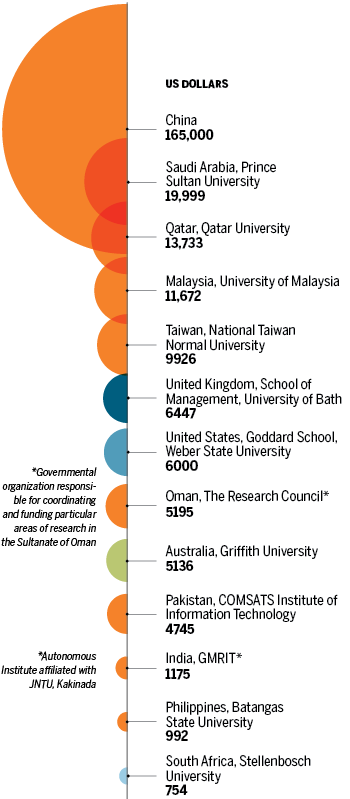
An article published in Science a few weeks ago sent shockwaves through the academic world when it revealed that most countries, notably China, Arab states, and South Africa where paying academics for publishing. However, this payment system opens a Pandora’s box- how much of the scientists’ publishing is fueled by greed and the need to enrich themselves? Will proper scientific conduct be upheld in order for academics to enrich themselves? How sustainable is this system in developing future scientists? Now, these questions are not without merit. In countries where this system has been put in place, there have been recorded occurrences of scientific misconduct (such as data manipulation, unethical experiments). No, I’m not saying that financial incentives always lead to misconduct, as unethical science occurs in “unpaid” systems too. But attaching a monetary value to an article certainly can nudge some to take that extra step towards cheating, if you were ever so inclined…payment


In South Africa, the rise up the academic ladder is contingent on multiple factors, publications being one of them. Primarily, most researchers in South Africa all seek the coveted NRF rating, and this has a great impact on the progress up the academic ladder. Your rating is strongly related to the number and quality of publications you’ve produced. Fair enough. But there is also a cash incentive system, which – in most cases – purely counts the number of publications (quality matters little).

A recent report highlighted that the ‘cash for publication’ system has led to increased research output at Stellenbosch University and North West University. Although both institutions state that it is “not all about money” they attribute the increased number of publications in international journals to the system. Of course, there are universities that do not provide these direct cash incentives (the University of Cape Town and the University of Witwatersrand, for example) and they have seen increases in research output, particularly publications in international journals. But the institutions that believe in the cash incentive system argue that it’s sometimes just the little shove that their academics and students need to take the extra step. After all, would you not be motivated to turn that minuscule little Honours thesis into a proper publication if it could get you some extra research money? Research (especially student-led research) may, therefore, become peer reviewed and published because of that extra financial lure.

For me, a report published by Prof. Catriona Macleod of Rhodes University (another university that does not offer these direct cash incentives) in South Africa perfectly echoes my sentiments on the matter. In it, she highlights three points of the incentive system that seem to be counterproductive, that is, 1) it leads to what she termed “salami-slicing” research, where instead of publishing a comprehensive paper there is an incentive to split that paper into several papers, 2) it discourages collaborations, as the money is shared equally between authors (more collaborators = less money), and 3) there is no distinction made between high IF journals and low IF journals. The tough call for many SA researchers is therefore that the cash incentive system works directly opposite to the prestige and career rewards associated with the NRF rating system (which focuses on quality, collaborations, and international recognition).

Admittedly, every researcher has their own motives for doing science and those would dictate their career trajectory. What keeps you motivated? What aspirations keep you in science?