A Student’s Guide to Cutting People Off, Dealing with Pain, and Not Shooting Yourself in the Foot

My life is like a game of Jenga – still in its early stages, but already dancing on the brink of violent collapse. Over the years, I have watched the pieces move, moved the pieces myself, and seen the tower tremble. As the game goes on, the stakes grow higher, and each decision bears more weight. For me, attending university was an exercise in growth – a move towards a life without a safety net. And there are a couple of things I’d do differently, if given the chance. It’s healthy to look back and recognise you’d change some things. It shows you’ve grown, and learnt, and you should be proud of that! People who claim to have no regrets are either lying to you, or they have terrible judgement, and I would never lie to you, dear reader! I do, however, have terrible judgement. So, let’s talk about all the things I’d do differently if I could restart my degree now…

The first thing I’d do is schedule a haircut. The second thing I’d do is find better friends. The haircut is important, but the friend issue was an oft recurring problem. If you know me, or if you look at any picture of me for more than five seconds, you’ll know I can’t say “no”. It’s such a problem. Every friend will one day ask you to sign a register for them, speak to their tutor over the phone, pretending to be their dying grandmother, or dress up as them to write their exam (and, just to be clear, I’ve not done this). It’s the campus experience (and slightly illegal)! I’m not condoning doing any of that, and I’m not saying you shouldn’t help your friends, but boundaries are important. I had friends who didn’t attend a single lecture, but who used my notes to excel in their classes. I had friends who asked me to write the entirety of their assignments – without pay (not that that matters)! I have done so many group projects – with my friends as group members – where I have done everything, and they still didn’t prepare their part of the presentation. Only one of my friends did prepare, and they didn’t use the cue cards I wrote; they badly memorised the Wikipedia page on the topic we were covering. And I didn’t say a thing.

Not one assignment passed without friends asking me to send them a copy of my work, the night before it was due. They “just want to see the structure” and, they can’t get into it, but “things have been so overwhelming”. You should be there for your friends, but that doesn’t include sending them your work to plagiarise. I cannot stress this point enough. I know students whose entire academic careers have been upended because of this. In some cases, it was someone they trusted, while other times, their friend shared their work with people they had never even met. Some people will call you selfish for standing up for yourself. When you’re insecure, and afraid of disappointing people, there’s a good chance you’ll believe them; but you deserve better, and you will find better. You’re not being selfish when you’re protecting yourself.   

Finally, I’d change the way I coped with psychological stress. My marks were never better than when my life was falling apart. During my second year of university, my friend group was collapsing, my relationship ended, and someone important to me passed away. My grades skyrocketed. If you asked me at the time, I would have said I was coping using sublimation – where you channel your painful emotions into a positive activity. Really, I was practicing repression – where you stuff your emotions deep down in yourself, then get surprised when those emotions don’t evaporate, but instead fester and metastasise. I refused to acknowledge my hurt, distracting myself with work, and I thought it was healthy because my marks were great. But the things I repressed in my second year made me spiral during my third, and final year of undergrad because I refused to face them. I’m so much better at dealing with my emotions now, at maintaining a healthy work-life balance. I am so much more secure in myself, and I’m not worried to lose people by standing up for myself. It takes a lot of time and a lot of practice, but eventually it becomes easier, eventually we grow and we learn.

You know, the fun thing about Jenga is, when the tower falls, everyone just laughs and rebuilds it. Your mistakes won’t mean the end of the world. You just have to learn from them.
Demystifying Gender Politics: A Lexicon for Empowerment

Bridging the gap between academia and the real world is so important. For starters, if our work is not impacting the communities we write about or the world we live in, then what is the point? In my discipline of political science (and especially in gender politics), there is a lot of confusion about the terms that are used. If political science is the study of the world we live in, and gender studies is the study of gendered dynamics in the world we live in, gender politics brings together the opportunity to study what happens in the world with a consideration of gendered power dynamics. There may be some terms that you recognise, as they have made their way into mainstream language. As a result, it becomes difficult to separate fact from fiction when originally academic terms become part of the everyday lexicon. This blog will be decoding eight terms within gender politics (with some others sprinkled in between!). The hope is that this can help foster a deeper comprehension of critical issues at the heart of these areas.

1. Gender: Gender is the expression, behaviour and identity through which you experience the world. The genders that society is often familiar with are ‘man’ or ‘woman’, but there are a plethora of genders that people identify with (or don’t identify with e.g. non-binary people/gender non-conforming people). It is essential to know that people’s gender expression (through clothes, hair, behaviour, voice) is not the same as gender identity (which has to do with self-identification), or sexual orientation. Within feminist scholarship, there are also those that challenge the idea of gender being a separate categorisation, they state that a binary understanding of the body is a product of social-cultural realities.

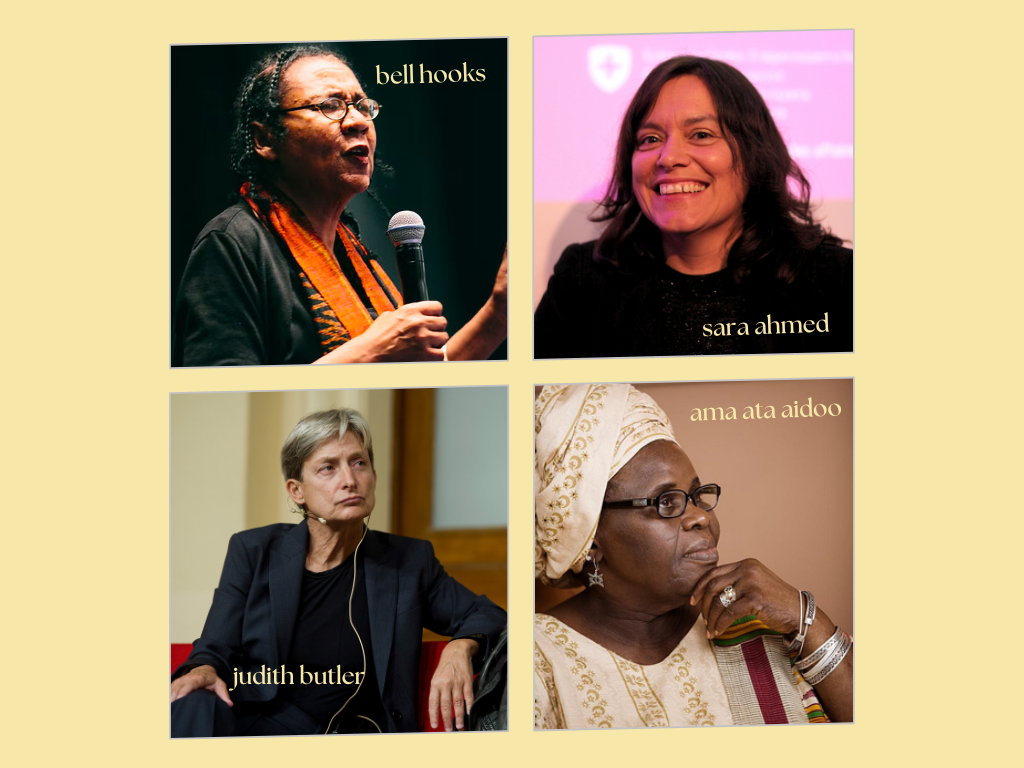
2. Feminism (feminist theory): Depending on where you get your information from, the term feminism can be defined on a wide spectrum. But is there a ‘right’ definition of feminism, and what would an accurate example of feminism be? This is a difficult question to answer in a straightforward manner. According to UN Women, feminism is “a movement advocating for women’s social, political, legal and economic rights equal to those of men.” Feminist theory is different in that it is a way of thinking and understanding how gender affects people’s lives. Examples of prominent feminist theorists include Sara Ahmed, Judith Butler, bell hooks and Ama Ata Aidoo.

3. Neo/liberalism: Within the discipline of political science, liberalism refers to a specific school of thought. Liberalism refers to the ideology of individual autonomy against state intervention. Over time the term evolved to also include protection against private businesses. However, in mainstream media, liberalism often refers to being a ‘liberal’, which is different from leftist ideals. Neoliberalism refers to the economic policies that highlight the political ideology of liberalism i.e. minimal state intervention, a competitive trade market and the principle of self-efficacy.

4. Patriarchy/Toxic Masculinity: Patriarchy can be defined as a system or hierarchy in which gender inequality is perpetuated through the unequal distribution of power that favours men and oppresses women. Toxic masculinity is a result of patriarchy, whereby the attitudes and behaviours of men towards women create a sense of entitlement towards violence and dominance. A popular example of toxic masculinity is the TikTok famous social media personality Andrew Tate, whose views and beliefs on men’s and women’s places in society have had a massively negative impact on young men.

5. Intersectionality: The term ‘intersectionality’ was created by Kimberlé Crenshaw in the 1980s, which was meant to highlight the intersecting ways in which differences (race, class, gender) amongst groups of people showcase imbalances in the legal context of the USA. However, intersectionality went mainstream around the mid-2010s, and the conservative backlash to the term created a fear-based idea about who deserves to be a victim, and who does not. At its core, intersectionality functions as an observation of power imbalances in varying socio-political contexts and is a tool through which said contexts can be examined and dismantled.

6. Cis-hetero patriarchy: There are three different terms in this one word, namely; cis-gendered, heteronormative and patriarchy. We know that patriarchy is a system that prioritises men by valuing behaviours, attitudes and systems that oppress women. Heteronormativity is the assumption everyone is ‘naturally’ heterosexual (romantic/sexual attraction to people of the opposite sex i.e. heterosexual men are attracted to women, and vice versa). Cisgender is the gender identity of a person who identifies with the gender they were assigned at birth. Therefore, when we put it all together, cis-hetero patriarchy is a “system of power based on the supremacy of cis-gendered heterosexual men through domination and exploitation of women and other marginalised genders/gender nonconforming identities.

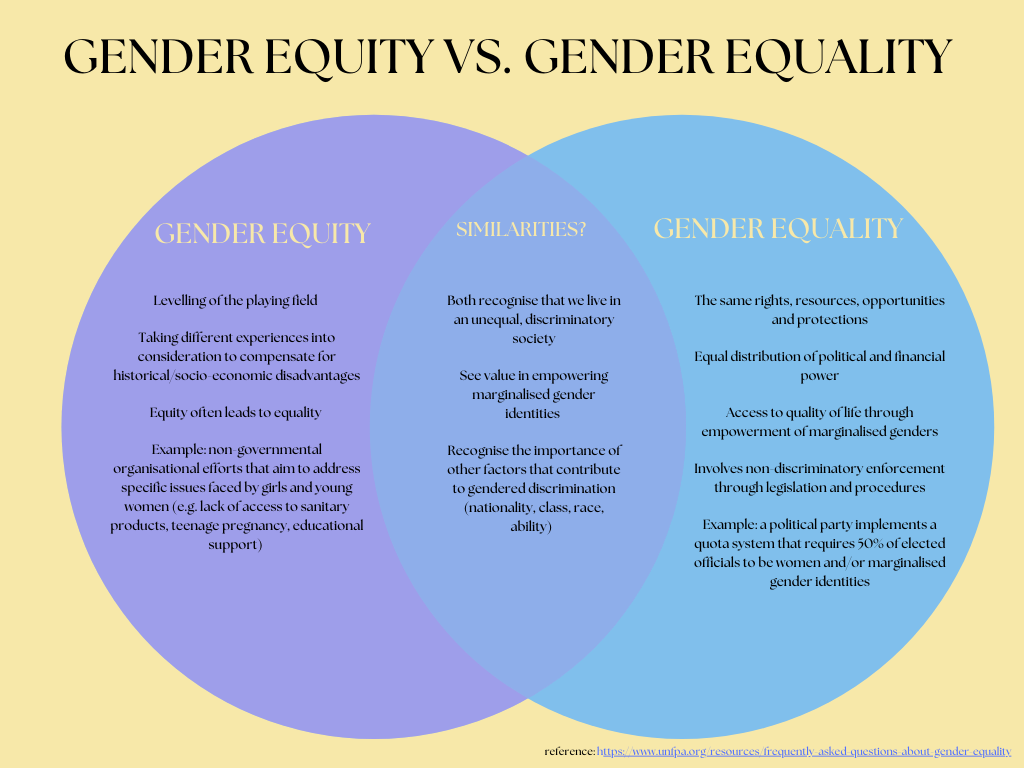
7. Gender Equity/Gender Equality:

8. LGBTQIAP++ (Lesbian, Gay, Bisexual, Trans, Queer, Intersex, Asexual, Pansexual, and more): This is an acronym that has changed over time to reflect other identities not included. Although it is shortened to LGBT, this can have different implications for those who do not identify as Lesbian, Gay, Bisexual or Trans. The earliest use of the term LGB was in the 1990s when lesbian, gay and bisexual activists adopted the acronym for the community they were part of.

Maybe other terms came to mind when reading through this that you’d like to understand more about. Also being aware, there are different implications for these definitions when applying them to different contexts and examples. Let me know in the comments below!