As the winter FINALLY loosens its grip in the Northern hemisphere (sorry for you, poor Southerners…), I welcome the warm weather and start planning my conference season. Attending conferences is an integral part of the graduate school experience, and with this honour comes great responsibility. As with many aspects of modern living, the use of social media apps like Twitter at conferences has increased dramatically in the past few years and these have provided the chance to interact more frequently with other scientists. As an avid Twitter user, I have found it very useful to stay connected and informed about talks I couldn’t attend. But – and this is a big one – the use of Twitter at conferences is not without its controversy. Read here and here on discussions that highlight the concerns with live-tweeting at a conference. Another Twitter user (@online_academic) recently published a book on this very topic, “Twitter for Academics”. Here, I will try illustrating how I use Twitter at conferences and “Twitter-etiquette”[1].
Firstly, most conferences (if not all) will have a conference hashtag that twitter users use to discuss the conference; for instance, a recent conference I attended had the hashtag #ISME16. It’s important to always use this hashtag in all your conference tweets – this ensures that people following conference updates can see your comments/tweets.
More importantly, I find it useful to think before you tweet. In most cases, the work being presented at the conference is new and not yet published. I try to keep that in mind, and make the question/comments short (well, you only have 140 characters :-)). Besides, as scientists we are accustomed to writing concise sentences ;-). Clear and concise questions/comments always promote discussion and re-tweets (more re-tweets= a wider audience). Such comments tend to be effective, instead of simply stating obvious statements that do not engage your audience.

Where possible I try to make sure I tag the speaker or related people in the tweet. In an earlier conference (Society of Nematologist), I made such a comment and was well received.

Lastly, I use it to share great news that may be announced at the conference – for instance when South Africa won the bid to how ISME in 2020.

Now, dear reader, I do not want to leave you with one side of this story. There is a dark side to using Twitter at conferences. Personally, I tend to lose interest when people are tweeting every slide and giving a blow-by-blow account of the presentation instead of summarising the talk in a single tweet. AIso, I prefer not to tweet pictures of people looking sad/bored and more importantly I try to tweet pictures that promote equality/diversity ( I know most conference still have a disproportional male:female ratio of speakers) #Feminism #WomenofScience #WomenScienceDay. A recent blog post by renowned communication specialist of UNDP Mehmet Erdogan (@mehmeterdoganIV) explores these ideas further — it’s worth a read.
So, you see dear reader, we ought not be afraid to engage and use social media at conferences.I hope this blog encourages you to engage more and not be intimidated by using social media at conferences. It was through Twitter that I was able meet some of my collaborators. Remember that Twitter is just a tool we use to interact with other scientists, but it cannot replace face-to-face interactions. So, next time you are at a conference think of a person you might want to meet and check if they are on Twitter. Use this platform and ask yourself how could I use it to meet people in same field? Have I met or identified anyone who could be a possible collaborator? Once all these questions have been answered, the next step is how to approach/form collaboration with people you meet – but I will leave that for another blog.
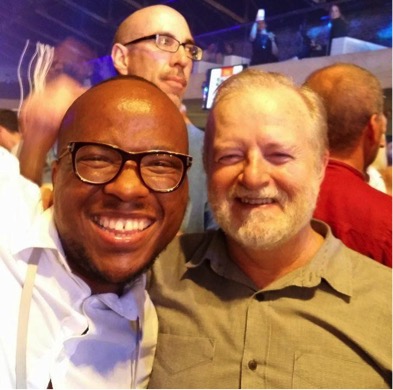
P.S…In this picture, I met my science hero (Charles Greer of McGill Univerity) at a recent conference ( I had been following his updates on Twitter) and Angel Valverde (University of Pretoria) brilliantly photo-bombing us 🙂
[1] Personal accounts on what worked and what did not.

 SAYAS BLOG