Curating research: moving beyond the notebook

As a researcher, in and out of academia, curating your ideas and findings is important. A notebook and a pen were my tools of choice… until the day I accidentally put one of my notebooks in the washing machine. The notebook contained months of research notes for my doctorate as well as ideas for future research. That day, my love affair with notebooks somewhat dimmed — much like a long-term romantic relationship that has run its course. There is care, even a familial love, but the spark is forever snuffed out.

The soul-destroying experience of accidentally erasing/obliterating all of my work forced me to find other tools to curate my research and my ideas.
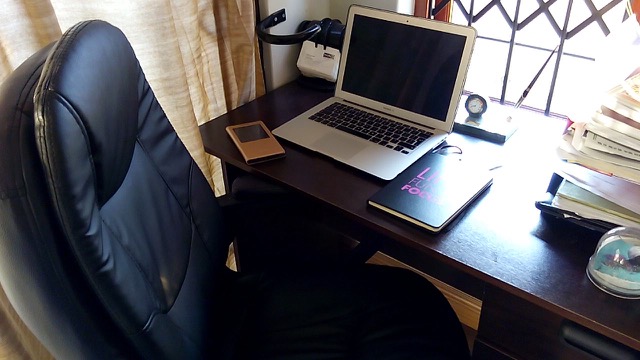
OdiDesk
Notice the important absence of any liquids and nearby washing machines

I get inspiration everywhere: social media, television shows and life in general. My caveat however is choosing what you allow to shape your imagination. Anything that catches my fancy gets clipped onto Evernote or written in my notebook.
These tools, incidentally, are the same tools I use when I conduct research.

I played around with a few options and my favourite tools are freely available: Evernote, Mendeley and Google Drive. All these applications are both on my smart phone and my laptop. This helps because even if I have had to take a long break thanks to a sick child or a prolonged period of load shedding, everything is readily available to me.

The first tool that I found was Evernote. In my opinion, this tool should be in every researcher’s arsenal. It is an application that works on your mobile devices as well as your computer. It allows you to write notes, clip web articles, project manage… it basically is my notebook on steroids. Julio Peironcely wrote a fun, but useful, article titled, 7 Smart Ways To Use Evernote For Research As A PhD. If you decided to give Evernote a try you should take a look at Elizabeth M Covart’s article on the uses of Evernote from a historian’s perspective. Personally, what I love about Evernote is that I could write a note on my mobile phone and when I get home all I have to do is press the sync button on the Evernote app on my laptop and voila! I can continue my work at home.

Mendeley is another tool that I have decided I cannot do without. The faculty  librarian at my university directed me to this application as well as few other similar apps. It is installed on all my mobile devices and computers and I love syncing. It allows for managing research papers and it also has a Word plug-in, so you can insert your citations and bibliography directly from Mendeley into your document. It also has a function that allows for collaboration with colleagues.

Google Drive is a storage application that puts all your information on the cloud. This is very important for me because I record all my interviews on the sound recorder on my mobile phone and save it to Google drive. Not only is this now saved for future reference but also it is synced to my laptop so I can get to work as soon as I have time.

I still travel with a notebook even though I don’t use it as much as before. It is still great to hold on to just because, at some point technology may fail you, and it is always good to have a back up – just don’t put it in the washing machine.

Permanent Head Damage: PhD lessons learnt so far

There are things that I didn’t see coming when I started a PhD. Bearing in mind that I did a Master’s that was largely independent and certainly felt like a PhD, I was completely surprised how overwhelmed I felt starting out. I really am in a great environment filled with not only two highly experienced and motivating supervisors but a suite of senior scientists and post-docs that are exceptionally passionate about their trade. I can’t but help imagine what hell PhD must be for people who have none of these things, because truly, this is the hardest thing I have ever done.

As a bit of an overachiever and perfectionist, my experience of the transition to grad school was devastating. In undergrad it was easy to see that I was on the right track – get an A and you pretty much understand your work- but progress in higher degrees is very hard to gauge. Your positive reinforcements come from getting awards and grants and being asked to speak at conferences, for most of which you are competing with people who are seasoned professionals. So, you have to celebrate really tiny successes whenever they occur. I have learned to become overjoyed when controls work in an experiment and celebrate everyday my cells look happy. I’ve also learned that things will take at least 3 months longer than what is planned and am slowly learning to let go of things I can’t get done. Most importantly, I’ve started to see the light, and I’m pretty sure it’s not just my life going up in flames (although that is sometimes how it feels).

Dog fire
From http://weknowmemes.com/2014/09/this-is-fine-meme/


If you are just starting out, I’m going to throw you a bone. I am by no means a seasoned PhD candidate but I can reveal to you several pieces of advice about things no one really wants to talk about – especially in a world where saying you aren’t coping means you may have to cope with no funding.

  1. When fielding “how is your PhD going” questions from people who clearly don’t think that doing a PhD is a “real job”… I like to use unnecessarily big words. An example would be, “I am currently analysing the nuclear fission impact of a quark.” Having just bamboozled them, I can silently take joy in the knowledge I have no idea what I just said. Lesson one: don’t let people make you feel small or silly because you chose a difficult path.
  2. You will occasionally feel that a fog has settled and that “Keeping up with the Kardashians” is looking pretty good right now (a sad aside; Microsoft Word just autocorrected “Kardashians” for me).
  3. Sometimes my days feel like wading through molasses and others like running against Usain Bolt. Learning to cope with the pace of a doctorate can be daunting; try to stay organised. I use OneNote for everything and I feel comforted that my lab book and my hair appointments are all in one place.
  4. Everyone feels overwhelmed, but very few people will speak about it and its best to realise early that people don’t always want to. Some people would rather make strange barking noises in the corridor. But that’s ok too. People all cope in different ways and the good thing is that they are coping, so don’t knock them for the way they deal. Some people sink into a depression, which is scarily common (read this great article on the link between mental problems and academia).
  5. You will feel overcome with an occasional sense of disaster and that you will not make any difference to the world. The difference will be small, but it will be made. I call this stage Stage Impending Doom. This usually occurs around the time industry starts to look particularly wonderful- sometimes not even in the field you have studied. I have found myself wondering what it would be like to be a cashier in a clothing store.
  6. Dating isn’t easy. It never is. Very often the person you are dating will never do a PhD and doesn’t understand the magnetism of this stage of life. My personal opinion? Don’t make major life decisions during your PhD. But, on the flip side of that I have known many wonderful scientists who have planned weddings (sometimes married each other!) and had babies all while succeeding marvelously.
  7. If you don’t feel like throwing in the towel at some point, you are not normal. In fact they should just give you your PhD upfront. A very prominent scientist in my field asked me how many times I had quit my PhD once while socialising over finger foods at a conference. I gave him a puzzled look, “well….never.” He proceeded to tell me how he had quit 3 times. Perspective is an ironic beast.
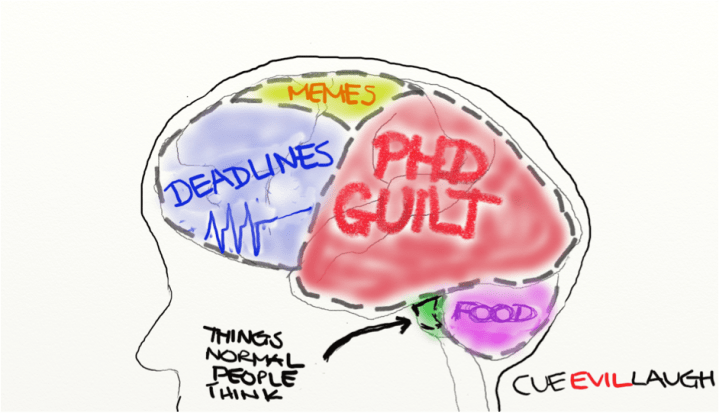
  8. I feel guilty all the time. Out with friends? You should be writing. Going to gym? You should be writing. Having lunch? YOU SHOULD BE WRITING. You get the picture.

    dog science
    https://za.pinterest.com/pin/321514860871188497/
  9. Every once in a while you will have imposter syndrome where you feel you have no idea what you are doing. But remember: You belong there and you are not simply a Labrador holding a pipette.
  1. You have to learn not to take yourself too seriously. There is a fantastic website that oversimplifies PhD theses (An example; Actual title: Somatotopy of Second Order Lateral Line Projections in Larval Zebrafish. Simplified title: Fish are friends, not food. Until you inject them with rabies and then they’re neither). Give it a read and suddenly your project will really become great again.
  2. Having a great supervisor really is important. Yes, you are responsible for your thesis and work, but having an experienced ear that I can rely on has truly been the biggest blessing I’ve had so far. Navigating the murky waters of science politics is an unexpected terror I have frequently and having back-up is imperative.
  3. Be kind to those newer than you. Some newbies will come to compete with you, even though you have nothing to compete for. Try to be patient and don’t get swept up in this. Maybe they are just trying to gauge how good they are and they are struggling too.
  4. It is entirely possible to spend your stipend on snacks.
  5. It will be hard to watch your friends in different fields move on with their lives (houses, weddings, families) but your time will come, it will likely just take a bit longer.
  6. Always try to maintain perspective and to remember why it is that you wanted to do a PhD. Try not to forget that a PhD is pushing the boundary of all human knowledge. Quite frankly, I think we all need a standing ovation just for that.


The best piece of advice I have is that PhDs have been done by at least 15 million people on earth. You can do it too.

head case