Boosting brainpower: drinking your way to success

The past month has been a whirlwind of scientific activity- starting new experiments, conferences, and writing manuscripts. In my recent blogs, here and here, I discuss how I navigate the scientific twitterverse and the power music has on my mental health and acuity. Notwithstanding all of these, in this blog I want to discuss how maintaining a healthy diet helps me stay focused and calm under pressure. Please note – I am neither a dietician nor a health professional and the tips that I share are what works for ME and may not necessarily apply to you.

 When you visit any graduate student lab there is always a coffee pot brewing, and our office is no exception. But, I remember during my masters I only drank green tea and coffee was never my thing– how things have changed! Coffee culture has become an integral part of the academic machinery; I am convinced that coffee and tears of graduate students fuel the whole machine. I have found that drinking a healthy dose of coffee (about two pots a day for me) keeps me focused and I do not have any adverse side effects. Coupled with my coffee, I find snacking on raw vegetables/fruits keep my system alert and functioning optimally. Also, I find that being a vegetarian gives me more snacking options and energy than my meat-eating counterparts (well, the ones I know ).
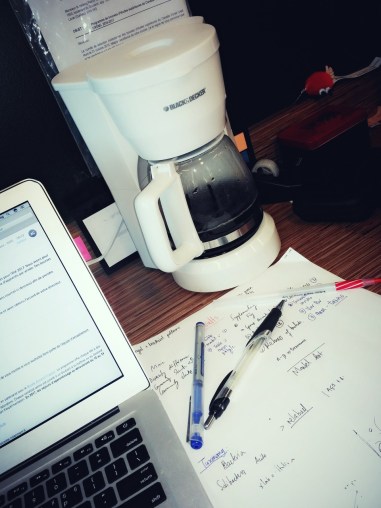
coffee
The desk of this caffeine-dependent postgrad

In recent years, there has been a growing concern amongst academics regarding the use of brain-enhancing drugs to improve performance. Melinda Wenner Moyer (@lindy2350), a science journalist, wrote a brilliant article for Scientific American, here. In it, she focuses on the issues concerned with the use of Modafinil– a drug prescribed to people who suffer from narcolepsy/sleep apnea, but in healthy individuals, it has been shown[1] to heighten alertness and provide cognitive enhancements. Another report from the UK indicated that 1 in 5 academics have admitted to using Modafinil. However, before you start running to your pharmacy to get the drug- it is worth noting that many neuroscientists are concerned about the long-term effects of these drugs on a healthy brain. Furthermore, the ethical issues that surround the use of these medications are yet to be resolved.

To return back to topic, I am fascinated about what people use to stay awake when ‘burning the midnight oil’ so to speak. For me, it is coffee + snacks, and for my some of my colleagues it is simply taking vitamin B12 supplements and that suffices. A friend of mine can only write when they are in the library – maybe the musty smell of books is a boost? What are some of the techniques that you use to stay alert? Is there a special diet or supplements you take?

[1] Results varied across different studies

Building a cohesive world

“Dream,” by Mathapelo.

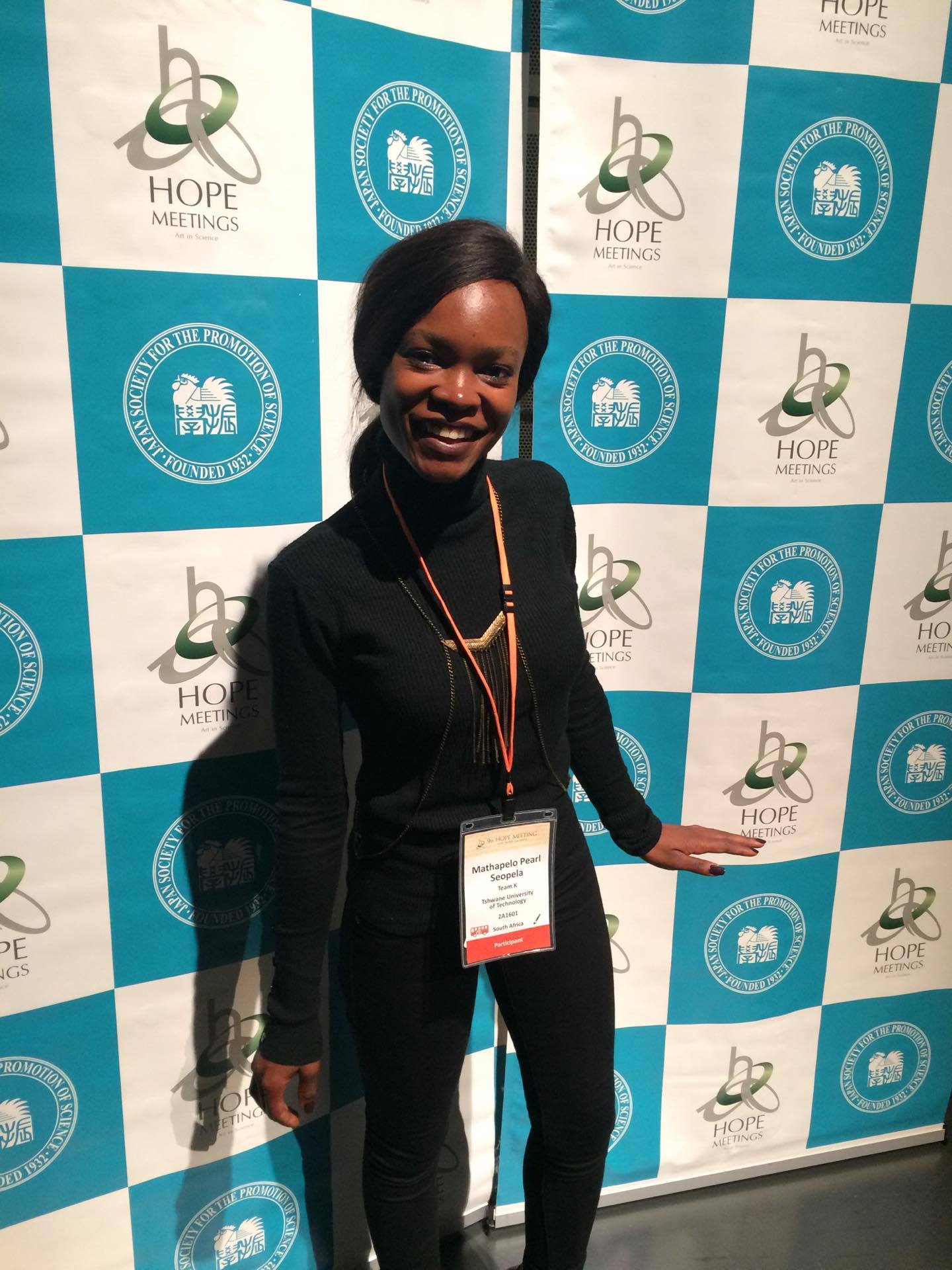
I recently had the opportunity to attend the 9th HOPE Meeting in Japan, with 110 delegates. This was quite an educational and exciting opportunity. Apart from learning about the culture and people of Tokyo, which included writing in Japanese, we had the chance to interact with Nobel Laureates. Through their unwavering consistency, these researchers achieved major scientific discoveries.

A Nobel Prize medal that belongs to Professor von Klitzing.

They, of course, gave us lectures on their Nobel winning work, but we were also given the opportunity, in small group sessions, to have discussions with the Laureates. These included their mindset, postgraduate journey, challenges and triumphs. They highlighted their need for consistently seeking knowledge, asking and answering questions differently, as well as resolving problems. They key driver to their success was the environment they were in at every stage of their lives.

The need to create relationships with people not only assisted them in growing as individuals, but also fostered their involvement in intercontinental research.

Team K

And we had the experience of true team-work and thinking with those who can challenge you. We we placed in teams, comprising exceptional doctoral and post-doctoral students from the Asian-African-Pacific regions. WOW!!! My passion was truly galvanized by this group of individuals. All teams arrived at similar conclusions: if we don’t work together, our progress as a world will be tainted. And, if we resolve mundane or even global problems, do the people who can use these solutions have access to them? We need to create platforms that ensure that science is not restricted to formal publications, but is distributed to societies through platforms they regularly have access to.

Photoshoot

Each delegate also had the opportunity to present their work. This was done in the form of a 60 second presentation and poster! If you haven’t done this before, you have no idea how hard it is to condense your life’s work into a single minute…The works covered ranged from chemistry to out of this world science (astronomy). I left the meeting feeling that the future is indeed bright in the hand of the young people I met there.

As we thrive to become individuals in a world full of pressures, in addition to inner drive, it is through the relationships we build that we are propelled into becoming better beings. Most of the idioms that carry us through the perils of life, mostly talk about giving rather than receiving. A Chinese adage I often reflect on speaks to “the life of a candle never getting shortened by giving light to another”. We cannot evolve as individuals and society without the aid of people that we come along in our path. On the whole, South Africa – at its best – is a true reflection of this example. Ubuntu: working together, encouraging each other and effectively bringing change to our world.