Setting Educational Precedent in a Time of Crisis Furthers Inequalities (Part I)

Should online Schooling as the ‘new normal’ leave older teachers behind?

The concepts of ‘e-learning’ and ‘online schooling’ are filled with a near magical aura of curiosity and novelty. When I hear these terms, I tend to think of words and phrases such as modernity, technologically advanced and futuristic. The truth is, I’ve always wondered what it would be like to teach online. I never ever thought, being a Primary School teacher, that I’d have an opportunity to do so. Enter COVID-19.

As educators begin the controversial migration back to our ‘natural habitat’, AKA the physical classroom, I am finally offered a moment to breathe, take stock and evaluate how the past seven weeks have gone. Since the initial announcement by Minister Motshekga that all schools were to be closed due to the COVID-19 pandemic, a number of wealthier and well-resourced schools began offering various forms of online schooling to its learners. My own experience of these past few weeks was filled with a sense of excitement and fascination in the beginning but was quickly turned to a sense of worry at the number of challenges that educators across the country began to face as a result of these sudden changes.
Laying all the emotions aside, I think it wise to stop and recognize the past few weeks, and this current moment in history, for what it is. A sombre, life-altering moment that has the potential to change every aspect of how we look at education and our educators – for the better or for worse.

What do I mean exactly? Well, in common law legal systems, a term that is widely used is ‘setting precedent’ (Lamond, 2016). This roughly means that a certain case or situation in the legal courts establishes a principal or rule that must be adhered to by lower courts. Stare decisis is the Latin term and offers a slight nuance to the above attempted definition. Stare decisis invokes the idea that decisions are made based on previous decisions (Timothy, 2017). There is no room for deviance if one invokes Stare decisis. Now, I do realise that I cannot equate the legal system to the education system as they are two distinct structures, but the danger I see today is that by making use of technology and online schooling in such a rapid and sweeping manner (due to COVID-19) draws the danger of setting precedent (Stare decisis) across the country’s unequal and imbalanced education sector. The sad truth is that in our current neoliberal world, it is often the neoliberal elite (and all of us stuck in their world) that tend to invoke Stare decisis upon others, without ever even realising it (Harvey, 2005).

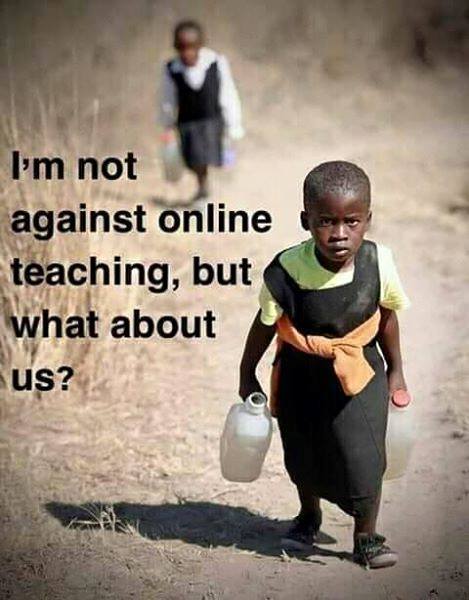
If those in the wealthier parts of society rush towards this new precedent, without realising what it does to the poorer inhabitants of our country, we risk furthering the already disastrous inequalities in South Africa. A quick cursory look at inequality in schools and we will see that some schools barely have a functional roof to provide shelter (Servaas, 2007). How on earth are they going to ‘follow precedent’ by conducting e-lessons? Can our society still claim to be in search for quality equal education with such neoliberal agendas at play? I think not.

If these neoliberal elite rush towards setting precedent, where online teaching becomes the new normal (or the way of showing excellence), then we also risk losing out on a number of experienced educators who have not been able to adapt to the sudden change of new technology. Human Capitalist Theorists will say that this phenomenon is part of the economy’s evolutionary life (Livingstone, 1997). But saying this removes the affectional value of human beings. Education should not be a conveyer belt for human capital in an economy. The dangers and negative side effects of that philosophy are huge, but the most important aspect of having education feed a conveyor belt for Human Capital is that is takes away teachers (and learners’) critical skills and pushes them towards the preconceived notions of economic life and the capitalist rat race that is inextricably linked to it. Education, I believe, should be about forming and moulding human beings into creative, critical thinking humans with free agency.

The original notions of neoliberalism are surprisingly similar to my belief about education. Harvey (2005, p. 2) describes the theory of neoliberalism as one that “proposes human well-being by liberating individual… freedoms… and progress”. The current neoliberal system, however, is a far cry from what its original theoretical framework attempted to achieve.

This current neoliberal system demands new, updated and relevant human capital and It does not give any second thoughts to the consequences of the lives and livelihoods of those that have become redundant. It does not seek the well-being of humans. Educators are considered mere pieces on a chessboard of the system’s self-imposed strategies. Proof of this is evident when the system harshly says that older teachers are to become obsolete if they do not upskill their knowledge of technology. How demoralising for those human beings must it be to be considered defunct and non-operational? Even worse, the system calls them ‘unwanted’ and ‘undesired’ in the Human Capital sense. How dare we set precedent in this way. How dare we toss these hard-working, selfless educators aside in the name of economic progress, excitement and fascination for technology.

I submit to you that setting precedent in this way is dangerous. As teachers across the country begin to forge a ‘new normal’ amidst the COVID-19 crisis, let us not do so to the detriment of our fellow educators and to the detriment of those we are called to educate. There is a better, moderate and less ‘invasive’ way to achieve a ‘new normal’.

Part II coming soon. 

Works Cited

Harvey, D. (2005). A Brief History of Neoliberalism. Oxford: Oxford University Press.

Lamond, G. (2016, Spring). Precedent and Analogy in Legal Reasoning . Retrieved from The Stanford Encyclopaedia of Philosophy: https://plato.stanford.edu/archives/spr2016/entries/legal-reas-prec/

Livingstone, D. (1997). The Limits of Human Capital Theory: Expanding knowledge, informal learning and underemployment. Policy Options, 9-13.

Servaas, v. (2007). Apartheid’s Enduring Legacy: Inequalities in Education. Journal of African Economies, 849–880.

Timothy, O. (2017, March). Stare decisis. Retrieved from Cornell Law School: Legal Information Institute: https://www.law.cornell.edu/wex/stare_decisis
The right to be wrong

Does the right to freedom of speech include the right to be wrong?

There is a touch of irony in one of the defining characteristics of the Information Age being #FakeNews, and in recent years the impacts and origins of #FakeNews have become the subject of much research. A Council of Europe report describes the term as “woefully inadequate to describe the complex phenomena of information pollution”, and that because it has been “appropriated by politicians around the world to describe news organisations whose coverage they find disagreeable” it is “becoming a mechanism by which the powerful can clamp down upon, restrict, undermine and circumvent the free press”. The report opts instead to use the term Information Disorder, and uses harm and falseness to divide the types of information into three sub-categories:

  • Mis-information: When false information is shared, but no harm is meant
  • Dis-information: When false information is shared with the intention to cause harm
  • Mal-information: When genuine information is shared with the intention to cause harm, typically by publicly sharing information meant to stay private

Tackling information disorders is a complex and multifaceted problem for various institutions within the scientific establishment. These include fringe movements such as “9/11 truthers” rejecting the analyses from engineers, material scientists, and demolition experts over the collapse of the World Trade Centre towers (#JetFuelCantMeltSteelBeams), to more well-known anti-science movements such as the Flat Earthers, anti-vaxxers, and the anti-GMO movement. For the large part I don’t think we as a society take these movements, and information disorders as a whole, as seriously as we should. However, as the COVID-19 pandemic grips the world, the narrative around information disorders has shifted. Multiple countries, including South Africa, have criminalised the spreading of false information surrounding the disease and this has raised the question of whether our right to freedom of speech includes the right to be factually incorrect.

As scientists we can get lulled into thinking those who perpetuate information disorders are an isolated group with whom we have little contact, but this is not the case. Recently a family member of mine posted a lengthy status on Facebook relating to the COVID-19 pandemic. The post claimed that the virus was a plot to destabilise the capitalist economies of the Global North, that communist countries had not been affected by the virus, and that the Chinese government already had a cure that was being hidden from the world but used to treat their own citizens. This post was one of the many I had seen discussed online, dripping with racist, sinophobic, and anti-science rhetoric. The only difference was not an abstract example on someone else’s timeline, but a very real post by a healthcare professional I knew personally. I wholeheartedly believe that we all have an obligation to tackle information disorders wherever possible, particularly when it is perpetuated by those close to us.

In our exchange, the poster (Person X) justified their sinophobia by referring to the reported brutalities of the Chinese government and the cultural differences in animal consumption between Western and Eastern societies. However, this is both an example of othering and whataboutism that only seeks to divert the attention from the racism and sinophobia under question. As Jonathan Kolby states in Coronavirus, pangolins and racism: Why conservationism and prejudice shouldn’t mix “environmentalism and conservationism are noble and vital pursuits” but “dialogues about coronavirus should not allow the topic of wildlife conservation to provide a smokescreen for prejudice”. Gerald Roche gives a superb discussion on the wider societal effects of this in The Epidemiology of Sinophobia, but this is not what I want to focus on for this post.

On top of trying to justify their prejudice, Person X posted follow-up comments with information that was more scientifically sound but in direct contradiction to the original post. Person X justified this by saying that they were not an expert in this field, that the original post was copied and pasted from an unknown source, and that their intention was to present information from both sides. The interaction between myself and Person X ended with the following comment, after I questioned why in the midst of a pandemic a medical professional would choose to share false information that could easily have been verified before posting:

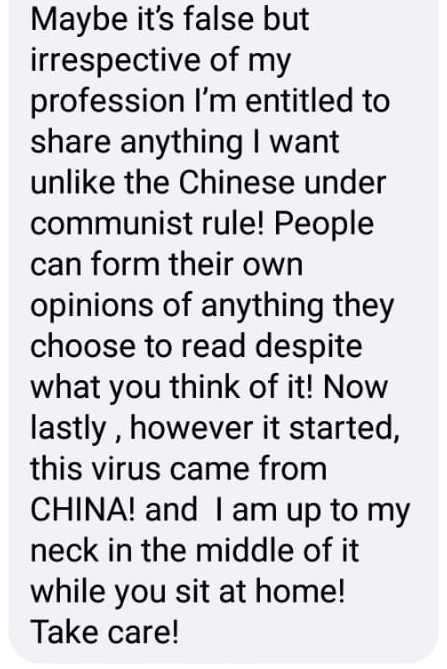
Person Y came to the defence of Person X stating that we are all entitled to our own opinions regarding the virus, and that they are “not really phased what that is” but “when [I] sit behind [my] phone or laptop and comment away while people are putting their lives at risks and in the trenches fighting all over the world, just be careful what [I] say. If [I] know everything about the “claims” then [they] would recommend going to assist with fighting this virus, fruit salts.”

The sentiments of both these people raise three questions:

  1. Does sharing information from multiple sources in an effort to present all sides of a story make one guilty of contributing to an information disorder if the information is factually incorrect?
  2. Is everyone entitled to an opinion, no matter how falsified it is?
  3. By virtue of their work, are frontline workers above criticism for their opinions?

To answer these questions we need to look with both a scientific and legal mind, which is a unique opportunity the COVID-19 pandemic provides us. At the time of writing this, at least eight people had been arrested for being in violation of COVID-19 Disaster Management Regulation 11(5). This regulation states that “any person who publishes any statement through any medium, including social media, with the intention to deceive any other person about a) COVID-19, b) COVID-19 infection status of any person, or c) any measure taken by the Government to address COVID-19 commits an offence and is liable on conviction to a fine or imprisonment for a period not exceeding six months, or both such fine and imprisonment”. What is important here is how intent is defined. In this instance the legal definition of intent is not just a person meaning to deceive others by sharing false information (Dolus directus), but also a person seeing the possibility of others being deceived before sharing the false information (Dolus eventualis) or a person genuinely believing the shared false information to be true themselves (Dolus indirectus). The three legal definitions of intent align quite heavily with the three categories of information disorders.

This legislation places a responsibility on all of us to check the validity of the information we are spreading, and I hope going forward this experience places this responsibility in the forefront of our collective conscience. If we do not know enough or are not willing to critically evaluate information that is presented to us, a safer option would be to not perpetuate the information at all. In The Salmon of Doubt Douglas Adams penned, “All opinions are not equal. Some are a very great deal more robust, sophisticated and well supported in logic and argument than others”. A central tenant of a democracy is the right to hold an opinion, but these opinions should not shielded from criticism and debate. In fact, one of the health indicators of a democracy is the quality of the debates. In doing this however, we must critically assess which opinions are worth debating, discarding those not founded upon evidence instead of debating for the sake of debate.

I believe the desire to share all sides of a story is a result of how the media has approached presenting complex stories in the past. All too often we see panels consisting of experts such as medical virologists and meteorologists seated alongside non-experts such as anti-vaxxers and climate-change denialists, for the sake of “balance”. This gives a false legitimacy to the side whose opinion is not supported by scientific evidence. I advocate for deplatforming people who hold opinions and beliefs that go against established scientific theory, such as the safety of vaccines, the effectiveness of genetic modification as a breeding tool, or the impacts of anthropogenic climate change. This is not to say that I don’t believe that these complex topics have nuance which needs to be unpacked debated, but rather that we would make better use of our time debating amongst experts over said nuance rather than with those who reject reality. This includes “front-line” workers of all types.

I believe the responsibility of ensuring your opinion is backed by facts is heightened when you are in a position of perceived authority as a front-line worker. In this instance I regard anyone who works directly with the public as a “front-line” worker, as these professions will have the largest influence on public opinion. In the case of the COVID-19 pandemic, when front-line workers such as nurses and doctors share false information, they undermine the work and credibility of the entire industry that supports them. The is includes everyone from the virologists working on understanding the virus, to the research groups working on developing a vaccine, to medical researchers working on developing treatment protocols, to government agencies trying to coordinate disaster relief efforts and reduce the spread. In perpetuating false information, these front-line workers reduce public support for these highly coordinated efforts, eroding the public’s trust in the scientific establishment, increasing tensions both locally and globally, and ultimately costing us lives as the public becomes less likely to follow guidelines aimed at reducing the spread of the virus.

Too many lives have already been lost from information disorders surrounding life-saving technologies such as vaccines and biofortified GM crops. If there is only a single positive thing to come out of the COVID pandemic, I truly hope that it is us a society taking the threat of information disorders more seriously.

Richard Hay

@HaysHarvest