“You may write me down in history
With your bitter, twisted lies,
You may tread me in the very dirt
But still, like dust, I’ll rise.”- Maya Angelou
When my editor approached us about writing a post for Women’s month, I was caught off guard surprisingly. What would I speak about? It is difficult to write about topics that are close to your heart, sometimes they are triggers, sometimes they get you fired up, sometimes they make you cynical about the world. That was the dilemma I found myself in, there is so much to discuss being a woman, not just in STEM but generally in life, there are so many challenges but at the same time there are so many successes, so much inspiration and ultimately so much resilience.
In a world that is truly designed for men (I mean that in the most literal sense, check out this article by the BBC and this article in The Guardian and prepare to be SHOOK!) it may seem like a constant uphill to carve a space for women. One thing that has helped us, though is our ability to come together and to build communities and support systems. The strength that comes from women uniting for a common cause is something that is truly awe-inspiring, it reminds me of a video I once watched of Army Ants who had held onto each other tightly to form a raft to survive a flood in the Amazon jungle. I use this analogy for a number of reasons, 1) people often think ants are small and insignificant however they are pretty incredible, 2) people underestimate how smart they are and 3) they are strong in numbers, just like the women in science that I know. The world has tried to crush them, but they have prevailed, the system has tried to force them out but they have stood strong.
They continue to rise, like dust
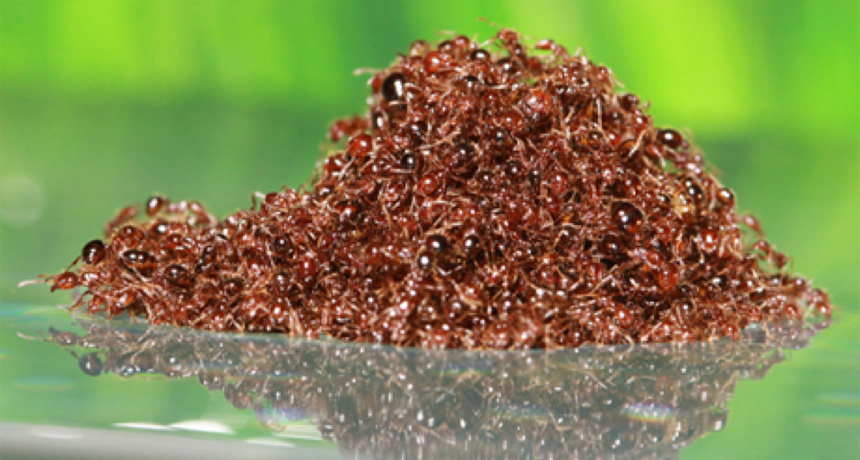
So, the purpose of my women’s month post is to highlight my own support structure and some of the incredible global initiatives that have provided a space for women to talk, connect, vent, draw strength and reflect on the past, present and future. These organizations are doing the important work of uniting women from all walks of life and providing them with a shared safe space in order to foster much-needed conversations but make no mistake, they are not all talk!
South African Young Academy of Science (SAYAS)
Although SAYAS is a platform for PhD candidates (not only women) this year was a special one because the entire team of bloggers and our editor all happen to be women! I have learnt so much from Joyful, Sesetu, Munira and Roula and I am grateful for our meme sharing, motivation and support of each other. Ladies, we have had a beautiful year together and I cannot wait to watch you all dominate your respective fields, it has been a complete privilege to share a platform with you. I look forward to hearing the future voices on here talking about the groundwork we once laid!
Black Women in Science South Africa (BWIS)
2019 has clearly been a fantastic year for me! I am also very honoured and privileged to have been selected as a 2019 BWIS Fellow. Black Women In Science (BWIS) is a registered NPC which aims to deliver capacity development interventions that target young black women scientists and researchers. Black Women In Science develops professional research and science conduct, leadership and mentorship skills for women within all scientific disciplines, in tertiary intuitions and professional environments nationally and internationally. The organisation was founded in 2015 by Ndoni Mcunu (CEO), google her, she is so incredible and there are far too many accomplishments to list!
This organization serves as a platform for telling the stories of emerging women in science. The forward was written by one of my icons in science, Prof Himla Soodyall and if this quote doesn’t make your arm hairs stand on edge then I do not know! “As I read through this collection of young women’s stories, marvelling at how their journeys through life have brought them to their current destinations, I am struck by a common theme that emerges through them. It’s a theme linked with sacrifice and passion to overcome challenges and a compelling drive to achieve one’s best, but at the same time to give back to society.” – Prof Himla Soodyall

Association of South African Women in Science and Engineering
The Association of South African Women in Science and Engineering (SA WISE) is a dynamic association for all those who support the idea of strengthening the role of women in science and engineering in South Africa. The website contains profiles, information about funding and links to other important resources. One to keep tabs on.
InspiringFifty is a non-profit that aims to increase diversity in tech by making female role models in tech more visible. The organization releases an annual call for nominations of inspirational women so keep an eye on their webpage and make sure to nominate the women in your life!
1MWIS (1 million women in STEM) is a campaign seeking to profile a million women working in STEM disciplines to provide visible role models for the next generation of girls. There is now a significant amount of research showing that visible female role models serve to increase the number of girls pursuing STEM subjects in higher education and of those role models, real women (over celebrities, historical figures etc.) have the most influence. To date, they have highlighted the work of over 300 women from different fields who are challenging the status quo and driving change. You can follow them on Twitter at @MillionStem

500 Women Scientists is a grassroots organization started in America but now has a global network of local ‘pods’ to build communities and foster real change that comes. Local pods allow for a personal experience where members can meet often and in-person in order to exchange ideas. The pods focus on issues that resonate in their local communities but rooted in the larger 500 Women Scientists mission and values.
In South Africa, less than 20% of sources quoted in the news are women and this online database of professionals seeks to change this by providing a resource for local and international journalists who are looking for comments! You can add your name to the database as an expert in your respective field.
In 2018 I was fortunate enough to publish an article through The Female Scientist (I am sure you know about this platform by now because I mention it all the time in my posts) on my experiences as a woman of colour in academia (I cannot speak to everyone’s experience- only my own) titled ‘Ebony in an Ivory Tower’ and my view on the position of women in STEM then was quite bleak. Today, although the challenges I mention in the article are still ever-present, I am more optimistic because I have met with women, spoken to women and been comforted by women who have fought alongside me, for me at my weakest and against me at my most cynical. That is the beauty of the life raft we have created together, it keeps us afloat, but it helps us to realise that it is always darkest before the dawn.
The article I had written ended like this: “We need our voices to bellow through the ivory tower, until the vibrations of our collective pain, anguish, and ultimately hope, rattle the foundations and bring it to the ground. Because we love a science field that never loved us and instead of hiding in the shadows of this unhealthy power dynamic, we stand in the sun and demand a day when science acknowledges who we are.”
Ladies, thank you for standing in the sun with me.
 SAYAS BLOG