Directing things differently: A Guide for the Undirected Learner

Do you ever think back to your choices and personal patterns that played out during an earlier phase of your life?

Though the lens of reflection may not be one of regret, I still frequently pull on those memories. While flipping through my mental album fondly, I wonder what may have been different if I saw my university life as a feature film.

It could have been my overwhelm with re-engaging my mind into calculus algorithms and learning about DNA replication machinery for the first time, but I found it really challenging to maximize my “first-year experience”. It was only during my academic third year that I felt like I had figured out how to do what I needed to do and balance what I wanted to do. Now that I’m a few years further in my learning, I realize there is precedent for consistency over perfection. For any future “firsts” – for me, or for you reading this right now – I want to reimagine life as a movie, drawing on these themes…

The Stage: Your mental health is more important than good marks. Be brave. Seek help.

The Protagonist: Participation is “so totally in right now”. It may be overwhelming at first, but you are likely judging yourself more than anyone else in the class is judging you. This falls away when you participate unashamedly.

The Antagonist: You’re here because you want to be, right? Be excited. Your course work isn’t a chore; it’s a choice. Attend every extra class, tutorial, workshop, or Q&A session that is available to you. If you still feel stuck, ask for more! Your success is in your hands.

The Set-Design: The library is your friend and your greatest resource. An unimaginable number of people have sat where you are now; reading the books on the shelf and soaking in the privilege of knowledge acquisition.

The Producer: There is always more work to get through, so try your best to stay on top of it. Do preparatory reading from the textbook or supplementary materials; consolidate with your given lecture notes. It almost never pays off to be writing furiously while you learn, so (vaguely) understanding the topic before you even enter the classroom will help you grasp where you get lost on the content.

The Director: You are a human being, not a productivity machine. Prioritize your rest, and rest well. Play frisbee with your friends on the weekend or join a mid-week poetry slam. Take up your interests! Join the society and attend the meetings. Want to rock climb? *Send it! Curious about ballroom dancing? Step into your salsa-self! Do the fun things that you convince yourself are less important than punishing yourself for not working 24/7.

The Distribution: Time waits for no human. You have enough time if you plan well and prioritize your tasks. Centralizing your resources and your to-do’s will be helpful, so that you know you don’t have to look around to find the hand-written paper notes from that lecture on Friday. I should have downloaded all my lecture notes onto one online- or hard-copy drive and used a task-management app to set more specific daily, weekly, and monthly goals.

The Hall of Fame: Be curious with your lecturers. They are primarily people with an intrigue so great that they committed to teaching younger people about it. Ask, “How did you get to this position in the faculty? What are your interests in this field and what advice can you give me for reaching these personal goals?”.

The Supporting Acts: Make friends with people outside of your course! The field you have chosen to study makes up a tiny portion of the student body. Challenges your views and your interests by dissolving boundaries between faculty niches; to encourage interdisciplinary thinking from an early stage of your “career”. Build a broad community that nourishes itself.

The Film: These years spent at university come with the full range of human emotions. Document these years – in journal-writings, or in photographs, or in a playful short-film made with your friends. There’s nothing like a little nostalgia to redirect your perspective. Rewatch the movie. Release an even better sequel. 

Ultimately, though, what wins the category for “Best Personal Project” is a project that I have poured myself into wholeheartedly.  Will we look back and say that for whatever we’re working on now?
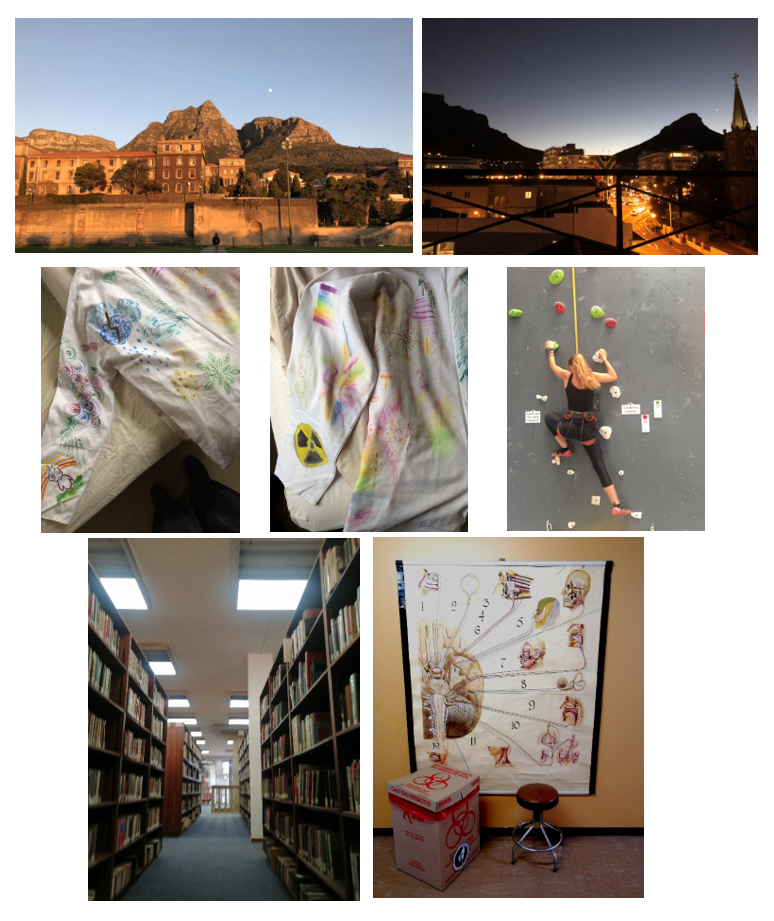
*To “send it” is a rock climbing (and other extreme sport) reference that encourages someone to follow through on the next move, regardless of how daunting it may seem.

Photos of some “firsts”, from top left to bottom right: University of Cape Town from the field, in my first year; my first night out at The Waiting Room in Cape Town; my first lab coat, painted on by my friends; my first time rock climbing in 2018; my first visit to Wits Education Library; my first day as a Bachelor of Health Science (Honours) in Neuroscience student

The Gift/Burden of Hindsight: Things I Wish I Knew Before Starting my PhD

Starting a PhD is never for the faint-hearted. And yet, that is exactly what I decided to do three years ago, when I was freestyling research ideas with friends over white wine on a summer evening in 2021. Since then, a lot has happened by the second-year mark of this degree. So, as a gift to you the reader (and myself), here are five lessons I have learned that I wish I knew before starting my PhD.

1. Discernment is a Practice

Knowing the difference between who your colleagues, acquaintances and friends are such an important part of forming your support system. We are all aware that being a postgraduate student is a lonely process, and with that, we work in anticipation that many of the long diligent writing sessions will be just us and our laptops trying to get our thoughts out. But that does not mean we don’t make connections – academia does requires some community. But by being so caught up in connections for the sake of connections over instead of practicing discernment and self-preservation is something that I wish I had been more cognisant of. Unfortunately, not everyone in academia is your friend – where you are seeing a kinship forming, others may be seeing as an opportunity to size up their own trajectory against yours. And this comes with its own reasonings – we know that jobs in the academic sector are scarce, and this seems to have filtered down into people’s mindsets of how they can also treat other people. Which is sad but a sobering experience.

2. Harness Technology to Work Smarter

Another thing I would be aware of, is knowing what software or AI tools I would like to use for research. What academia looks like now compared to even 10 years ago when I was in undergrad is a completely different experience. But new technology aside, we know that working smarter and not harder will always pay off in the long term. Therefore, cluing myself up on the relevant tools that will speed up the research process is something that I would want to ensure beforehand. Examples include the well-known Mendeley and Open Knowledge Maps.

3. Double down on a Reliable Routine

Another thing – routine, routine, routine! As a neurodivergent person, I know that I struggle with sticking to a work plan that isn’t affected by my oscillating feelings towards wanting to work. But at the same time, that does not mean certain delimitations must be put in place to make it easier to have systems in place. Compared to my Masters and Honours, this PhD is the one project that requires way more premeditative effort. This is scary – a last-minute situation is just not going to cut it at this stage in the game. Therefore, knowing that I am aiming towards incorporating writing as a daily practice as opposed to fury-fueled writing bursts is something I’d need to practice beforehand. Being the ‘best’ researcher has nothing to do with writing the most profound thoughts at the strike of innovation. It’s about committing to the practice of showing up and trying over and over again. As someone who finds it difficult to deal with rejection, when I get comments back from my supervisors or am simply “not in the vibe” for writing, knowing that there is a routine that allows for writing regardless of how I’m feeling eases the burden of feeling overwhelmed. And this leads to the next thing…

4. Be Flexible Amid Uncertainty

BE 👏🏽 MORE 👏🏽 FLEXIBLE! 👏🏽 NOT EVERYTHING WILL GO THE WAY THAT YOU EXPECT IT TO! 👏🏽

Since my first blog, I have talked about waiting for my ethical clearance. From then until now, I had my resubmissions rejected thrice before they were accepted. If I had been more flexible, the idea of working on my chapters would not have been an issue. But because I was so fixated on when I was supposed to get the ethical clearance, when I was supposed to start doing my fieldwork, and when I was supposed to start writing, it created a mental block for the majority of 2023. Furthermore, many young black researchers often experience the inability to simply ‘do’ their research because the pressure to not only produce the work itself is an impediment but when they are often at the forefront of discovering novel ontologies and research methodologies, it creates heightened pressure. In a chapter titled ‘Carrying a Double Load’, Dunlap (2022) notes that much of the academic research that black scholars do involves searching for solutions that “only the eradication of settler-colonialism can solve”. This is further complicated by the idea that for many black women scholars, hegemonic knowledge production often does not recognise marginalised voices. Ditto to doubling down on ensuring that you can cover all your theoretical bases lest you are deemed unable to have the range within your discipline. So, being less hard on myself and knowing that due processes are part of the journey, while also having practices to remind me that my worth is not tied to following the ‘right’ timeline is something I would be more aware of if I had to restart this journey.

5. Put Self-Care Practices in Place

This ties into the next point: you have to prioritise your wellness. In an upcoming podcast episode I recorded with AVReQ, I talked about how other than gym and consuming different forms of media (TV shows, movies, and music), there was not much else I did (or did) to contribute to my well-being. I think when you are so caught up in ‘living your life’, the optics and spectacle of trying to build your profile as a young researcher can be all-consuming. But something I would definitely be more intentional about is choosing healthier activities that prioritise holistic re-balancing.