The Bedtime Tale of Brainwaves: A Sleep Story

The science of sleep weaves together nearly every other discipline of medicine. In fact, the curiosity around why we sleep and what sleep can and cannot accomplish for us binds the book of the human experience. I’d be so bold as to say that for as long as Homo sapiens have been communicating, part of that ancient communication has centred around dream recall, symbol interpretation, and ancestral connection.

There was clearly a lot of speculation that came with the phenomena of sleep states, some of which has shifted over the last 200 000 years or so into unanimously accepted “truths”. As sleep is a procedural change from one state of awareness into another, I thought I’d tell a “bedtime” story of that process rather than alphabetically list these terms…

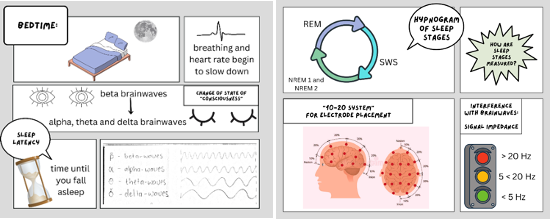
You’ve assumed your comfy spot at the end of a long day. Your eyes delicately blink closed, shutting out the visual stimulation of wakefulness. Your state of consciousness – no, not some esoteric interpretation of enlightenment – speaks to the relative arousal or alertness of your brain activity, characterised by electrical activity between several regions of the brain. From wakeful awareness, your conscious state will slow down into “alpha, delta and theta” states that indicate the initiation of various sleep stages. This slowing is called sleep latency: the time it takes to reach a certain stage of sleep. The initiation of sleep is not only a function of tiredness and closed eyes. At various times over a given 24-hour cycle, our internal body clock releases certain neuromodulators. These are chemical messengers which brain cells communicate through, sending the global signal of “okay, time to slow down these brainwaves and get to bed!”

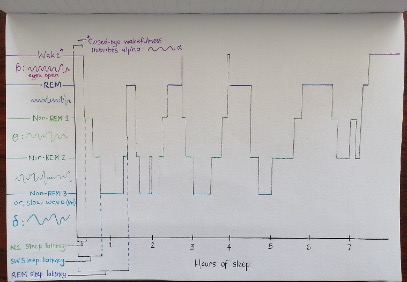
Though everybody has a different pattern of sleep stages, a standard hypnogram – which is the graph representing sleep stages – follows a particular pattern. Usually, the early parts of your sleep are focused on slow wave sleep, and rapid eye movement (REM) sleep increases through the night. REM is when your limbs are inactivated from bodily arousals, and your eyes move quickly, as the activity in your brain resembles a hustle and bustle that is representative of wakeful awareness, or beta brainwaves.
How do we measure the shifts in conscious awareness? Electrodes are placed on areas of the scalp, with an allocated reference point depending on which map of the brain the sleep scientist is following. Commonly, we use a 10-20 system for electrode placement; the distance between electrodes follows a universal spacing ratio despite people having heads of all shapes and sizes! The electrodes must have a low signal impedance, meaning that the interference of the environmental electrical energy (and, strands of hair or dead skin cells) does not confound the beta, alpha, delta, and theta brainwave formations which we are able to read.

From the sleep recording, called a polysomnogram, we are also able to measure the change of a person’s nocturnal oxygen saturation. Your red blood cells are responsible for oxygenating the blood; reduced “sats” suggest that the oxygen supply to the body from the oxygen available in the blood is being disrupted.

Some truly fascinating things occur in your body while you are asleep. For one, your brain has its very own detoxification system, known as the glymphatic system. Disposal of waste products – like small protein segments or unused chemical byproducts – by the glymphatic system during sleep helps to maintain a healthy nervous system. This prevents the build-up of molecules that cause neurological harm. Another important reason for getting good sleep is memory consolidation. Research supports that as your brain solidifies the things you learned or experienced during the day, a memory is replayed with a few creative additions and fictional musings; potentially, this is how memories are theorized to played out as our dreams.

Before you know it (because you’re in dreamland, of course), the internal body clock kicks in again, releasing the neuromodulators which encourage you to wake up from sleep. Your brainwaves speed up, and the connectivity between many areas of your brain is increased. In good health, you are likely more alert; rested; detoxified; and prepared to have an energized day.
The Difference Between Being Invited to the Party and Being Asked to Dance

Hi there! It has been some time since we last dived into the depths of my research and field. I must admit that I am feeling quite nervous about this particular blog post, as I am more accustomed to writing in an academic style, so breaking down academic terms rather than using them in their natural habitat is pretty intimidating for me. Nonetheless, let’s explore my list of eight words related to workplace diversity and inclusion and the psychological elements that are commonly at play. The terms “diversity” and “inclusion” are often considered twins, but, in reality, they are more like two sides of the same coin. Still unclear? Don’t sweat it! I am here to guide you through this maze. Whenever in doubt, just remember Verna Myers’ insightful breakdown, “Diversity is being invited to the party; Inclusion is being asked to dance.” So, are you ready to dance? Let’s jump right in!

Workplace diversity refers to who is represented in the workforce and encompasses various dimensions. Whether apparent or not, diversity is about more than just ticking boxes; it’s about recognising and valuing the unique perspectives that everyone brings to the table.

Workplace inclusion is about the overall experience that employees have at work. It’s about how much organisations actively create a work environment where everyone feels they belong and can thrive. Essentially, it’s about ensuring that every employee feels involved and that their voices and opinions matter and will be considered. 

Social identity theory explains that our self-concept and self-esteem are formed by the groups we are part of. We tend to favour our own group (in-group) because of shared traits while viewing other groups (out-group) negatively because of differences. This theory explains why we sometimes prefer those like us and discriminate against those who are different.

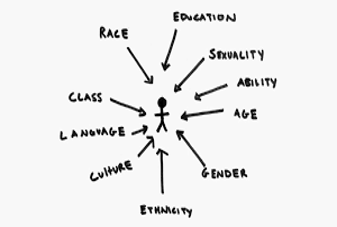
Intersectionality is a term that helps us to understand how different aspects of a person’s identity can affect their life experiences. Imagine you’re looking at a picture, but you’re only looking at one colour. You’re missing out on the full picture, right? That’s what happens when we only consider one aspect of someone’s identity, such as race or gender. Intersectionality tells us that these aspects don’t exist in isolation; they overlap and interact. For example, a woman who is also black may face unique challenges different from those faced by a black man or white woman. This is because she belongs to two social groups that are often disadvantaged. So, intersectionality helps us see the complete picture and understand the complex ways in which different identities interact.

Identity work is all about the continuous journey of understanding and managing the things that shape our self-identity and self-esteem. It’s a dynamic dance between us, our social surroundings, and our efforts to strike a balance between them. In essence, identity work is a mental negotiation that fuels the pursuit of creating and upholding a consistent and meaningful sense of who we are.

Microaggressions are subtle, daily interactions that can cause people to feel overlooked, underestimated, or disrespected. Often, these microaggressions are related to race or gender. They’re not always verbal – they can be a dismissive glance, a gesture, or a specific tone of voice. These small actions can send negative messages to the target, contributing to their feeling of being marginalised. 

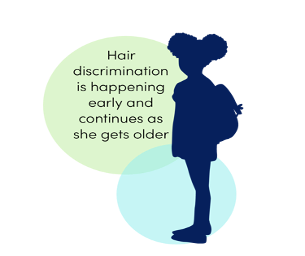
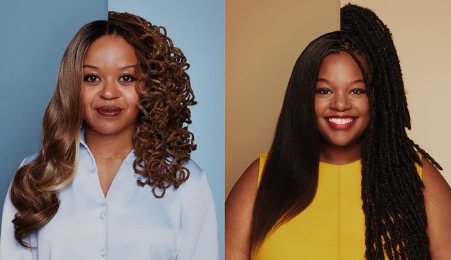
Hair bias is a harmful stereotype of textured/Afrocentric hair. This means that people often unconsciously judge black women and girls negatively because of their natural hair or hairstyles. This often starts when black girls are very young and can negatively affect their self-esteem and experiences in school and work. 

Lastly, regarding psychological burnout, stress levels are shaped by how we perceive and evaluate our surroundings. Imagine you have a physical trait that constantly worries you because it is seen as undesirable and unprofessional at work and in society. This worry is a stressor, and if you’re spending a lot of time trying to change it to fit into societal standards of attractiveness and professionalism, it can lead to psychological exhaustion. Why? Because this stressor feels unchangeable and hopeless. Over time, this can result in burnout. So, it’s not just about the actual trait but the psychological strain and burnout that comes from trying to conform to societal norms.

And there you have it! We’ve twirled through the terms and danced through the jargon. I hope this glossary was illuminating and that I successfully demystified any confusion you might have had about some of the words. Until next time. 🙂