Imagine receiving a crisis call and wanting to assist. You know that you have the professional expertise to assist, and you have the passion to help people. However, you never know what you would find on your way to the individual who has made the call, or upon entering the home or setting where the call has come from. You enter an unfamiliar area alone, often with limited back-up, no weapons, and no way to protect yourself.
What is not often spoken about, is that this scenario is quite common in the healthcare field. Social workers, psychologists, psychiatrists, medics, nurses, occupational therapists, and other members of the helping professions are frequently exposed to unstable and potentially violent situations. It is mind-blowing to read that higher rates of violent incidents are reported in health and social sciences than in all other industries combined.
| On the 14th of December 2013, Deon Kondos began his day with the intention of supervising a visit between a father and his child. When the father pulled out a gun and started shooting, he killed the social worker, the child’s mother, the stepfather, and then himself. During 2015, a social worker in Rustenburg was killed when he intervened in a domestic violence case (Ola, 2018) and in 2016 another social worker was killed while attending to a case in Malamulede area (Gazankulu, 2018). Nokuthula Dlamini, a social worker, wrote an open letter to the Minister of Social Development in 2017 in which she pleaded to the minister to improve the working conditions of social workers. During the same year, a social worker in Empangeni was stabbed to death. The most recent reported incident in South Africa, was in 2021 in Pietermaritzburg, Sithembile Vilakazi, brutally murdered in an allegedly orchestrated incident, approximately three months after the murder of her husband – both of them were social workers. |
When helping professionals engage with service users, it is often because service users are encountering stressful or crisis circumstances. Research has found that the intensity of stressors and crises, whether physical, cognitive, psychological, or spiritual, can have an impact on service users’ thoughts and behaviors. In the event that a service user is under the influence of alcohol or substances, has a history of mental illness, or faces any developmental delays, it contributes to having a distorted perception of reality and/or lower cognitive capacity, which can cause difficulties with impulse control and related aggressiveness.
Service users would at times engage in physical violence, emotional abuse, verbal attack, property damage, and sexual assault (collectively known as client violence) against helping professionals. Younger helping professionals are more likely to experience all categories of client violence. In a 2014 paper Malesa, Kgashane Johannes confirms that younger professionals are particularly vulnerable when the service users they serve are older than they are. Furthermore, helping professionals with little experience are more likely to face various forms of client violence. In this context, it is a mystery why there are limited protocols and regulations by government and employers to protect and safeguard professionals against violence from service users.
My PhD research focused on client violence and the protection of social workers in South Africa. The purpose of the study was to learn more about the nature of client violence against social workers and the factors that may contribute to it; to better understand client violence in the context of South Africa and to explore the relative risk of social workers being exposed to client violence occurrences; to identify relevant international and national policies, frameworks, protocols and guidelines that could inform the development of a policy framework to enhance the protection of social workers and finally, to design a concept policy framework that was reviewed and refined before it was submitted to key role players in the social work profession.
A focus on these aspects did not only assist our understanding of the phenomenon, but also ensured a better understanding of professional and client risk profiles, the lived experiences of social workers, as well as incredible insights on how to properly manage the client violence cycle. International guidance and inspiration assisted with the development of a reliable concept policy brief and policy framework for the South African setting.
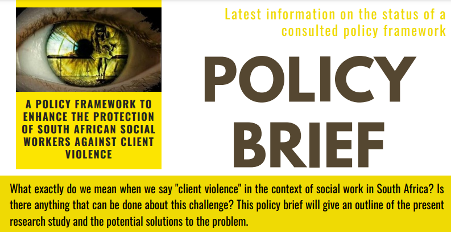
The policy brief and policy framework presently include programs to make social worker safety and security a national priority, programs to establish a safety culture in the workplace, and initiatives to support social worker safety in the office, while traveling, and during site visits. Local experts and stakeholders in the social work profession was consulted to review and refine the policy framework. The current version is a practical guide, with ready-to-use templates and visual aids, that may be consulted and immediately implemented by practitioners and stakeholders.

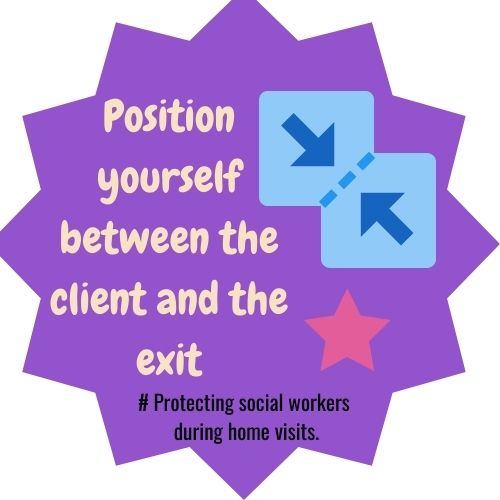

Image: The policy framework includes a set of visual guidelines of initiatives to support social work safety. Example of some home visit guidelines.
And while this particular study focused on the social work discipline specifically, the findings can be translated to other disciplines as well. After all, this critical issue affects health and social science sectors, as well as all helping professions who engage with service users. Who will be responsible for ensuring the safety of helping professionals when they provide care to service users? This policy may be a first step for stakeholders to answer the question.
Imagine receiving a crisis call and responding confidently, because you are assured that you will be safe to do your work. This makes an enormous difference to you, the service user, and the overall workplace.
Additional references:
Gazankulu, O. 2018. Social workers killed on duty [e-mail]. 13 Nov 2018. South Africa.
Ola, O. 2018. 2018. Social workers killed on duty [e-mail]. 13 Nov 2018. South Africa.
 SAYAS BLOG