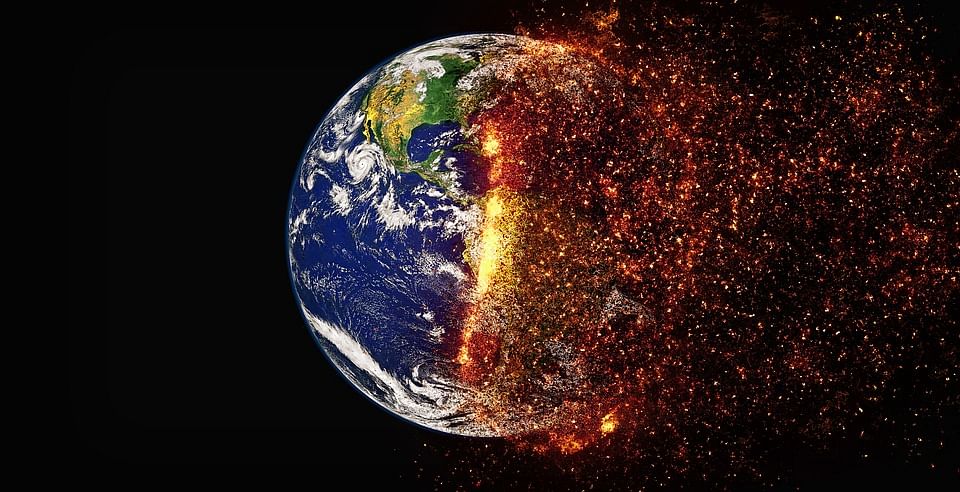
Is it just me, or is it hot in here?

In the coming decades, ecological degradation, rising temperatures, and extreme weather events could intensify the threats to human health posed by viruses. The world’s healthcare systems are not ready to face what’s behind the curtain.

As the temperatures are rising, long-term changes in climate and wildlife habitat could have a significant effect on human health and escalate the risk of infectious diseases like the COVID-19 outbreak. Ah yes, COVID-19 is that guest that overstays their welcome after the party has ended 4 hours ago. After the world has largely failed the stress test of COVID-19, decades of progress to control century-old diseases such as dengue fever, malaria and cholera are under immense threat unless the world leaders commit to more ambitious climate solutions.

As a virologist, I think it is very important to identify the factors that play a big role in spreading infectious diseases…and with planet earth starting to boil rapidly I have concluded that there are numerous factors that I could mention to you that increases viral transmission…but we all have lives to live, so let me keep it short and sweet!

Have you noticed how humans have adapted to rising temperatures? Swimming pools! Air conditioners! Pouring cold water all over yourself! (most affordable solution for a student like myself). Just like humans, viruses also adapt to rising temperatures to ensure population survival. Diseases traditionally associated with tropical and subtropical regions are reaching new areas of the world. Rising temperatures and precipitation are making temperate, northern or mountainous countries more susceptible to outbreaks of “southern” or “low land” diseases like malaria. Another example is how for all of reported history Nepal was always been too cold for the dengue fever virus yet suffered its first outbreak in 2006 with 32 cases. There are many more examples I can mention, but there are also more factors that I would like to talk about!

Now the next question to ponder: how are the habitats of wildlife a factor in an increase in infectious diseases? Well, the quick answer is that many of the viruses are zoonotic, meaning that they are transmitted from a vector, such as an insect, to animals and humans. A loss in wildlife is linked both to climate change and to disease outbreaks. Experts believe these diseases may be associated with increased human-to-animal contact as people encroach on animal habitats. Deforestation and mass forest fires are also responsible for habitat loss, and they both contribute to climate change and are exacerbated by it, creating a feedback loop.

Johannesburg is not an aesthetic tourist attraction at all. Smog and air pollution can be seen from kilometers away. Fine particulate pollution such as black carbon, sulphates and nitrates penetrate deep into the bloodstream and lungs, creating serious health impacts leading to weakened immune systems of animals and humans. Scientists have suggested that air pollution particles may also act as vehicles for viral transmission. An increase in fine particulate pollution of just 1 mg/m3 corresponded to a 15% increase in COVID-19 deaths. Sources of air pollution in cities such as traffic, waste, energy and industry all play a role in the increase of greenhouse gas emissions. So, how can we make our immune systems stronger to fight off disease? Easy – improve air quality and reduce emissions, especially in cities. Easier said than done though.   

Multiple movies these days focus on zombie viruses and ancient viruses resurfacing and killing 90% of Earth’s population. Okay, maybe these ideas are a bit far-fetched. However, scientists have uncovered a variety of bacteria, viruses and fungi due to ice and permafrost melting in Antarctica. I can explain this by giving an example of the working environment I experience at the Centre for Viral Zoonoses. Viruses from many species and pathogenicity are stored in -8°C freezers, and once thawed the viruses are infectious. As ice melts due to global warming, there are concerns that pathogens could be released and cause havoc which our immune systems won’t be able to fight off.

Lastly, viruses absolutely love to mutate.  A changing climate could lead to pathogens mutating and evolving to adapt to warmer temperatures. Researchers from John Hopkins University in the USA raised concerns about climate change that will cause new-heat tolerant diseases to evolve and jeopardize one of the most important fighting forces of the immune system in mammals – fever, which is the ability to maintain high temperatures to fight infections.

What is the takeaway message of my blog post that my readers, and all of humankind, need to remember? Fighting global health risks and diseases, including outbreaks with pandemic potential, is also, fundamentally, about fighting climate change. We need to treat the health of humans, animals, the economy and the planet as one.

Please follow the following links for more information:

https://www.ncbi.nlm.nih.gov/pmc/articles/PMC8047528/

https://www.ncbi.nlm.nih.gov/pmc/articles/PMC2974686/?report=reader

POST GRADUATE STUDIES: “A HURRY-UP-AND-WAIT PROCESS”

Looking back over the last few months, I can honestly say that my life has changed dramatically. I almost feel like I need to reintroduce myself because so much has transpired! Moving away from “someone like you” and toward “the emergence of a new me”. I’ve been ecstatic to learn in the last month that I’ve passed my PhD. While this was a pleasant respite, it also meant that innovation and new expectations were on the way. In addition, I’ve had numerous interactions with current and potential post-graduate students, all of whom were curious about the process and what to expect. When I reflect on the journey, the best way I can describe it is: “hurry-up-and-wait“.

The most relatable definition of this phrase comes from Farlex’s Free Dictionary:
“to quickly take some action, only to be halted at the next step in the process.”

Post-graduate education… Getting everyone and everything ready as quickly as possible, and then preparing for what may turn out to be a long, significant delay before anything happens. It’s like growing a tree, from a seed, if you are a toddler. The idea of a tree is thrilling, but the process of germination and growth is less so. You see a sliver of green now and again, just enough to keep you going, but overall, the rate of growth tends to be glacial. Furthermore, you become acutely aware of all the other trees in the vicinity, making your own seem rather insignificant. Postgraduate studies are similar: a method that simultaneously assesses agility, tenacity, and rigor, as well as patience and tolerance. Can you relate?

The “stand by to standby” procedure starts with a research proposal.  Researchers spend months refining their proposal to find themselves before some kind of scientific committee that provides feedback and input. I’ve encountered students who have awaited feedback for weeks without knowing what’s going on or why. It’s like those first few days when you’re trying to germinate your seed and hoping against hope that it will sprout. Even a small crack has the potential to be meaningful. When the crack does not provide immediate growth, a back-and-forth process might begin, and some students simply give up. Those who persevere and dig their way to a glimmer of hope for a breakthrough, advance to the next level of their research.

Before students in most social, scientific and medical disciplines can move forward, they must first obtain ethical approval. These ethical approvals are issued by specialized committees that convene only on specific days. As a result, students must make the necessary preparations and continue to care for their sprouts while waiting for the right season for seedlings to emerge. Waiting for ethical approval can be tedious – the tragedy is that some students simply stop caring for the sprouts, allowing them to dry out or perish. 

If the ethical committees provide their approval, the formal research process can start. The seedling of the metaphorical tree is well matured, the season is pleasant, and can be planted in a prepared container. This does not, however, imply that your tree will bloom the next day! Trees, like the research process, need time to grow. Following the researcher’s unique methodological design, he or she will do a literature review and start data collection. Throughout this procedure, the researcher will keep track of and report on the work, which he or she will send to their supervisor and co-supervisor for feedback and revisions. This becomes a continuous loop of writing, editing, and improving, similar to how a seedling needs to be watered, maintained and treated against pests and diseases.

Data collection is also no walk in the park. Whether you are working with pure numbers, or with human participants, aspects like reviews, surveys, and interviews all have specific protocols to follow.  The same may be said for data analysis, especially when working with a reviewer, co-coder, or other collaborator. I’ve discovered that the tree has its own biology and environmental conditions are not always reliant on your own preferences. And just when you think you’ve got something that looks like a tree, you realize it’s nothing near majestic. Writing a dissertation or thesis is yet another time-consuming procedure with numerous stakeholders…

It’s not that it’s horrible; it’s simply that it takes a long time. Since the process is not entirely dependent on yourself, my opinion is that time-management skills are not applicable.  However, if you are in charge of any portion of the process, you work as quickly and accurately as possible to catch up and fulfil some kind of deadline. Then there’s the wait. You strive to keep your tree happy by giving it all it requires, then sit back and oversee it as it grows. Dreaming of swaying branches in the gentle breeze while listening to birdsong.

I was in a hurry. I sat and waited. This was definitely a challenging process. But, oh my, you should see my tree.

I would encourage students to grow their own trees. But be realistic about it, be realistic about yourself, and be realistic about your abilities. Don’t give up along the way as the bloom will not appear immediately, but only when the timing is right. Hurry-up-and-wait. I’d love to see your trees.

*The actual tree-planting process is not depicted in this blog.