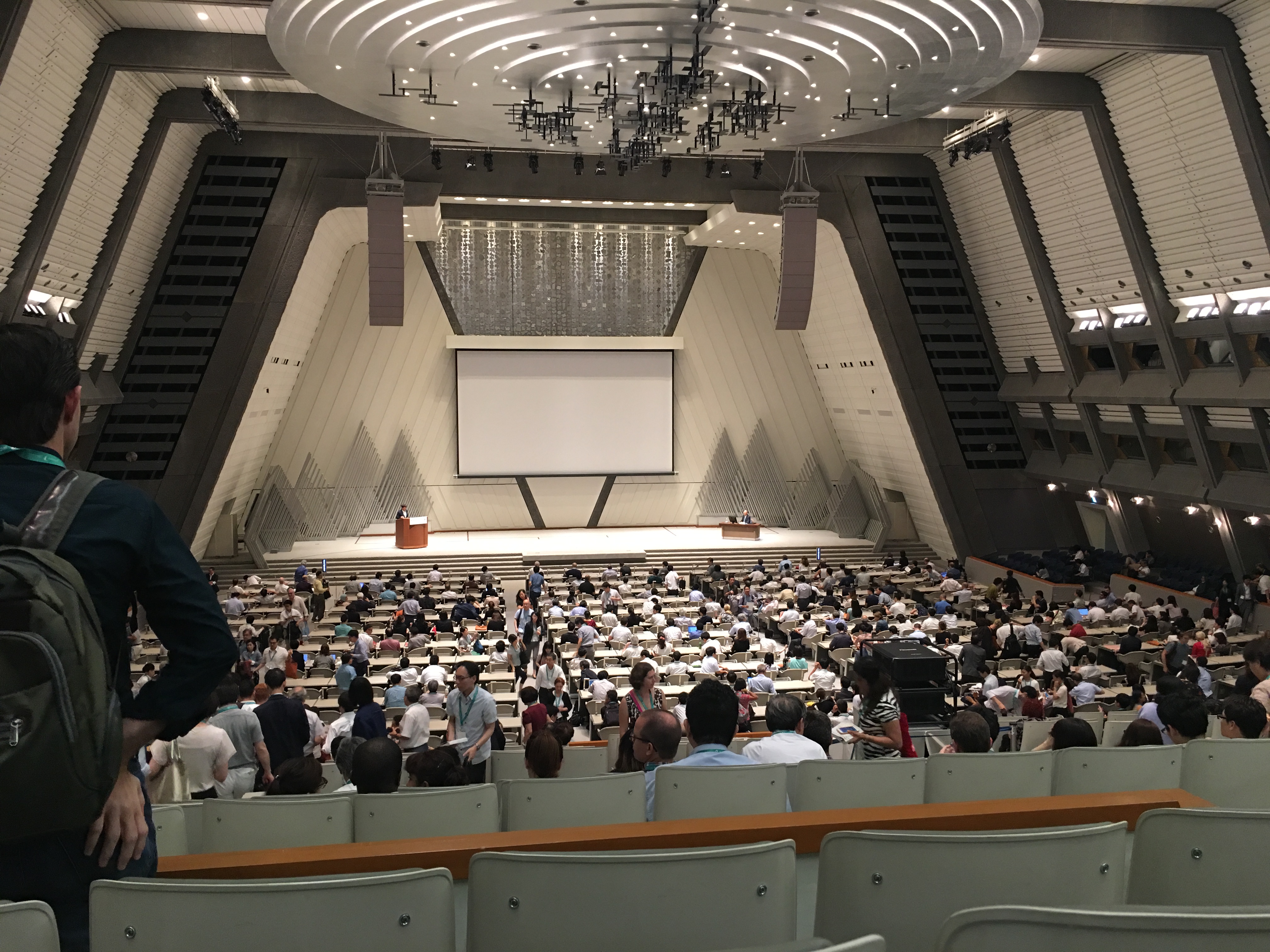
Attendees at the 18th World Congress of Basic and Clinical Pharmacology in Kyoto, Japan.
Conducting research can be one of the most laborious things for a person to do. It involves identifying gaps in the current body of knowledge and providing clues to various unanswered questions within a specific field. The approach differs slightly between various research specialties. In my field, Pharmacology, it involves reading a lot of scientific papers, planning and conducting of experiments, and ultimately publishing the obtained results in the form of journal articles and a Doctoral thesis. In all of this, there is one specifically exciting and rewarding part… sharing your findings with peers at scientific conferences.
Academic conferences are a platform where researchers meet to share research ideas and discoveries. This is usually done via oral presentations by senior researchers and presentations of posters by students. Conferences are a valuable platform that allow for collaboration and establishment of relations among academics. Typically, conferences run over a period of 4-5 days, and are a worthwhile experience, especially for young researchers.
Personally, attending conferences offered me an opportunity to travel out of the African continent for the first time. I got to travel to Lindau Germany to meet Nobel Prize winners. For any young scientist, being selected to attend the Lindau Nobel Laureates meeting is a huge privilege. Not only did I get to meet and have discussions with Nobel Laureates for the first time in my life, I also met and interacted and shared research experiences with PhD students from the most prestigious universities in the world. As a result of being selected for this meeting, I was featured in an article from the largest newspaper publishing in my city. As such, this meeting will remain a major highlight of my academic career.
From Germany, I immediately travelled to Japan to present my research findings at the 18th World Congress of Basic and Clinical Pharmacology. We had booked the return tickets to both countries during different times, and I had to first travel back to South Africa the whole day, and immediately connect to Hong Kong for a 14-hour flight, before taking another 4-hour flight to Japan. As you can imagine, I was fatigued when I got to Japan, but experiencing the difference in the landscape and way of life in Japan compared to Africa rendered the fatigue was worth it! I found one thing bizarre though, some individuals wore facial masks in public, are rare sighting in the South Africa at the time. It turns out, Japan has a long history of disease outbreaks, and with the current advent of COVID-19, I now understand why they wore masks in public. The conference was abuzz with researchers from across the globe, who shared ground-breaking findings from their individual labs.
In addition to these international conferences, local conferences have afforded me the opportunity to meet peers form various Universities in South Africa, with whom I have exchanged research findings and ideas. Conferences have also offered me an opportunity to display my presentation skills. As a consequence I was given the Young Scientist Award in Basic Pharmacology for the 2nd best podium presentation at the First Conference of Biomedical and Natural Sciences and Therapeutics in 2018, while my late colleague lab mate got the 1st prize.

Left: Myself, presenting a poster in Kyoto Japan at a world Pharmacology conference. Right: colleagues and myself carrying awards at a National Science conference in Stellenbosch, South Africa.
Unfortunately, the global wave of lockdowns due to the COVID-19 pandemic has rendered conducting science conferences in person a challenging task. As a result, there has been an increase in online research conferences, as a way to sustain the level of academic exchange during these difficult times. Virtual meetings have many advantages, including a decrease in the financial burden and ease of access. A screen with multiple faces (figure below), and phrases like “please mute your mic” have been a familiar feature over the past year. Although the online environment allows for easy organization of meetings, I personally feel like the social connection that usually happens during person to person interactions is lost. For example, when I am presenting I love making eye contact with people in the audience as a way of evaluating their level of concentration. This falls away when your audience is behind muted mics and cameras and all one has to stare at is a computer screen.

The 2021 South Young African Academy of Science blogging team, meeting for the first time, in a virtual meeting earlier this year.
Person to person interaction during conferences fosters the establishment of relations and collaboration amongst researchers, and this is not particularly easy to do in a virtual setting. With vaccination strategies being rolled out in various countries being rolled out, I am hopeful that COVID-19 and lockdowns will soon be a thing of the past and we can safely resume physical conferences.





 SAYAS BLOG