The role of research in eradicating food insecurity

The beauty of being an Animal Science researcher is having to attend the South African Society of Animal Science (SASAS) Congress, which was hosted by the Stellenbosch branch of the Society from 1-6 July 2016. During the congress, I was lucky enough to be part of the exceptional group that was in charge of blogging about the SASAS Congress. If you want to visit the blogs, you can go to http://sasas.co.za/sasas-gala-dinner-2016 and http://sasas.co.za/49th-sasas-congress-kick. Working with Dr Yonela Njisane, Sipokazi Nyeleka and Mzuvukile Mcayiya was a fun and humbling experience.

SASAS Bloggers
The SASAS Congress Bloggers 2016 – Dr Yonela Njisane, Mzuvukile Mcayiya, Sipokazi Nyeleka and I


I only attended as a “visiting professor” – I never had time to submit an abstract. Oh, but the joys of attending a conference where you aren’t actually presenting is that you get to enjoy all the presentations without having chest pains every time you think about yours!


A typical congress provides a platform where respective researchers can show off their research and findings. Having industry (farmers, feed, premix and additive manufacturers etc) and scientists in the same venue is always great because it is bound to raise much-appreciated questions and debates. These questions and debates in particular helped me to think about the context of research in the world that we live in. Mostly looking at the socio-economic ills facing our beloved Rainbow Nation.  The gist of the debate was the role that research could potentially play in solving the problems faced by the Agricultural Industry. When trying to contextualize the role of scientific research in our community, a few questions need to be posed by yours truly.

Dr Nkukwana (Supervisor), Sipokazi Nyeleka and I (the "visiting professor")
Dr Nkukwana (Supervisor), Sipokazi Nyeleka and I (the “visiting professor”)

What is research?

What purpose does it serve? Is it about simply about finding a plant, feeding it to an animal and testing a few parameters, or is it about identifying problems faced by the South African agricultural industry and helping solve those problems through novel solutions?

For a number of years, I have always believed research to be a tool that can be used by scientists to find solutions to the world’s problems. Currently, South Africa is facing the harshest drought in decades. This is undoubtedly related to global warming and climate change that scientists have been talking about for a number of years. Furthermore, the world population is growing exponentially, which means that food production needs to keep up with that growth. It’s however a sad reality that the conventional means of food production that have been used for the past millennia are becoming less and less effective due to climate change. This is where I think research can play a critical role in developing farming strategies that can help mitigate the adverse effects brought upon by global warming and climate change.

I believe that researchers should conduct research that will ultimately help improve the socio-economic status of the country. How do we do this? How do we make sure that scientists are conducting vital and relevant research that will benefit the South African citizens?

Collaboration is the answer for me. There needs to be a partnership between bodies such as SASAS, Industry and Government to ensure that applied and interdisciplinary research is being conducted. Currently we have a system where Industry conducts its own research with a respective institution of learning and when there is a breakthrough, the company will claim Intellectual Property Rights (IPR) to the results and they will only publish the findings after 3 years or so. This is fair enough because the companies invest a lot of money in that research. The only problem is that this type of partnership tends to benefit only corporations and not every Jacob, Julius and Helen in South Africa.
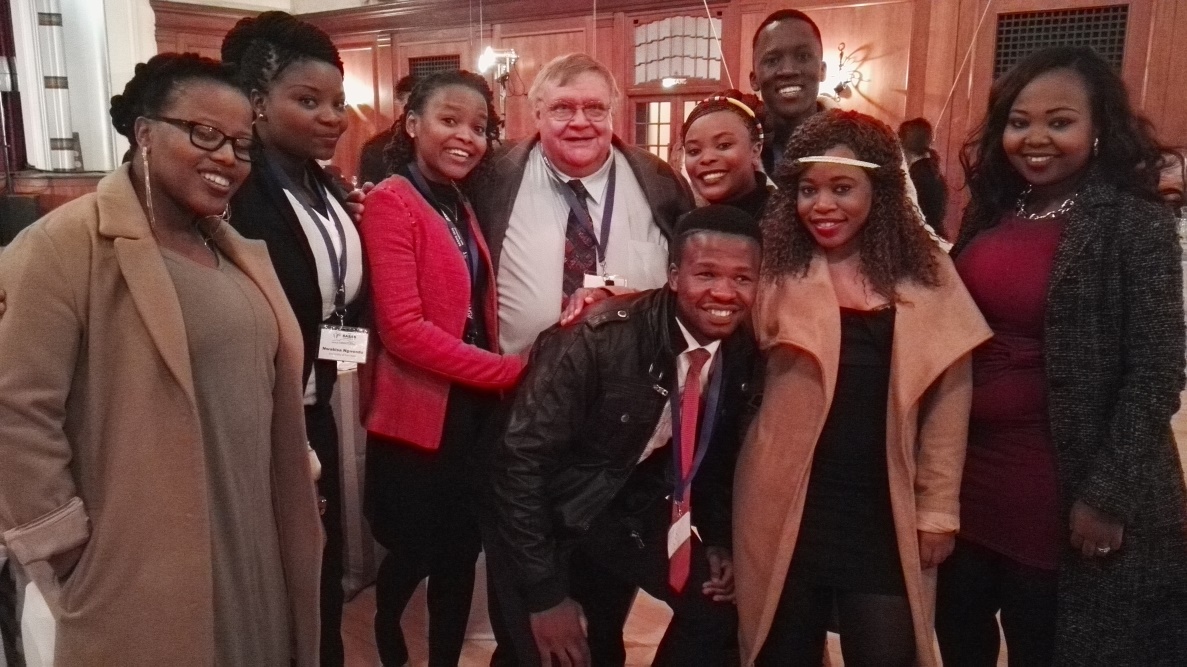
Photoshoot with Professor Michael Scholtz - President of the South African Society for Animal Science
Photoshoot with Professor Michael Scholtz – President of the South African Society for Animal Science

Perhaps there should be a council or commission where Industry, Scientists and the Government are equally represented. This council would be tasked to identify problems in South Africa (which shouldn’t be hard) and assigning those problems to Research Institutes and providing funding. An example from Europe would be, “Improving knowledge transfer between research institutions and industry across Europe”. This document not only deals with the issues of IPR but it also ensures that the associations — businesses and farmers — who are in charge of producing local food will also benefit. All South African citizens will end up benefiting because our country will be not only be food secure but that food will also be affordable to everyone who lives in it. Perhaps a step further would be for the Government to utilize its Extension Officers to ensure that scientific breakthroughs get relayed to all the farmers. This would not only ensure that farmers do not suffer from problems that the country has already solved but it will also ensure that the money spent on research funding doesn’t end up in library shelves collecting dust.

Every person mistakes the limits of their field of vision for the limits of the world

This July, Durban played host to their second International AIDS conference. This is the biggest and most publicised of the HIV conferences, with the likes of Elton John and Prince Harry showing up to support the cause. This meeting is not really recognised for its pure scientific nature, but is regarded in our lab as something everyone should attend at least once. The goal of the meeting is really to bring social issues to the fore: interventions, activism and policy to improve the lives of those affected. Ultimately for basic scientists, it’s about gaining a wider perspective about the work we do, the impact we make and to motivate us to work harder to lighten the burden South Africa has borne for so many years. But the world of activism, especially celebrity activism, is also a world that could learn from science.

Charlize Theron spoke at the conference saying several things that upset me. The media raved about her speech saying she certainly didn’t sugarcoat anything – as if we don’t know how bad the epidemic is already. I think one of the things that upset me most was this, “The real reason we haven’t beaten the epidemic boils down to one simple fact: We value some lives more than others.” I do not deny that this is a very real issue in the world today; but I truly don’t agree that this is why we haven’t beaten the epidemic. It is easy to get swept up in this statement and feel some guilt as a privileged and fairly happy PhD student who lives life with a clean bill of health (apart from sleep deprivation), but I am worried that a statement like this really works against scientists.

There are legitimate and horrifying biological challenges that we face with this formidable foe. HIV adapts so rapidly our immune systems can’t keep up. About 20% of people develop amazing antibodies that can target 90% of the circulating virus but because this only happens 3 years after infection, this doesn’t help the person at all. We have had 6 HIV vaccine trials, none of which have done any better than 31% protection. The virus integrates into the person’s DNA, which makes a complete cure very difficult. We have cured one man by completely irradiating him twice and nearly killing him and we have thought we cured one baby by giving it ARVs in the first hours of its life (it has since rebounded), with little knowledge about how it will affect it over life. Please understand that the dearth of progress is not for lack of trying or because scientists are secretly plotting against adolescent women.

We simply have not figured it out yet.  Even with incredible education, support and dedication by some truly wonderful people in this country, there continues to be a barrage of infections. While social behaviours and injustices definitely help spread the disease, the ONLY thing that will stop it is a vaccine or a cure. It sounds noble to try and reinvent social interactions (a goal that must be pursued in our lifetime) but this is not what brings about a real-world cure to a horrible disease. Polio swept the world several times throughout history. Do you know when they stopped it? When they found a vaccine! (Read about other diseases defeated by vaccines here.)

The second thing that bothered me in Charlize’s talk, “I know this because AIDS does not discriminate on its own. It has no biological preference for black bodies, for women’s bodies, for gay bodies, for youth or for the poor. It doesn’t single out the vulnerable, the oppressed, or the abused.” This isn’t true: the disease does discriminate. Women are biologically more likely than men to contract the disease (read this link for an in-depth analysis and click here for a simplified version), and routes of transmission make gay men in particular vulnerable to infection. I understand what she is trying to say, but to a scientist these statements are incorrect and are once again, making the point that AIDS is only a social disease. People will never perceive themselves to be in a socially-constructed high-risk category. Many of the people I know own cars that they drive every day (a truly high-risk activity!) and not one of them wears a crash helmet.

Charlize later went on to say that we “have all the tools to end HIV.” And we don’t. The fact is education and empowerment doesn’t work completely. We need an intervention that people will not have to think about. How seriously do you worry about Pertussis every day or dying from Mumps? Everyone has access to these vaccines and that is what we need to do for AIDS. I agree completely with Baron Peter Piot (a researcher from the London School of Hygiene and Tropical Medicine) when he spoke at the same conference, “We need to stop saying that we have the tools to end the HIV and AIDs epidemic, until we have a cure or a vaccine- then we can say that.”

I wouldn’t want any young person to listen to Charlize Theron’s speech and assume that there is any lack of urgency in the scientific field because the disease is not prevalent in the white upper class. We are facing a terrible enemy and while we know a lot about it, it keeps coming up with clever ways to evade our advances. The world could always do with improvement. Young girls should think they are better than their relationships and can go on to live an HIV-free life. I applaud people trying to change this. Ultimately though, scientists are dedicated to making a vaccine for everyone. It, much like ARVs, will shape the lives of people much more quickly than changing social perceptions can. It would be easier if we could just give an injection that would bridge the social divide, but then again, I am a scientist looking out of scientist goggles, with potentially limited eyesight.