My Work is My Art: the PhD thesis as a reflection

Much like a painter or a sculptor moulds their soul onto a project, so does a doctoral candidate lay their very essence into a document that would forever be laid bare for others to admire or admonish. As Africans, across the colour spectrum, we often get bombarded with statistics about how South Africa, and Africa in general, does not produce enough doctoral candidates. What all these statistics and policy laments seem to forget is the human element in producing a doctoral thesis. Living in a social context that has  dual expectations of its emerging academics: put your nose in your books and figure out solutions to the countries problems; on the other hand, always keep your mind on the fact that you’re expected to plough back into your community sooner rather than later.

My journey as a black African female PhD candidate has been a very interesting one. The very nature of being black and female already socially locates you in your interactions with colleagues, and your community of practice. There is an unspoken pressure to conform to “rules” that nobody ever voices out loud: be confident but not seen as aggressive; be well read and articulate but not appear arrogant; and, take initiative but do come off as bossy… amongst other ridiculous unspoken rules.

Certainly, all women, regardless of race, have undue pressure placed upon them but the weight of the pressure is made more acute by their intersecting identities. Some identities have a heavier burden than others.

My other identities are as wife and a mother of two children, each identity with its own pressures and complications. What does this have to do with completing a thesis? A lot. Writing any piece of academic work entails you wearing two hats simultaneously: a researcher hat and that of a writer. The work you ultimately produce is a reflection of your skill, labour, spirit and how much you have been able to translate your knowledge into a piece that is capable of impacting your reader in some way. Putting it differently, there is a constant tension between the creative and the academic.

Photo credit: modul via Foter.com / CC BY-NC

All these unspoken pressures have a way of either spurring you on to produce something worthy or pushing you completely off course. In the Atlantic’s Creative Breakthrough Series, Ta-Nehisi Coates, an author and journalist, provides profound advice on writing. I would like to share two gems, put in my own words: innovations come from pressure; and, to become better writers we need to write more.   This truth is the same for academic composition- at least in my opinion. Every thesis chapter that I write, revise, and rewrite, has made me a better writer. The academy, at least in South Africa, is pretty good at teaching research and data mining skills but not how to write. Yet, the art of writing is one of the most powerful tools of communication and provides a snapshot of who we are.

What does your snapshot reflect?
Inspired to Inspire

Many people ask

Many people ask me why I came to South Africa to study. I usually answer with “It is the best place in the world to study forest diseases”. Though I completely believe in that answer, it wasn’t the primary reason I moved here from the opposite side of the world—the USA.

LeaveComfortZoneMy name is Joey Hulbert and I am a PhD student at the University of Pretoria, studying in the Forestry and Agricultural Biotechnology Institute (FABI).

I moved to South Africa for 4 reasons:

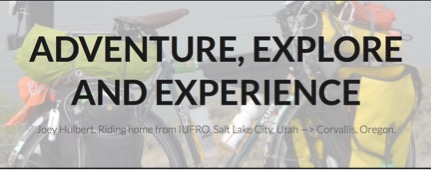
  1. I crave adventure. Once I started looking at PhD programs abroad, multiple opportunities had my attention, but I was attracted to South Africa because it offers plenty of adventure!
    AdventureBlogLink
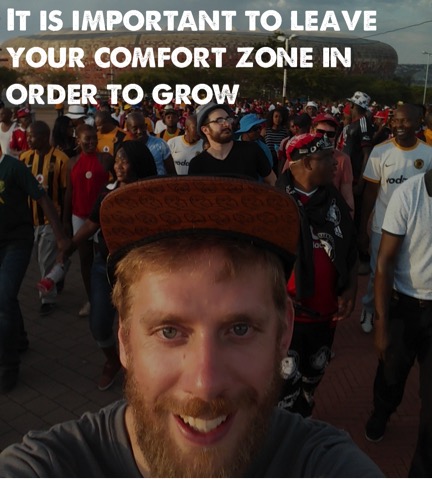
  2. I knew I needed to leave my comfort zone. During my MSc at Oregon State University, a friend and I started a radio program called Inspiration Dissemination. The program features graduate students to introduce their research live over the air. During one of the episodes, our friend from Columbia said it best: “It is important to leave your comfort zone in order to grow into a scientist”—I didn’t know how much it would affect me at the time.
  3. FABI is exceptional. The Forestry and Agricultural Biotechnology Institute is aFABI signn oasis of plant health researchers in Africa—well actually, in the entire world! These days, it is difficult to find training in forest pathology—the study of tree diseases; many academics around the world have retired without being replaced and the continual decline in financial research support doesn’t help.
  4. There is support for my Dream Project. Finding research support is one thing, but finding research support for a project that you dream up is the real challenge. Fortunately, my advisers Mike Wingfield and Jolanda Roux were willing to support my dream, and that is the primary reason I moved to South Africa.

The PhD Project

CrowdfundedLinkCitizen science is something else I was introduced to through Inspiration Dissemination. Citizen science projects engage the public in scientific research.

YouDontHaveToBeAnExpert


Cape Citizen Science is the project we have initiated tCapeCitSciLogoo couple educational outreach with hypothesis-driven research about plant disease in the fynbos biome. We want to study a group of microorganisms called Phytophthora—translated from Greek = “Plant Destroyer”—while educating anyone who interested about microorganisms as the cause of disease, the importance of biodiversity, the consequences of introducing invasive species, and the general process of scientific research.


Citizen science projects are fantastic tools for education. I really enjoy designing the educational component of Cape Citizen Science and I think Madiba would approve.

EducationIsAPowerFullWeapon


My involvement in Inspiration Dissemination had a profound impact on my life. Through the program, I discovered that I am more passionate about connecting the public to science than I am about advancing science. You could say that I was Inspired to inspire others. This is why I chose to initiate a citizen science project for my PhD.

GreatestGood

Stay tuned for more blog posts about communicating science and engaging the public!