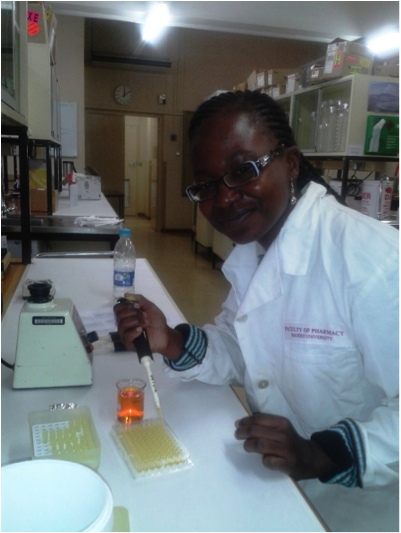
Pipetting for dummies

By Keafon Jumbam

PracticingI’m back in the lab once again to hone my skills on faecal hormonal assays. The unsuccessful ending to my first lab visit didn’t deter me from trying again. If anything, the lessons I gathered from that experience made me more determined to succeed in my analyses this time around. Besides, I’m surrounded by several lab experts who are always happy to offer support and guidance; starting with this – relax and develop a pipetting rhythm that works for you.

And on that note, I plunged into the fundamentals of hormonal assays.

Back to basics

The prerequisite for me to obtaining a good assay was to master the steps and types of reagents needed as well as brushing up on my pipetting techniques. So I set aside a couple of days for these tasks but the monotony of the mundane exercise – and in particular, pipetting – started to get to me by day two. I needed to persist through it for two main reasons: To get a ‘feel’ of the different assay liquids and subsequently handle them better and secondly, to develop that all too important pipetting rhythm!

Finally tackling the real deal – hormonal assay

By day three, I had a firm grasp of the basics and was confident in my abilities to pull off a good assay. The assay involves preparing a standard curve from a serial dilution of different volumes of liquids and reagents, which are then pipetted into a “plate” of 96 tiny wells. The wells are closely packed and certainly require your utmost concentration during pipetting. In fact, it is not uncommon to completely ignore visitors when busy with a plate; unless of course it’s an emergency.
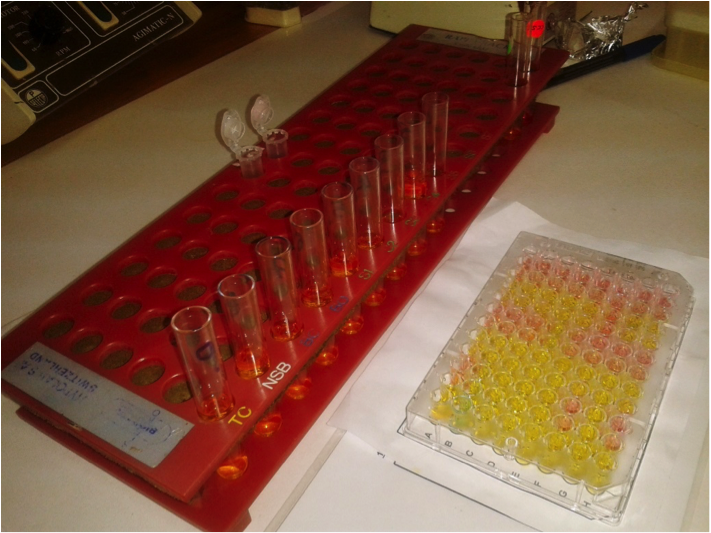
pipettes

Three’s a charm

You would think that with all those days of practise I’ve had, surely I would nail the first assay but it turned out to be a disaster – and the second one too – both plates had HUGE outliers spanning the length of the standard curves. Was I already re-establishing my previous pattern of disappointment? Self-doubt was slowly setting in…But I thought to approach this non-academically and perhaps a bit more like a sportswoman. This is a physical feat, and after all, expert runners benefit from having somebody critiquing their technique.

The moment of truth... my hard work about to be interpreted...
The moment of truth… my hard work about to be interpreted…

So I solicited the help of an expert to invigilate my every step and it paid off – she quickly identified the mistake – yes, it was my pipetting technique! Another bout of training later and I was geared up for a third assay plate. I could hardly contain my excitement when it came out a success! The standard curve was on point as were the rest of my results. Practise does make perfect. I know it’s too soon to claim total victory but as I head back to the field to collect more faecal samples, I’m more confident in my abilities to analyse them in the nearest future. Watch this space…


A thing of beauty -- not a single outlier on my standard curve!
A thing of beauty — not a single outlier on my standard curve!

Walk the talk

By Davide Gaglio

It’s time for the 2nd World seabird conference! I am very excited to be a part of it and luckily it happens to taking place in Cape Town this year. An international conference is an important step for a PhD student, and I get to meet my heroes in seabird research! Researchers from institutes all of the world will be gathering this week at the CTICC in Cape Town.

This conference will give me the chance to make a lasting impression that could make a huge difference to my project and my future career. It will give me the opportunity to showcase my PhD and in particular follow up on my mission to convince everyone that “not only penguins are cute… but also Swift Terns!” (But maybe I’m shooting myself in the foot with this mission — recently I won in the Oceans of Life Photographic Competition with a cute penguin photo…) It’s probably the most important international photo competition on the marine environment, so to be one of the winners makes me feel very privileged and super-excited! And I can’t wait to see my picture displayed at the conference!
I’m starting out right with the photo, but I’m a bit stressed about my talk… So I thought I’d share some suggestions, which I found helpful.

1) Be yourself

Figure out what my “natural” presentation style is, is crucial. Ok, English is not my first language…but I always try to find a way to entertain my audience! I will start my talk with an old Italian say “Tell me what you eat and I will tell you who you are!”… good intro to show a dietary study, right?

you are what you eat

2) Preparing slides

I’ve been told that when it comes to slides, less is more. There is not point to rush through 50 slides in 10 minutes. The bulk of my talk will be 5 or 6 slides, which will be focused on the results. I mean, that’s the interesting stuff, really – who cares about the boring background detail?

3) Be clear and concise

My goal will be to make the audience remember my focal points, trying to highlight my primary message more clearly. I want a broad audience, not just experts in my field, to be able to understand my results. So I won’t ramble and I won’t use overly complicated language.

4) Engage your audience with illustrations

… “I DON’T WORRY ABOUT THAT!” I have plenty of photos!

5) Handling the Q&A

For me, the most nerve-wracking part of a presentation is that after I have delivered my talk and I will be waiting for unknown questions!!…hhmmm… It’s a bit intimidating! Well, people told me “Davide… You designed and implemented the study and conducted the analyses so no-one better than you, can answer the questions related to your project”…Yes, they are right! I should relax…

6) Practice makes perfect!

Perfection is my second name!! ha ha… Allow yourself enough time to practice your talk at least three times before going live on stage, focusing on transitions, eye contact, and rate of speech, which are often problematic when first giving a talk. Practice your talk in front of a diverse audience. Use your lab mates, who probably already know a lot about your research and can give detailed comments. It may also be useful to spend some time toying with any equipment you may use, such as a laser pointer or projector, so that you don’t waste time during your presentation to figure out how to use it. The more comfortable you feel during a talk, the clearer your message will be to the audience.
My preparation for my talk is going well, but I know I will get the most out of the conference once my talk is done. Then I will stop practicing in my head, and actually listen to the other presenters, too. And I am really looking forward to it, especially the numerous social events!! ☺ ☺