Most people aren’t scientists. And scientists love to split metaphorical (and literal) hairs amongst themselves, creating a barrier of jargon and statistics between themselves and the rest of the world. But in the current era of information overload, all people create their own hypotheses, their own ideas, and draw their own conclusions based on whatever unverified information is out there. And, more and more, this means that the average person does not trust the average scientist.

It is becoming crucial for scientists themselves to speak up, because science should not be hidden, mysterious, unintelligible. Below I have listed four reasons for improving our science communication skills, effectively improving the accessibility of science. If you have more reasons, I encourage you to comment below.
Improve democracy
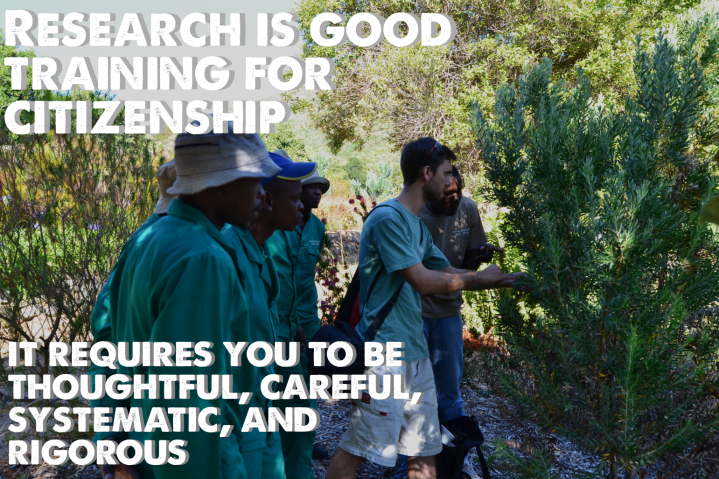
The success and effectiveness of democracy depends on the education of the voters. The more innovative, skillful, and knowledgeable the voting population is, the stronger the democracy. Making an effort to increase the accessibility of science will enhance the education system, inform more decisions, and promote innovation. Science also provides opportunities to improve citizenship. Involving the public in, or effectively sharing about the scientific process will improve democracy.
Inspire the next generation
Many of the tips for communicating science (e.g. less jargon, shorter sentences, etc.) essentially lower the reading level required for understanding science writing, thereby improving accessibility and reaching younger audiences. Thus, improving our science communication skills will enable us to reach and inspire a younger audience.
In addition, social media is widely recognized as a tool for communicating science and has been described as the language of the youth. Mastering outreach on these platforms requires improving science communication skills (e.g. introducing a paper with only 140 characters on Twitter), but will likely reach youth that wouldn’t have known about our research otherwise.
Adapt to shifts in funding
More and more, the importance of this skill is being recognized, with top-down calls for more science engagement and ‘science for society’. Requirements from grant-funding agencies are, right now, changing! For example, many project proposals have to commit to disseminating the outcomes to society or incorporate ‘broader impacts’, such as mentoring a student or conducting educational outreach.
I was first introduced to the ‘broader impacts’ requirement when applying for the National Science Foundation (NSF) Graduate Research Fellowship Program in the US. Each proposal required a section titled ‘Broader Impacts’ where I was meant to explain how my project would immediately benefit society, aside from the results of the research. Educational outreach and public engagement are ideal criteria for this section, and both of these activities heavily depend on science communication skills. To my knowledge, the NSF now requires a statement of broader impacts on every proposal.
Ensure accuracy
The final reason I suggest improving your science communication ability is so that you can share your own research yourself. Regardless of how good external science communicators are (science journalists, media specialists, marketing agents, public relations, etc.), the scientists that did the research have the best understanding of its significance. Inevitably, like the ‘telephone’ game we played when we were children, the message gets distorted the farther it gets from the source. Results are commonly reported inaccurately in media because the writers aren’t scientists, and they want to sell issues rather than report results. Generally, the results aren’t distorted, but the relativity, representation, and implications are.
The personal justification for me to spend time practicing and improving my science communication comes from the same part of the heart as my passion for research. If you are like me, having pursued a career of research as a means to make a positive impact on the planet, I am confident fine-tuning your ability to communicate science will increase the size of that impact. Together we can improve the face of science in the public eye, inspiring others and informing more decisions, while learning to make the most of the world we live in for the people around us.


 win every day but we don’t appreciate, we only celebrate when we win big”.
 SAYAS BLOG