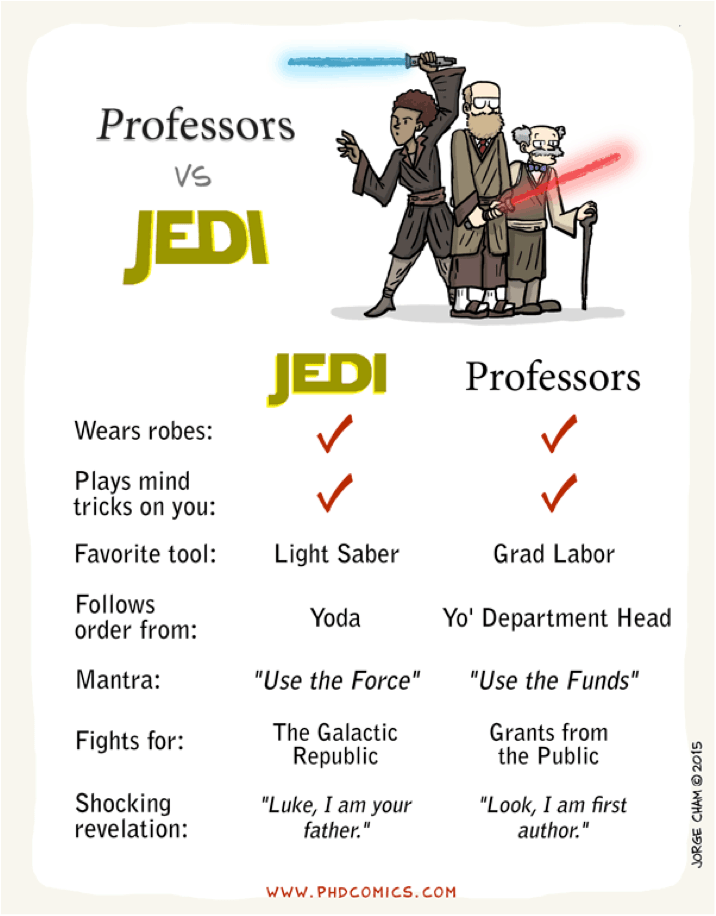
Academia is first and foremost a teaching environment. Many people that pass through its fickle doors are earning higher degrees and those that mentor them must have a strong stomach. The supervisor-student relationship is a strange one. I, being a complete nerd, like to think of my supervisors as Yoda guiding the innocent clueless Padawan through the minefield of poorly devised experiments and failed controls. Of course, I am Luke Skywalker in this scenario.
I have been lucky to only experience only one bad mentor — an undergraduate advisor who made me so terrified of doing a PCR that I still suffer from post-tramatic stress disorder. In my Honours year I was supervised by a vibrant Cuban woman who truly has one of the best scientific minds I’ve ever encountered. She was always 20 steps ahead of me, which was excellent because I had no idea what I was doing. She spoke like a freight train and on that basis we did have some comical misunderstandings. Often I would just nod and then panic because I would realise that “Put those precious samples in the kitchen” couldn’t be what she meant. Then one day she told me to sit down (probably because she knew I was prone to the dramatics) – she had some bad news. She was emigrating to Aus and I needed to finish without her there. A lesser supervisor would have left and never looked back. But every week for the duration of my course, I had Skype calls with her. We spent time on Skype practicing for my presentations and copious emails back and forth as if she was in the next room. Other senior scientists in my lab also helped me — It takes a lab to raise a scientist… This advisor was the one who taught me all the skills I needed to know in 3 months and it was glorious. I never felt orphaned and was grateful that I had her. The best piece of advice I had from her is, “It’s ok to be slow now Simone but some of us remain slow. Don’t be one of those people, those people get eaten.” That last word may have been “beaten” (the Cuban accent still had me occasionally confused).
I have been fortunate for both my Masters and my PhD to have the same 2 supervisors who truly have my back. I have always been the one student doing things that are not the direct focus of our laboratory and my supervisors have always tried to give me the best resources and contacts. In a female-led lab, it has been a great privilege to see the success of my supervisors in a field dominated by males. With one supervisor rushing off to do the Duzi or climb another mountain and the other having the most incredible shoe collection with 3 very cute kids (she says I’m her 4th), I feel I have access to wide perspectives not only one in terms of science but in terms of life.
I have realised that a supervisor is not just someone who is science smart but is someone who is willing to make time for you. Having an open door policy is imperative. Being hard on your student so that they don’t crumble when the science world gets tough is also important. Good supervisors never put their names on things that are sub-par and neither should you. The best line from my current supervisor? “Yes well science isn’t easy. Doing a PhD is like producing a really potent antibody. It’s how many mutations you can take in order to target lots of things.”(This is alluding to a process called somatic hypermutation, check out this video for an explanation.) She knows how to be tough on me. I hope it’s because she sees potential in me! It seems that supervision is a bit like parenting: you can mould and mould your little ball of clay but it is unclear at the start whether your masterpiece will be a wonky vase that your 5 year old made or a beautiful work of art.
Mentoring is something everyone has to do in academia and the truth of the matter is that not everyone is a good advisor. What you as a student need to remember is that you are ultimately the person that picks your supervisor. Don’t pick on fame/name alone; read the work your supervisors have been involved in and critically assess whether this person will want to see you grow or wilt in their shadow. You want to become part of a research family, not war zone. (For other good guidelines on picking a supervisor see this great article by Tara Brabazon.) So as is the case with most things in my life, I will end with another Star Wars reference; choose a Jedi, not a Sith lord to be your supervisor. The Dark Side may have more street cred, but the Light Side, well, they have publications.
 SAYAS BLOG