Animal rights and liberation: A Christian and Animal lover/ Scientist’s opinion

By Yonela Z. Njisane

As my academic mentor always says, it’s important that we tolerate each other, otherwise the wars and destructions in the world will never end. It’s good that you know who you are as a person and stick to it; it’s also good to realise that we are all different and our beliefs and morals differ.

While I was busy with various meat sample analyses in the lab the other day, I recalled a shocking comment I once heard about us (meat scientists and those who eat meat). Apparently, we tend to cover up our cruel actions by saying we are eating “meat” instead of calling it what it actually is, “Body parts”… My first reaction to this statement was laughter
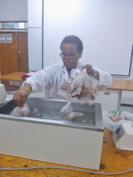
Putting meat samples in the water-bath in prep for tenderness analysis

with disbelief. I found it quite funny…

But, I attended a seminar on “critical animal studies” earlier this year and I later found this video on YouTube, which basically covers the main points the vegans and/or activists raised in the seminar that day. It turns out; this animal activism is a worldwide movement. One of the speakers that day said there should be no hierarchy placing some lives above others; everyone and everything is equal on this planet. This made me think, rather than laugh.

And then I realised:

As a Christian, I don’t think I should even be debating this issue. It is obviously a matter way outside my league. The Bible clearly states in the book of Genesis 1:28 that from the beginning God granted humans dominion over all creatures on earth. I know that even back then, the Israelites followed this idea, and so did early Christians. So there is a certain rank order, which I was even taught in primary school.

My background taught me:

Growing up, I knew that livestock and poultry are food animals. As strongly as I feel about animals, I never had problems with that fact. There was a time I was even eager to learn how to slaughter a chicken, mostly to impress, and I did it. I’m still capable of doing it, I just choose not to.

My animal science journey exposed me:
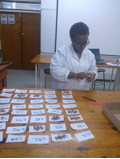
Harvesting the sub-samples for the Instron machine (tenderness determination)

Through my studies and career, it’s only recently that I grew fond of other domesticated animal species apart from dogs and cats. I almost missed out on how cute they are in nature; I just never looked at them that way. But still, that doesn’t change the fact that they are food animals.

My point of view through knowledge and education:

Of course, that does not mean we have a right to abuse and ill-treat these animals. Our responsibility is to ensure their good well-being from birth till the end. We are their shepherds and a shepherd looks after his own. The Bible does not just say humans are the bosses, but that we are stewards of the earth – everything on this earth still belongs to God – we are just managing the planet for Him. So, we may be placed at the top, but we have been given a large responsibility with this rank; it’s not just a case of ruling and doing as we please.

Maybe I am saying all this because I love meat so much (chicken and pork) or maybe it’s because I am a fan of eggs and milk. I don’t know. We were born omnivores after all.
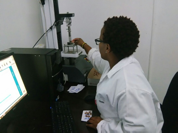
The famous Instron machine, in the process of tenderness analysis... meat or body parts?
The famous Instron machine, in the process of tenderness analysis… meat or body parts?

But does this really mean that I don’t love animals? Does this mean a farmer does not love his flock/herd? Does it mean that, because I am an animal scientist working on animal production, as they put it, a murderer? Is it ok to label the scientists working with animals murders? Aren’t we being hypocrites in all this?
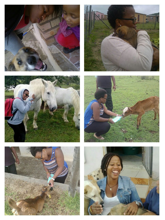
Despite it all, I vow to love all animals (ok, most animals) the best way I know how, till death do us part.

For me, it boils down to some important thoughts:

  • Some of the medication we use, how did its approval come about? Or should we stop taking medication for conditions like Alzheimer’s and other diseases that still require the use of live animals to test different cures?
  • The leaves and vegetation we eat; how do we know it’s not needed by some hungry animal, or that its harvesting didn’t cause hundreds of tiny deaths?
  • What if these plants also have feelings, as some people believe? Are we going to say they are crazy?
  • How do we think a cow feels when she loses her new-born calf in the freezing weather outside while we are locked inside our houses by the fire place?

Think about it…

The truth is:

No one is perfect, and somehow you are missing the point if you try forcing your beliefs onto other people. We all have a way, a system, and morals we were brought up by. The world has plenty of grey areas, and the more we learn about this beautiful planet, the more we realise that there are two sides (or 10!) to every issue. I think we are building a better world if we remember:

“Religion is like a pair of shoes…..Find one that fits for you, but don’t make me wear your shoes.” (George Carlin) (More quotes on tolerance)

And so I write to you

By Yonela Z. Njisane

Social writing: Through this blog, I have been receiving very positive comments about my writing. Apparently I write so well, mmmh! I am flattered, really. I remember I used to get similar feedback in high school (Sehole Combine School) from the dialog stories/books I used to write… I wonder where they are now. At the time, the stories got a lot of attention from all the different social groups residing in the boarding premises.
Even my tutor from the S.A. Writers College has been really impressed with my writing on the tasks they’ve been requesting for a blog-writing course. “Your writing is great and fresh and original, I love your stories” she says. I have been enjoying all the praise, I must say ☺. With all this positive reinforcement, I really should have no writing “issues.” However…
Scientific writing: I can’t say the same about my scientific writing skills; it’s been a nightmare. Ever wrote something and felt “Yeah! I nailed it,” only to find out that you didn’t? LOL, at least not as great as you thought. Yup! That’s the story of my life. You see, I can strip down someone else’s document and suggest this and that to improve it, but it seems I am failing when it comes to my own.

Maybe if I cleared my desk, things would get better...
Maybe if I cleared my desk, things would get better…

I have been trying to write a publishable review paper for almost two years now and my supervisor is not pleased at all. I am not too happy with myself either, and I am not taking it well. How could I take this long with a single paper? ☹ You would think reviewing literature is the easiest thing to do; I mean, you are supposed to just be analysing information that has been generated over the years: everything is there already. Or not, since you are actively trying to identify a sensible gap.
I honestly think it’s the most challenging type of paper to write, and yet has the most potential to boost your research profile once it’s out there. Everybody reads and cites review papers! But rejections and vague, mysterious comments by anonymous reviewers are not helping me with this. Exposing yourself to criticism is part of the job, but it’s so hard to go back to a manuscript after your masterwork has been rejected. It makes me feel like a complete failure and trust me, I know that is a very bad way to respond to the challenge.

Or maybe if I get out of my comfort zone and allow Mother Nature to speak to me while I’m at it...
Or maybe if I get out of my comfort zone and allow Mother Nature to speak to me while I’m at it…

I am even considering putting it aside and concentrate on writing the experimental papers instead; maybe I will get inspiration afterwards. There are four of them and each of them individually includes an Introduction, Materials and Methods, Results and Discussion, Conclusion and list of references. I even have an unfinished experiment from lab work. Maybe I should do all that so long — get something done in the little time that’s left to me.
However, a wise man once told me that publishing a review as early as possible at PhD level is more like building your thesis on solid ground. I think it was something along those lines. Don’t forget, it can’t be just any old publication, but a world class paper that will be suitable for a high impact factor journal. I mean this is where you prove yourself as a scientist, right? And we all want a bigger RG score (ResearchGate) through citations and contributions.

I don't think I like my desk this way, makes me feel empty. Maybe I'll just stick to my mess...
I don’t think I like my desk this way, makes me feel empty. Maybe I’ll just stick to my mess…

I guess it’s time I pull up my socks, stretch them out if I have to and learn every trick in the book on how to overcome this review threat. That “finding your motivation or inspiration” I spoke about last month must now come to the rescue. “Njisane et al., 2016″ suits me, right? ☺ I know hahaha! If you have any trick for me, please don’t be shy to share (I promise to read them VERY quickly before returning to my scientific writing).