Much like a painter or a sculptor moulds their soul onto a project, so does a doctoral candidate lay their very essence into a document that would forever be laid bare for others to admire or admonish. As Africans, across the colour spectrum, we often get bombarded with statistics about how South Africa, and Africa in general, does not produce enough doctoral candidates. What all these statistics and policy laments seem to forget is the human element in producing a doctoral thesis. Living in a social context that has dual expectations of its emerging academics: put your nose in your books and figure out solutions to the countries problems; on the other hand, always keep your mind on the fact that you’re expected to plough back into your community sooner rather than later.
My journey as a black African female PhD candidate has been a very interesting one. The very nature of being black and female already socially locates you in your interactions with colleagues, and your community of practice. There is an unspoken pressure to conform to “rules” that nobody ever voices out loud: be confident but not seen as aggressive; be well read and articulate but not appear arrogant; and, take initiative but do come off as bossy… amongst other ridiculous unspoken rules.
Certainly, all women, regardless of race, have undue pressure placed upon them but the weight of the pressure is made more acute by their intersecting identities. Some identities have a heavier burden than others.
My other identities are as wife and a mother of two children, each identity with its own pressures and complications. What does this have to do with completing a thesis? A lot. Writing any piece of academic work entails you wearing two hats simultaneously: a researcher hat and that of a writer. The work you ultimately produce is a reflection of your skill, labour, spirit and how much you have been able to translate your knowledge into a piece that is capable of impacting your reader in some way. Putting it differently, there is a constant tension between the creative and the academic.
Photo credit: modul via Foter.com / CC BY-NC
All these unspoken pressures have a way of either spurring you on to produce something worthy or pushing you completely off course. In the Atlantic’s Creative Breakthrough Series, Ta-Nehisi Coates, an author and journalist, provides profound advice on writing. I would like to share two gems, put in my own words: innovations come from pressure; and, to become better writers we need to write more. This truth is the same for academic composition- at least in my opinion. Every thesis chapter that I write, revise, and rewrite, has made me a better writer. The academy, at least in South Africa, is pretty good at teaching research and data mining skills but not how to write. Yet, the art of writing is one of the most powerful tools of communication and provides a snapshot of who we are.
Rubbing shoulders with the big guns — the new Dr Amanda Yucca Chulayo
Just the other day a senior colleague and a big sis, Dr Amanda Yucca Chulayo, graduated with her doctoral degree in Agriculture-Animal Science. It was a great achievement and the beginning of a new chapter for her. For me it was inspiring and motivating. The thing is, she is “one of us”- another girl from the small town of Cofimvaba, blossoming for the whole world to witness.
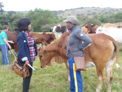
Myself and Amanda, some years ago. I would like to think the conversation was about our work on cattle, getting some tips from the sweetest breed – Boran.
Seeing her make it out strong despite of all the ups and downs I have seen and heard from her about her academic journey made me reflect on my own share of troubles. See, the journey itself may be bitter at times but the fruits to bear at the end are certainly sweeter. I know it’s hard to think about the sugary side of it when you are busy climbing the mountain with its obstacles.
As Greg Child said “Somewhere between the bottom of the climb and the summit, is the answer to the mystery why we climb”
The last picture I took with the Boys just before they were transported.
It sure is a climb…
I am currently in the phase of my studies I would like to refer to as “The beginning of the end.” It has been a long and hectic five months of data collection and everything before and after that. The Boys are gone and I don’t really want to talk about it. They were loved dearly.
In short, we wrapped up all the behavioural observations and physiological sampling. I had to organize all the administrative issues around the slaughter processes. The observations and sampling was followed up during transportation and slaughter. And now, at the “almost” end, I am only left with some lab analyses.
Well, for obvious reasons, a part of me is glad it is all slowly coming to an end. But so far, I’ve learned more than I thought I could, and I think it’s not nearly the end of the learning process for me, even though I am edging closer and closer to that Dr title.
I think I am going to start writing a journal on “lessons of the day” just to make sure no day goes by without a dose of daily development. For instance, I have learnt a lot about myself, other people, different animal species and a long list of skills during this period of my studies: • Selfie 101: I learnt that Yonela (Myself) is a strict, highly organized (Oh Yes I am!!!), straight forward and a professional person, period! She pays attention to details and she doesn’t really allow room for negotiations when it comes to that. Over time she can lose her cool when her patience is being tested. She gets frustrated when things are not going in order. She may be a sensitive person but she is very forgiving and has a big heart. She has learned to talk about herself in the third person 😉 and she might be doing better that she realizes… • Society 101: I have learned that not everyone is as bad as I always perceived (personal experience). There are still good hearts out there, like those that tirelessly devoted their time and energy assisting me with my field work. As a good friend said in Shona “Yu werokamu” which means “we help each other,” and if it wasn’t for them, I don’t think I would have ever practically learned and seen the significance of that concept.
Of course you also have to learn the tough lessons about people. A friend made me realise that people will always talk. Whether you do “good or bad” there will always be those that are simply not satisfied with you. Sometimes you may know the reasons but sometimes you may not. But you can’t live trying to please other people. The lesson there is that you always strive to do the right thing, stick to your path without even trying to please anyone but God… in that way you will be safe. • Animal 101: The time I spent at the farm was my favourite part of this PhD process. I always say that animals are the best creatures. I learned that it’s not just dogs and cats that are interesting, with that ability to amaze and make you smile. All animal species are fascinating and entertaining in their own way (but, sure, I may be biased a little bit…).
The Boys filling up in the afternoon for an evening snack — it’s their favourite time to graze.
For instance, I didn’t know that donkeys were such anti-social creatures. We (with the Boys) were in the same paddock with them the other day and they would make sure to move further away whenever we got closer. But most of all, the animals I have studied all taught me to stay true to myself and always stick to the people that support and understand me. • Time 101: Who would have thought that I (without being pushed) would make decisions to go to the field on weekends – even long ones and holidays? When I joined postgraduate studies I was told that there are no holidays at this level but I would always steal myself some time. I now have learnt the importance of each and every second. Time adds or subtracts towards the goal, depending on how it’s used.
Don’t they say you reap what you sow? I believe that! For every sacrifice there is a reward. One of the greatest examples is in the Bible, that of Jesus on the cross. One just needs to focus on the mission at hand and be disciplined, keeping the ultimate end in mind. What is a couple of holidays and weekends compared to the time of harvest? The ultimate goal…
All in all…
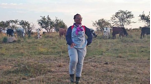
The last day of paddock behaviour observations — my catwalk to the finish line.
One has to take a breath every now and again to reflect. As the Greek philosopher Socrates famously said, “The unexamined life is not worth living,” and that is true about the smaller parts of that life, including the PhD journey. Every journey is a teacher; either you take the lessons positively or negatively. What matters is the destination, which should inform your decisions. Whenever you feel discouraged, find inspiration from wherever you are. It could be from within or from other people or things. Just keep taking those steps towards the finish line.




 SAYAS BLOG