30 April 2015
When preparing 200 agar plates, the mind tends to wander… This morning I was reliving a recent conversation with a 17-year high school kid who was considering a career in science and wanted some advice. She wanted to know what I do as a scientist, what my average day is like and what I’ve learned so far (aside from the structures of 20 amino acids).
Goodness. What do I do? I sukkel, I think, I experiment, I think some more. My days are long but I control my schedule (well, the bacteria have some say but for the most part it’s up to me). And I have learned… ahem… that question is harder to answer. Perseverance, patience, planning, practice, more patience (the lessons are repeated until they are learnt). The big lessons are made up of smaller experiences (like pouring hundreds of agar plates) and although the small experiences aren’t particularly meaningful on their own, when viewed within the context of this loooooong journey they have changed me.
Lab life lesson #1: Be present
Or else you mess up (like this morning). I was making a dilution series of my bacterial cultures. Starting from the first test tube it goes: mix, flame, draw up, flame, close tube, take next tube, flame, squirt out, flame, close, mix. Repeat. Repeat. Repeat. Then the mind starts to wander… and when you come to your senses you have two tubes in your hand and no clue where in the sequence you are. Which wouldn’t have been a major problem if I had labelled each individual tube – but I hadn’t because I wanted to save time (see Lab lesson #2).
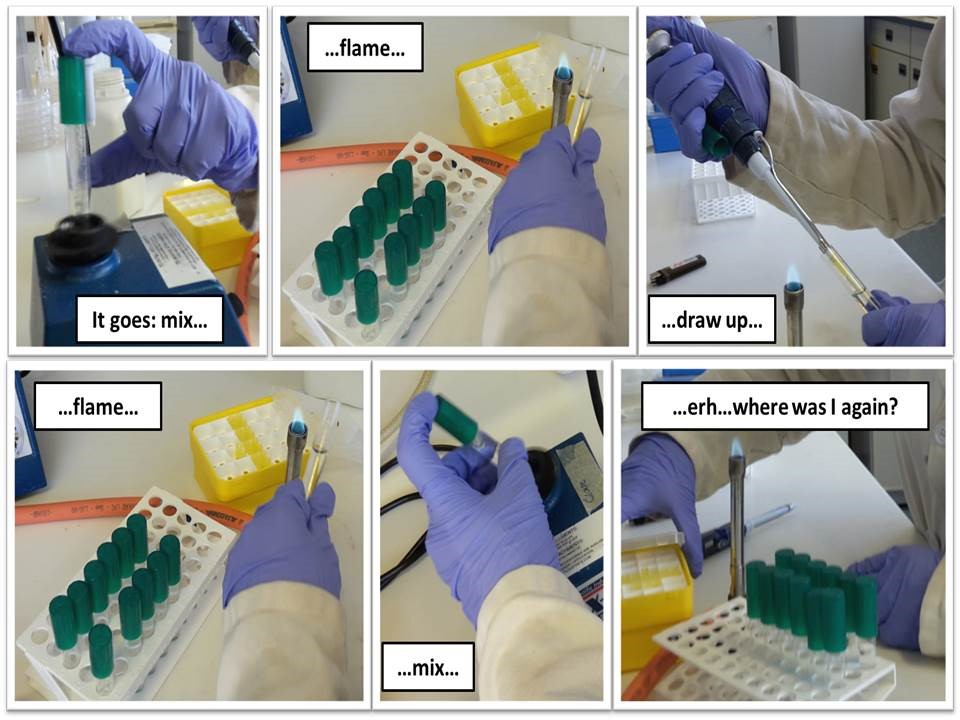
Perhaps the deeper lesson here is that there are no menial tasks in the lab (or in life). Each moment deserves my full attention:
accurate dilution series → accurate plate counts → accurate conclusions.
Even extra care and attention when washing test tubes may lead to better results the next time round. As Jim Elliot said, “Wherever you are – be all there.”
Lab life lesson #2: Label your frikken test tubes!
Lab life lesson #3: Do the to-do list
Walking into the lab on a Monday morning with no game plan is a stress trigger. I tried to address this by making to-do lists. These lists were somewhat unrealistic in the beginning:
- Discover something novel.
- Write an article.
- Finish the thesis.
In order to make the lists more ‘achievable’ I would try to think of all the steps to complete Goals 1 – 3. Then the lists became long and incredibly daunting. Now I try not to over-complicate it: make a list for every day the day before (that way I know where to start in the morning). Keep it short: 5–7 items including postponed admin tasks, boring lab chores and scheduled time to read the article I printed 2 weeks ago (the one marked NB!!!!). Writing the to-do lists makes me feel organised and doing the to-do lists makes me feel like I’ve accomplished something (no task is menial – see lesson #1).
Lab life lesson #4: Not all PhDs are created equal
Heading into Year Five of the PhD (2 years behind schedule according to ‘official’ timeframes), it is easy to get discouraged. Especially when students who started their research after you are graduating before you. Thursdays, 13:00 is our departmental research forum slot. This platform gives post-graduate students the (compulsory) opportunity to present their research progress. Thursdays, 13:00 is a daunting time for me: the progress of others reminds me of the lack of my own. I sit there, stewing in a long list of excuses to make myself feel better.
I’m a biochemist doing a microbiology project and I didn’t even take Micro subjects during my undergrad!
The focus of my research changed at least three times in the first two years (so technically I’m only in Year 3…).
I waited three months for quarts tubes from Germany to grow my bacterial biofilms in.
Then I had to learn how to grow bacterial biofilms.
The microscope broke.
Sometimes the bacteria just. don’t. want. to. grow.
The microscope broke again.
And really, my PhD is so much harder than the presenter’s PhD because… (insert another long list).
During last week’s forum, I remembered something A.A. Milne said:

Stewing doesn’t make me feel better and doesn’t make me progress any faster. Yes, novelty is easier to find in some research projects. Sometimes experiments work first time round. Sometimes orders are delivered on time. But each thesis comes with its own hardships and sacrifices. It is difficult not to let the success of others make you feel unaccomplished. It’s even harder to accept responsibility for your research and not blame your lack of progress on the research field, delivery delays or your supervisor’s involvement. My mandate now is to celebrate everyone’s research success as if it were my own in the hope that it motivates me to make it my own.
Goodness. I have learned a lot…and I don’t think I’m anywhere near done! There are lessons on time management, scientific methods and thesis editing (something I call “killing your darlings”) to come. But for now, I’m going to go label my test tubes.
 SAYAS BLOG