Protecting the Fynbos Biome: South Africa’s greatest natural resource

Is biodiversity more important than oil? Is it more important than the coal we burn for electricity in SA? What is South Africa’s greatest resource?

I want to argue that the fynbos biome is South Africa’s greatest natural resource because of its unique biodiversity, containing thousands of species that are only found in South Africa.

Biodiversity is the harmony of life derived from many years of evolution. It is the product of seemingly infinite natural equations that determine survival and reproduction success, of which, we are only just beginning to explore. Biodiversity is generally measured as the number and variety of species within an environment and it is a race to discover the complexity before our own irreversible actions proliferate.

E.O. Wilson, global leader in ecological conservation, has suggested biodiversity is the planet’s greatest resource.

BiodiversityGreatestResource

Why is it such a great resource?

Conserving biodiversity ensures the continued production of clean water, an abundance of species for exploring as medicinal products, and diverse gene pools for crops and natural resources. Biodiversity facilitates the production of these resources through processes such as soil formation, nutrient cycling, climate regulation, and pollination dynamics.

For example, the Cape Honeybee is endemic to the Cape Floristic Region (AKA Cape Floral Kingdom), meaning it only exists in this area of the world. This species uses fynbos vegetation for about 80% of its hives, where it produces honey. Not only is the production of honey a valuable resource, but the Cape Honeybee also pollinates agricultural crops is in the region, providing benefits to many Western Cape fruit productions. This example demonstrates the indirect benefits of biodiversity to agriculture, through the Cape Honeybee.

picture20140801151740

DSC_9904

The fynbos biome is also a ‘biodiversity hotspot’, being exceptionally diverse (and, therefore, epic in my opinion). It is one of only six biomes in the entire world, and it is the smallest and only biome contained within one country. (More information about the fynbos can be found here.)

Considering only plant species, the fynbos biome contains more than 7000 species, representing close to half of the plant species found throughout South Africa. In order to demonstrate the richness of this resource, I created the graphic below.

FynbosInfo

Along with the unique characteristics of the fynbos biome are unique challenges. As many as 1700 plant species in the Cape Floristic Region are threatened to some degree, representing 3/4ths of the plants in the South African Red Data Book (http://www.plantzafrica.com/vegetation/fynbos.htm). Much of these are threatened by urban expansion or land use change, such as conversion to agriculture, but what else should be investigated and mitigated?

I nominate invasive plant pathogens; a threat we can research with Cape Citizen Science.

DSC_9998

How are Phytophthora species affecting the biodiversity in the fynbos? Phytophthora cinnamomi is a root rot pathogen known to be present in the fynbos, but we have a poor understanding of what it is doing there. Although it has been dubbed as the biological bulldozer in Australia, we havn’t really studied its impacts on the biodiversity in the fynbos. How does one species affect the fynbos? How does it affect us? Does the pathogen kill plants that the Cape Honeybee relies on for foraging/shelter? Would there be different plants on the landscape if this pathogen was absent? All of these questions are still left unanswered.
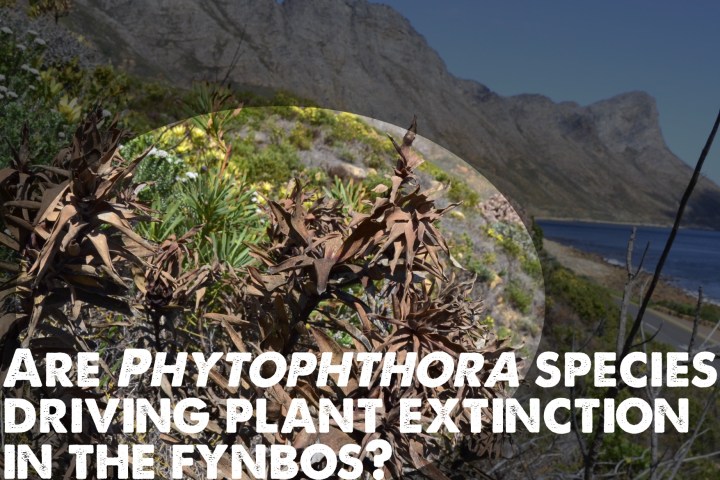
PhytophthoraPlantExtinctionLowHow many of the 1700 threatened species in the fynbos are battling to survive the biological bulldozer?

There are many examples of pathogens that have nearly eliminated single species from the landscape (e.g. chestnut blight, sudden oak death, Dutch elm disease), but what happens when you have a generalist pathogen in a biodiversity hotspot?

There are also many questions about the diversity of the pathogens in the fynbos themselves. What is the diversity of Phytophthora species? How many species are there and are they native or invasive? How did Phytophthora cinnamomi get to the fynbos?

As you can see there are many unanswered questions that need to be addressed with more research. Understanding the effects and the diversity of Phytophthora species will help us conserve species in the fynbos. However, research is not free and life is short. That is why we are calling on you to release the inner scientist in you. You can contribute to research to help conserve the biodiversity in the fynbos biome by participating in Cape Citizen Science. More information about Cape Citizen Science is available here http://citsci.co.za.

Of dreams and GDP: The 2016 Science Budget

I was feeling positive about science in South Africa while poring over Minister Pandor’s budget speech. Maybe I was still basking in the afterglow of a leadership workshop that fundamentally changed the way I feel about the future of science on this continent. Maybe it was because I was watching Star Trek (the ’84 classic Wrath of Kahn). And yes, maybe there were parts of her deliberations that made me feel optimistic.

Our Minister of Science and Technology rightfully boasted about quite a few accomplishments that her Department can be proud of: boosting the number of SARChI chairs headed by (highly competent!) women, and launching new programmes supporting youth involvement in the sciences.

What excites me is that our scientific goals appear NOT to be restricted to applied research only. After all, what is more “Blue Skies” or fantastical than exploring space? It captures the imagination the same way that Star Trek and Star Wars have done for decades. Some spectacularly successful Astronomy ventures are currently slipstreaming our entire continent into the future. The globe is paying rapt attention to SKA and the African Union’s new space strategy. And, in the absence of leadership from, say, our telecoms and electricity providers, the DST appears to be ploughing funds into innovative technology that can really change the lives of most South Africans for the better.

Even better, it looks like Minister Pandor and her team of science diplomats are improving our access to international research behind the scenes. Go to the NRF website right now, and you will see funding calls open for cooperative ventures between SA and Namibia, Angola, Uganda, Switzerland, Belgium, France…

But how many South African researchers will apply for these funds?

And how many applicants will write competent proposals, on well-planned projects that will be executed well?

I’m willing to bet my front teeth that only already accomplished researchers will apply for the collaborative funds. And early career researchers, fresh off the PhD presses, are left hanging without the skills and mentorship to grab such opportunities.

This is where the NRF needs to invest more wisely in our emerging scientists.

I’m not talking about students – the NRF admirably supports postgraduate students – I’m talking about qualified, inexperienced scientists who want to go forward but lack mentorship, proposal writing skills, networking skills, and don’t know how to develop a vision, let alone follow that dream. To me, this is one vital arena where the NRF and minister Pandor need to bridge the growing gap between being a student and growing into a fully-fledged researcher.

On this front, the NRF can level the playing field between the established and more marginalised universities. I’m talking about giving early-career researchers time and access to networks of excellence. Splurge a bit on advanced skills-development workshops bringing together early and mid-career researchers across the country, across disciplines. Host writing retreats, brainstorming sessions, statistical get-aways, bring together those people who have great ideas but perhaps limited funding and experience. Offer more sabbatical support for mid-career researchers; include family support and lecturer replacement costs. Support flagship programmes that explicitly aim to develop research cultures on campuses where expertise remains fragmented. Currently, this kind of thing only happens at institutions with cash clout. And that simply sharpens the divide between the haves and have-nots.

Finally, there is another important way for Minister Pandor to set South Africa apart from others on the international stage. I firmly believe in the eye-opening value of mixing disciplines (full disclosure: I’m a zoologist married to a social scientist…). And I don’t mean slapping an “interdisciplinary” label on collaborations between microbiologists and zoologists – true interdisciplinary research spans schools of thought to create entirely new ways of thinking. Bring together epidemiologists and town planners, historians and evolutionary biologists… how else will we uncover novel answers to the world’s truly complex problems?

But it’s only through “therapy” that the DST could ever hope to join such odd couples. Minister Pandor will have to hire experts (such as these guys) whose job it is to encourage communication between experts who can’t even agree on the basic definition of “data.” Take this unconventional leap, and we may actually end up showing the world how to do it.

Let me say, I love our minister’s vision and passion. I’m delighted about the SAYAS members she highlighted, our Next Einstein Forum Fellows Tolu, Amanda and Alta, poised to change the world! So much would be impossible without our minister’s vision and drive. I hope she continues making me a proudly South African scientist, follows through on her promised Youth Assembly on the knowledge economy, and continues to listen to the voice of young and female scientists especially. That is how we can change the face of science in Africa in real life, not just during speech time.