The Visceral Humility of Showing Up

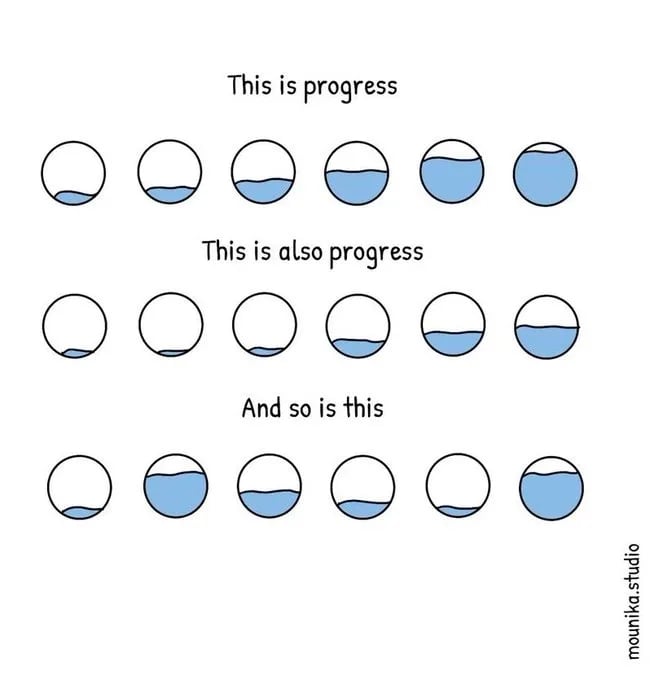
I can’t lie – showing up is hard. Most quotes to do with success have the same thread running throughout – to achieve your goals, being consistent is the best thing you can do. This applies across the board, regardless of what field you’re in. As a postgraduate researcher, this is the lesson that heavily underpins the degrees we pursue. Getting your Masters or PhD has less to do with whether you are the smartest in the room and far more to do with whether you embody the characteristics of perseverance, diligence and consistency in finishing what needs to be done (among other attributes). It seems pretty straightforward, right? Except anyone who is a researcher will tell you that it is never a linear journey, but the little progress that you make every day could look like this:
In my vlog, I only show the aesthetic parts of what makes up a day in my life.

Although I take everyone through my typical day as a postgrad researcher, there are still some ups and downs. Sometimes, I wake up at 8 am, and other times I wake up at 11 am (depending on my sleeping schedule). Some days I do my entire morning routine, and other days just brushing my teeth and moisturizing is all I can muster.

The full breakfast or fruit and coffee on the go.

Productive writing session or procrastination station.

Feelings of joy or feelings of being overwhelmed and frustrated.

Viewing the ‘bad’ days as an indicator of where we will end up only sets us up for failure, as there is nothing inherently wrong with them. It is part of our inch-by-inch work to strive towards the future. But on a larger scale, there are still some challenges. A quantitative research article by Boone, Vander Elst, Vandenbroeck and Godderis (2022) cites a high workload, work-life interference, continuous publication pressure and job insecurity as the main reasons young researchers reach burnout quickly. Although the study was conducted in Finland, within our context in South Africa, I can say through anecdotal experience that young researchers are struggling to find balance with the demands and pressure of being in academia, on top of other socio-economic related issues that pertain to being a young person in Africa. What will it take for things to change?

On the one hand, pursuing postgraduate studies is a highly privileged position. Yet, on the other hand, there are unique challenges prevalent in academia that rely on overworking young researchers. But unfortunately, this article alone cannot posit the solutions to these more significant structural problems. A beautiful tweet from 2016 by singer Mitski captures my everyday approach to research life:
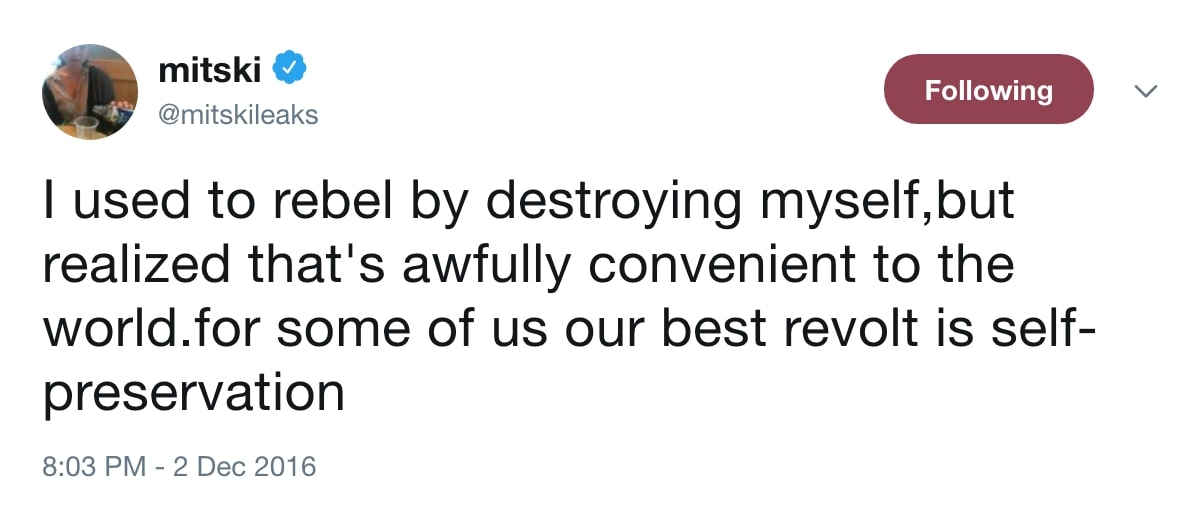
Being radical in choosing to rest amongst the productivity-industrial complex is essential and part of why it is necessary to be vigilant in protecting one’s peace of mind. This is especially true when trying to carve out a somewhat impossible nexus between progressive politics and wanting a successful career.  The prolific black feminist writer audre lorde said in her essay Uses of Anger in Sister Outsider:

“…change is not just about a simple switch of positions or temporary lessening of tensions, nor the ability to smile or feel good… (it is) a basic and radical alteration in those assumptions underlining our lives.”

The visceral humility required to show up authentically in our everyday lives requires us to remove the ego in our everyday decisions. As I enter the second year of my PhD, I choose to remember the value of choosing radical peace amongst the chaos of academia.

While in the pursuit of excellence, we deserve joy.


I am if you are, and if you aren’t I still am.

I am…

Take a moment. Breathe in. 

Say, “I am…” and the first few things that come to mind. Notice how these thoughts feel. Any words that follow “I am…” have the power to mould and manoeuvre your sense of self.

I am human. I am curious. I am kind. It is perhaps one of the greatest instincts of the human condition to attach ourselves to a sense of identity. This may be rooted in connection, community or companionship.  Perhaps identity stems from creation, control, or ceremony. To construct a comfortable and assured interaction with the environment, we tell ourselves (and those around us) who we are. I am not my research, though I am working in the field of sleep science – diagnosing obstructive sleep apnoea in persons living with HIV. This involves tracking the brain patterns of a sleeping patient, as well as their breathing. I am constantly reminded to be humble in my knowledge acquisition.

I am a learner. I am a teacher. I am a neuroscientist. Effectively, this means I study the squishy, convoluted pink organ housed within the skull. This lump of biologically active stuff, which somewhat governs our lived experience, fascinates me so deeply that I am compelled to tell you why it is part of who I am.

As you read this sentence, your brain is making associations between what I write; the sounds in your environment; any aromas wafting past your nostrils; and even the temperature of your body. When you think back to this moment, your brain will recount – within milliseconds – all the sensations activated within you to remind you of this experience.

The average human brain can create about 60 000 thoughts every day!

We can practice calming or stimulating our minds by the type and timing of awareness we employ. I might be so bold as to say this awareness is a series of thoughts. So, what is a thought? A thought is an electrochemical trace that occupies multi-dimensional space in your brain. A thought is the internal experience of how we process external stimuli. This internal experience relates to one’s senses and (new term incoming) somatosensation, or the sensory relationships of our bodies with the space around it – a tickle, an itch, a chill. We even have this epic internal ‘sixth sense’ called interoception – sensing what we feel within our bodies! In some ways, I agree that what we think we can become.

Still, I am more than just my brain’s interpretations of my body’s sensations.

Humans have humanity. We adapt to circumstance and unite in hardship. I am an activist. I am an advocate. I am an ally. I situate myself at the intersection of neuroscience, public health, and social justice. I have more than just a love for science – I have a love for sharing science. This brings me to a chilling (but in no way “chilled”) fact:

In 2020, the Annual Mental State of the World Report showed that 36 % of South Africans are living in mental health distress. Let that number sink in. 36 % is about four out of ten people. I dream of a day where we see this number crumble like the last rusk in the packet. My research aims will likely centre around this dream for as far into our future as I can imagine. This percentage is not the fault of our brains, but a psychosocial consequence of centuries of suffering and oppression.

Restructuring the paradigm of cognitive wellness requires not only inclusion of minority groups, but in fact building new systems with excluded groups at the centre of our focus. While I have an ongoing love-affair with the brain, I feel even more inspired by Black joy, trans joy and accessible places for people with disabilities. As I pursue my neuroscientific dreams, I want to cultivate safer mental health spaces and research outcomes for LGBTQPIA+ people, Indigenous peoples and disabled persons.

There is no quick fix for mental health reform, but I am committed to proactively prioritizing both systemic and systematic wellness. I invite you to ask yourself, “Am I?”.