Of dreams and GDP: The 2016 Science Budget

I was feeling positive about science in South Africa while poring over Minister Pandor’s budget speech. Maybe I was still basking in the afterglow of a leadership workshop that fundamentally changed the way I feel about the future of science on this continent. Maybe it was because I was watching Star Trek (the ’84 classic Wrath of Kahn). And yes, maybe there were parts of her deliberations that made me feel optimistic.

Our Minister of Science and Technology rightfully boasted about quite a few accomplishments that her Department can be proud of: boosting the number of SARChI chairs headed by (highly competent!) women, and launching new programmes supporting youth involvement in the sciences.

What excites me is that our scientific goals appear NOT to be restricted to applied research only. After all, what is more “Blue Skies” or fantastical than exploring space? It captures the imagination the same way that Star Trek and Star Wars have done for decades. Some spectacularly successful Astronomy ventures are currently slipstreaming our entire continent into the future. The globe is paying rapt attention to SKA and the African Union’s new space strategy. And, in the absence of leadership from, say, our telecoms and electricity providers, the DST appears to be ploughing funds into innovative technology that can really change the lives of most South Africans for the better.

Even better, it looks like Minister Pandor and her team of science diplomats are improving our access to international research behind the scenes. Go to the NRF website right now, and you will see funding calls open for cooperative ventures between SA and Namibia, Angola, Uganda, Switzerland, Belgium, France…

But how many South African researchers will apply for these funds?

And how many applicants will write competent proposals, on well-planned projects that will be executed well?

I’m willing to bet my front teeth that only already accomplished researchers will apply for the collaborative funds. And early career researchers, fresh off the PhD presses, are left hanging without the skills and mentorship to grab such opportunities.

This is where the NRF needs to invest more wisely in our emerging scientists.

I’m not talking about students – the NRF admirably supports postgraduate students – I’m talking about qualified, inexperienced scientists who want to go forward but lack mentorship, proposal writing skills, networking skills, and don’t know how to develop a vision, let alone follow that dream. To me, this is one vital arena where the NRF and minister Pandor need to bridge the growing gap between being a student and growing into a fully-fledged researcher.

On this front, the NRF can level the playing field between the established and more marginalised universities. I’m talking about giving early-career researchers time and access to networks of excellence. Splurge a bit on advanced skills-development workshops bringing together early and mid-career researchers across the country, across disciplines. Host writing retreats, brainstorming sessions, statistical get-aways, bring together those people who have great ideas but perhaps limited funding and experience. Offer more sabbatical support for mid-career researchers; include family support and lecturer replacement costs. Support flagship programmes that explicitly aim to develop research cultures on campuses where expertise remains fragmented. Currently, this kind of thing only happens at institutions with cash clout. And that simply sharpens the divide between the haves and have-nots.

Finally, there is another important way for Minister Pandor to set South Africa apart from others on the international stage. I firmly believe in the eye-opening value of mixing disciplines (full disclosure: I’m a zoologist married to a social scientist…). And I don’t mean slapping an “interdisciplinary” label on collaborations between microbiologists and zoologists – true interdisciplinary research spans schools of thought to create entirely new ways of thinking. Bring together epidemiologists and town planners, historians and evolutionary biologists… how else will we uncover novel answers to the world’s truly complex problems?

But it’s only through “therapy” that the DST could ever hope to join such odd couples. Minister Pandor will have to hire experts (such as these guys) whose job it is to encourage communication between experts who can’t even agree on the basic definition of “data.” Take this unconventional leap, and we may actually end up showing the world how to do it.

Let me say, I love our minister’s vision and passion. I’m delighted about the SAYAS members she highlighted, our Next Einstein Forum Fellows Tolu, Amanda and Alta, poised to change the world! So much would be impossible without our minister’s vision and drive. I hope she continues making me a proudly South African scientist, follows through on her promised Youth Assembly on the knowledge economy, and continues to listen to the voice of young and female scientists especially. That is how we can change the face of science in Africa in real life, not just during speech time.
 

The dangers of misinformation and miscommunication

I will start this article, I’m fairly confident, the way that no good story has ever started:

I was standing in the line at home affairs last week. I happened to strike up the usual conversation one has at these places; “Why is the line so long? Do you need photos?  (It amazes me that no one ever knows the answer to this question!) Are we going to be here so long that the sun will absorb all of our moisture and when our families come looking for us all that will remain is our tortured souls still hoping for our passports?” Having run out of things to complain about, I asked my fellow brave soul what he did for a living. He was a very high powered investment banker who also had a PhD. I learnt that day that education truly is not enough when ignorance is a dominating plague.

I wish I had told this man I was a struggling actor or an astronaut – but then again he would have had an opinion on that too. “An astronaut? Really? I heard the earth is flat and the moon is Gorgonzola. Is that true? Wait, I know it’s true. So don’t respond.” I didn’t though. Sadly I said I was a HIV researcher and his face darkened. A frown dug its way into his forehead and I could hear the 10 ton piano that was about to fall on me strain in its support. “You know,” he said in a suddenly condescending tone, “I don’t buy this whole ‘HIV’ thing. (He actually did the inverted commas with his fingers, which somehow made the whole thing worse.) I heard that it was the Americans.” I realised by the way he sneered the last part of his sentence that nothing I said was ever going to change his opinion. Valiantly I tried to explain that HIV was a zoonosis and had jumped species on at least 3 different occasions. (Read more about why this doesn’t happen that often.) I spent what felt like an entire lifetime trying to convince him about the scientific evidence. And in the end, the best line emerging from this conversation was his, “Well, you can have your opinion and I will have mine.”

The benefit of having a science degree is knowing that the most popular opinion is not always the right one. Having been trained to question everything, I’ve since understood, is not a skill everyone has. In society, the loudest (most obnoxious!) person is the one who gets heard (once again think Donald Trump) while in science you will get laughed off of a conference stage without any data. This is possibly the root of misunderstandings in science. The people listen to the strongest voice and all the while the white coats are in a corner throwing around statistics. Even when scientists are completely right, some rapper may still convince a few people the earth is flat (see this hilarious exchange between B.O.B and Neil Degrasse Tyson – thank goodness for him!).

Another huge contributor to the hall of misunderstanding and strange theories is the media. Now let me be clear; it is not just the journalists who misinterpret. It is the job of a scientist to simplify and explain their work. One of my science heroines Françoise Barré-Sinoussi (co-discover of HIV), who I was privileged to hear speak, said that at the end of your life you do not remember the journal articles you published or how high their impact number was, but the lives you have changed with the work. If you can’t communicate and translate your work, who will it ever truly benefit? I find that if you can explain your project to your Granny so she understands why you are doing it and how it may help the world, you really understand it yourself.

As a postgrad it’s easy to feel lost; to feel that your work is too far removed from any kind of real-world application. It is easy to think that you’re just doing this to get a degree. However, it’s good to communicate your science for lots of reasons: 1) you can prevent misinterpretation, 2) you can make people feel that they can engage with science and not have their heads explode, 3) you can help scientists in queues at Home Affairs retain their sanity when non-scientists begin to ask questions and 4) you can feel relevant. It’s important to remember it really is our duty to not lock ourselves in a lab, but to reach out: to teach not only the uneducated but the ignorant too. It’s up to scientists to add their voice, otherwise we may be drowned out by the loudest opinions. It’s up to us to build public trust in science. If we are only heard when there is crisis then we are never heard in calm (see this article by Tolu Oni).


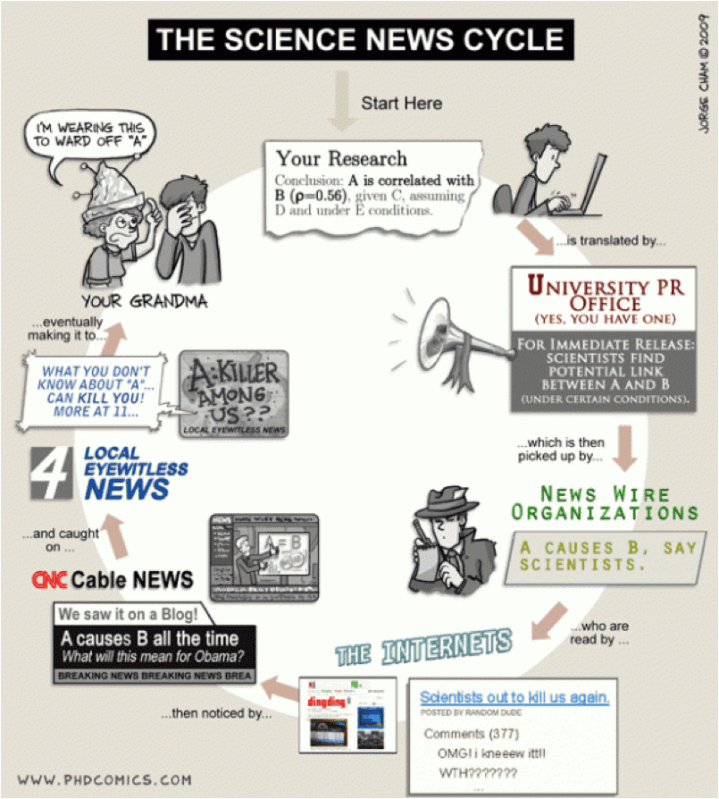
Scientist news cycle
How science communication works… (www.phdcomics.com)

There have been miscommunications that have done very serious damage too. One is most certainly the notion that vaccinating your child will result in autism (read here why this isn’t true). This has resulted in 100s of unnecessary deaths from measles in small children. Another is that HIV doesn’t cause AIDS, perpetuated by our very own ex-president Thabo Mbeki. Some “facts” are even started out of fear as a rumour: in a small town called Vulindela, wonderful things are being done by the organisation we work with (CAPRISA), to try to reduce unwanted pregnancies and HIV incidence. One of the proposed ways to do this was to insert IUDs into young girls following extensive education on the matter. The programme had to be stopped because one of the girls told all her peers that maggots would grow internally. Naturally teenage girls were then hesitant about IUDs. A far more famous case of misinformation is what happened to Hendrietta Lacks in 1951. With questionable ethical practice, doctors treating this woman took samples of her cervical cancer and made a cell line (cells that are descended from one cell and have the same genetic features) that was able to be kept in culture indefinitely. This cell line is one of the most widely used in clinical trials today; a form of which we use to test the efficacy of HIV vaccines. This woman had no idea what these doctors and scientists were doing and many years later, her family thought that she was still alive because scientists had “immortalised” her cells (Read more about this incredible story in Rebecca Skoot’s novel).

Miscommunications in science can be deadly and disturbing and we have to find ways of changing this. As a PhD student it is my job to pick the hard questions and find answers but, it is imperative that I find ways to explain the hard questions in a way that anyone can engage with them. Solutions can come from the strangest places, even the line in home affairs.